Showing posts with label overshot. Show all posts

Tuesday, October 22, 2024

Crackle Manners of Weaving: Overshot Manner


Overshot manner (also known as traditional crackle) is probably the most well known and popular of the crackle manners of weaving. In fact, some books (such as Anne Dixon's The Handweaver's Pattern Directory) show it as the only way to weave crackle. It's the most traditional way (hence the name "traditional crackle") and is probably synonymous with crackle in the minds of many weavers. 

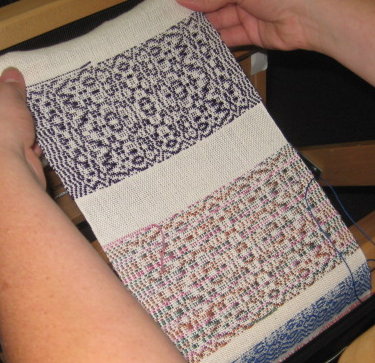
I wove two samples in overshot manner. The first (sample #3) was "as drawn in" for the threading pattern, i.e. I followed the threading draft for the treadling. The second (#4) was a small "novelty" overshot treadling I found in Marguerite Porter Davison's A Handweaver's Pattern Book.
 
#3. Crackle in overshot manner woven as-drawn-in
 
#4. Overshot manner crackle in one of Davison's patterns
Overshot Manner Crackle Characteristics
  • two shuttles
  • alternates pattern and tabby wefts
    • pattern weft
      • heavier than tabby wefts and warp
      • contrasting color to warp and tabby wefts
    • tabby weft - same as warp
  • as with overshot, the tabby wefts alternate to create a plain weave ground cloth, while the pattern weft is supplementary, floating over and under groups of warp thread
  • differs from overshot as there are no floats longer than three threads. The pattern weft is tied down every 4th warp end.
  • typically uses a 2/2 twill tie-up (or lift plan for a table loom)
    • shaft 1: 3-4
    • shaft 2: 1-4
    • shaft 3: 1-2
    • shaft 4: 2-3 
  • treadling (numbers indicate shafts, a & b = tabby shots)
    • block A: 2 a 2 b
    • block B: 3 a 3 b
    • block C: 4 a 4 b
    • block D: 1 a 1 b
  • most overshot treadling patterns will work with crackle threading
  • Patterns featured in Marguerite Porter Davison's A Handweaver's Pattern Book and Anne Dixon's the Handweaver's Pattern Directory use this manner of weaving.

Weaving Notes
  • Sample #1
    • warp and tabby are 10/2 in natural, pattern is 6/2 in gray
    • treadled following the threading draft, as drawn in
    • I should have used a pattern weft with a better color contrast
    • And I think a heavier pattern weft would have looked better
    • woven to square
  • Sample #2
    • warp and tabby are 10/2 in natural, pattern weft is 6/2 in navy
    • I like the stronger color contrast better
    • the treadling pattern is variation VII of Valley Forge Dogwood, a small novelty overshot from Davison's Handweavers Pattern Book, (page 148)
    • overshot treadling drafts can be long and complicated, but for my sampler, I wanted something short and easy to follow. This one was perfect and I like it.
  • Overshot manner weaves a little faster than classic crackle, I reckon because the tabby is always 1-3, 2-4, no matter what block I'm on.

Another Example

Detail from my overshot manner table runner, Scandinavian Favorite.

Resources
  • Wilson, Susan, Weave Classic Crackle & More, pages 33-35
  • Brusic, Lucy M., A Crackle Weave Companion, page 26
  • Davison, Marguerite Porter, A Handweavers Pattern Book, page 148

Wednesday, September 20, 2023

It's a Wrap! The Twill Gamp Dishtowels Are Done

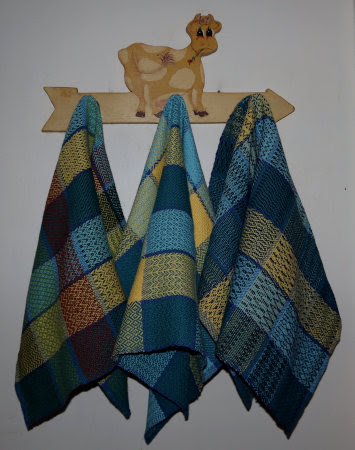
My three dishtowels are off the loom, wet finished, and hemmed. I have to say that this was a great first project for my return to weaving. I learned that a gamp is definitely an interesting way to explore possibilities. I can see why weavers can spend months weaving them. I'd say gamps are the very best in sampling options. It's fascinating to see the patterns revealed pick by pick, how the colors interact, and be able to compare the different patterns side by side. 

Here are some close-ups of each of the towels.

Towel #1: Same color for both warp and weft gave let me see the textures.

Towel #2: Different color weft was good to see color interactions.

Towel #3: Overshot manner gave a completely different look to it.

Finishing them off, I realized the impact of having them in hand. When I look at a photograph of handwoven fabric, I see it. When I hold the actual fabric, I experience it. Does that make sense?

Notes and Observations

  • I knew the draw-in for the various twill samples would vary, but it's acceptable.
  • The draw-in for the overshot fashion towel was consistent for the length of the towel, however.
  • Even though my favorite is the towel woven in overshot fashion, overshot is not something I am drawn to exploring. It doesn't spark my interest.
  • I experimented trying to get the squares square, but I failed, I fear. With towel #1, I tried to weave each weft section a quarter inch longer than the square width. The other two, I made the same number of weft picks (threads) as warp ends (threads). My observation is that the different patterns react differently in their draw-in, take-up, and shrinkage.
  • All the obvious random warp tension issues seemed to work themselves out with wet finishing.
  • Hemming. I need to weave more between the towels for hemming, from now on.
I really like several of the individual woven samples in the towels. I'll get pics of them and make a draft for each, to file away for future projects.

Saturday, September 16, 2023

Weaving Off the Twill Gamp Warp

After I wove my three dishtowels plus a good ending header, I still had some warp left on the loom. Of course, a warp can never be woven completely to the end; rather, it can only be woven until the back apron rod gets too close to the heddles to make a good shed. Once I can't pass the shuttle through the opening between the warps, that's it. So, there's always loom waste. The question is, how much?

I gave myself plenty of length when I calculated how long my warp needed to be, so just maybe I have enough leftover to experiment a bit. I got this idea from Peg's blog post, "End-of-Loom Sampling" over at Talking About Weaving. It's true that questions and ideas pop up during the weaving of a project. What better place to sample than the end of the warp?

After I wove the off enough to hem the last towel, I figured it would be a good time to clear off some bobbins. Which I did, and was intrigued by the random stripes that occurred. 

I like stripes. And plaids.

And that made me think of random plaids. So, perhaps that's an idea to tuck away for future use.

What I was really curious about, though, was a thicker yarn for the "overshot fashion" treadled dishtowel. It seems that the common recommendation for my 8/2 warp and tabby weft is a 3/2 pattern weft. Of that, I have only pink and a brownish-gray, but I didn't think I could subject myself tor that color combination. Some weavers double the 8/2s (which is equivalent to an 8/4 yarn), but I finally decided on some cotton crochet/rug yarn, of which I inherited a lot when I bought my Schacht Mighty Wolf loom. It's a bit fatter than the recommended 3/2, but it's just an experiment. 😁

Next decision. What color?

What do ya'll think? Blue? I agree. Blue it is.

So, here it is overshot fashion with the heavier weft. 

Left side of the warp

Nubby selvedges, I see. And of course contrast is key (maybe I should have used the orange). 

Right side of the warp

I don't know if I chose the best pattern, but it gives me an idea, anyway. A heavier weft will truly make the pattern more dominant. 

I wove until the apron rod was advanced as far as it could go.

The end of the warp at the back of the loom. 

One problem I ran into was that some of the knots securing the warp bundles to the apron rod became untied once they were no longer wrapped around the back beam. I retied them, but will probably switch to lashing on the warp in the future.

The end of the warp at the front of the loom.

That was as far as I could weave, but I still had a good shed at that point and could easily throw the shuttle. That's a good thing to know about any loom. 

The unwoven warp from the back apron rod to the fell edge (edge of the weaving) measured 13 inches. This is my back loom waste. In the front, I measured about 5 inches, including the header. So my total loom waste is 18 inches. This is important information, because it enables me to not be wasteful with my yarn. I need enough, but there's no sense wasting it, especially if the yarn is expensive or in limited supply. I allowed 20 inches, which turned out to be a pretty good guess. 

The next step is to cut it off the loom and prepare it for wet finishing.

Friday, September 15, 2023

Twill Gamp Weaving 6

This is the last of it! The third of my three dishtowels is woven, so the next step is getting it off the loom. Then I'll wash it and dry it, and we'll see how they turned out.

I only had one thing to figure out this time. I wove through many of the short treadle draft patterns first and then took a look at some with longer sequences. I'm using The Weaving Book, remember, and many of the patterns have sections that repeat the treadling anywhere from 2 to 6 times. This is characteristic of overshot and creates large pattern shapes, but I avoided these at first because I wasn't sure how to keep track of the treadle order. 

This one, for example. In my case, it's a liftplan, so it indicates the pairs of shafts that I'm lifting:
1. 2 - 3 (x 4)
2. 3 - 4 (x 2)
3. 1 - 4 (x 2)
4. 1 - 2 (x 2)
5. 1 - 4 (x 2)
6. 3 - 4 (x 2)

That's a total of 28 pattern weft shots. Did I really want to work with 28 beads? My numbered bead method for keeping track was working well for ten or less treadle changes, so I had to decide what to do about the repeats. I finally decided to work with just six beads and slide the bead to the middle of the stick until I completed all the repeats.
 
I'm on #4 in the pattern, lifting shafts 1 and 2 twice.

When I complete the repeats, I slide the bead all the way to the right and I'm ready for the next one. I found this works quite well, because it's easy to see the repeats in the fabric and make sure I've got them all.

For future reference, here are the last five sections.

Weft section 5, II 238 to II 241 (page 73)

Weft section 6, II 254 to II 257 (page 74)

Weft section 7, II 278 A to II 281 D (page 75)

Weft section 8, II 298 A to II 301 D (page 77)

Weft section 9, II 294 A to II 297 D (page 76)

Current length on the loom is about 24.75".

Twill Gamp Weaving 6 © Sept 2023

Related posts:

Tuesday, September 12, 2023

Twill Gamp Weaving 5

Two dishtowels down and one to go. But first, I had to decide how I wanted to weave it. I've done something different with each towel, so for this one, I finally settled on exploring the 'overshot fashion' section in Helen Bress's The Weaving Book. It continues with the same four twill threadings I've been using for my gamp (straight twill, point twill, rosepath, and broken twill), with overshot's heavier pattern weft and a tabby weft the same as the warp. 

Third twill gamp dishtowel woven in overshot fashion.

For my non-weaving friends, overshot is a traditional weave structure that uses two weights of yarns. The heavier yarn creates the pattern, and the lighter weight yarn basically holds the pattern in place. This is important because the patterns typically call for multiple repeats to build shapes of color in the cloth. The lighter weight tabby (which is just plain weave) serves as a binder between the rows of heavier yarn. You can see pictures of an overshot coverlet woven by my 4x-great-grandmother here.

My yarn stash is mostly 8/2 and 10/2 cotton, with very few choices in heavier yarns. Of the 6/2 that I thought would be an option, the only colors I have are pink, gray, white, and navy. Only navy looked good with my warp colors, so navy it is! I'm using navy for the pattern weft for the entire length of the dishtowel, and rotating tabby colors the same as my warp.

Notes and Observations
  • My lever sequence counter is working very well, although I still have to remind myself to move the beads when I change the levers.
  • I think I'm going to need to clamp the loom to the new desk. It has a smooth surface and the loom wants to move with every beat.
  • I'm finally starting to take advantage of the two dowels on which the beater bar can rest. Being a compact loom, there isn't much distance between the breast beam and the castle, which means I have to advance the warp frequently. Simply moving the beater back gives me a few more inches before I have to do that!
  • I'm wondering what it would look like if the pattern weft was a little heavier, although for the purposes of a dishtowel, it' fine.
  • Maybe that's just an excuse to talk myself into buying more yarn.
  • The addition of a third color makes each unit visually more complex, which intrigues me.


Even though I'm finding weaving on a table loom to be pretty slow, I still seem to be making good progress. Here are the first four weft sections, each with a different treadling pattern and tabby color. The treadling patterns don't have specific names, so I'm just identifying them with the codes given to them by Bress plus their page number in the book. All can be enlarged by clicking on the image.

1st weft section,  II 198 A to II 201 D (page 70)

2nd weft section, II 210 A to II 213 D (page 71)

3rd weft section, II 270 A to II 273 D (page 75)

4th weft section, II 202 A to II 205 D (page 71)

Twill Gamp Weaving 5 © Sept 2023

Related posts:

Tuesday, August 15, 2023

Sampler Off the Loom

I've woven my sampler to the end of the warp and taken it off the loom. I zig-zag stitched its edges and  washed it.

Hand washed in cold water and Dawn dish washing detergent. Cold water rinse.

After rolling the excess moisture out in a towel, I laid it flat to take measurements. In looking it over, I can see that I improved with practice! My weft beating and selvedges became more consistent and I made fewer mistakes. There's still a lot of room for improvement, but I definitely made progress.

First 7 samples with mistakes and wonky selvedges!

Last 6 samples; much more consistent and even.

At first I was just going to line dry it. But I've been thinking about dish towels and thought, 'how many people line dry dishtowels?' I use my clothes line all the time when the weather's cooperative. But hand towels make good gifts, and how many people are able to line dry everything? I decided to dry the sampler in my clothes dryer to check for further shrinkage. 

Sample particulars:
  • Yarns:
    • warp - 8/2 cotton
    • tabby weft - 8/2 cotton
    • pattern weft - 3/2 cotton
  • reed: 10 dents per inch
  • Sett: 20 EPI
  • Sley: 2 ends per dent
  • Total ends: 120
  • Width in reed: 6 inches
  • Threading: straight draw (plain twill)
  • Woven width on loom: 5 - 5.25" (depending on sample)
  • Woven length on loom (per sample): 3 - 3.25"
  • Wet finishing - cold water hand wash (with Dawn) and hot machine dry
  • Washed width (still damp): 4.75 - 5 inches
  • Washed length, per sample (still damp): 3 - 3.25"
  • Finished width after machine drying: 4.75 - 5 inches
  • Finished length (per sample) after machine drying: 2.75 - 3"

Observations:
  • I'm happy with the yarns and sett.
  • I like the fabric's hand after washing and drying.
  • I lost width with washing.
  • I lost length with machine drying.
  • The turquoise weft on the white warp was diluted both the color and the pattern.
  • The turquoise weft on the blue warp offered good contrast to make the pattern stand out.
  • The purplish pattern weft was the opposite; good contrast on the white but visually obscured on the blue.
  • Even though I didn't especially care for the white and dark warp stripes, they were useful to show how color differences between warp and weft interact. 

Samples after washing and drying:

Here's the pebble weave I blogged about here:

Sample #6, pebble weave

And here are a few more. The links go to their original on-loom posts:

Sample #3, vertical herringbone

Sample #7, waffle weave treadling

Sample #8, overshot

Sample #10, warp emphasis twill

Sample #12, broken twill

Sample #14, Monk's belt

The next step is to plan my project. More on that soon.

Saturday, September 11, 2010

Guild Retreat

The Western North Carolina Fibers/Handweavers Guild had its annual guild retreat today. The turnout wasn't large, but that only seemed to make the event all the more cozy and intimate.

It was a rainy, gloomy day,


but that didn't dampen anyones spirits for kool aide dyeing.


Did you know that the different drink mix brands create different hues?  For example, a green mix in four different brands will give you four different kinds of green.

Two looms were set up for working on baby blankets for Project Linus.


The spinning circle offered a time to visit and chat.


That's my Kromski Minstrel in the lower left corner.  I actually made some progress on my pol-paca! I can't believe I first blogged about it almost two years ago. Most of the yarn I've already spun is still packed away from our move.


Teena joined the circle while working on heddle making.


Walt brought his work with him, one of his custom benches with woven seat. You can see another one here.


The other fun thing we did was to weave our name draft.


Several looms were threaded in an overshot name draft with our Guild's name, Western North Carolina Fibers/Handweavers Guild.


We learned how to draft our own names for the treadling.


I was familiar with the concept, but had never actually woven a name draft before.  Each letter of the alphabet is assigned a shaft number.  We learned how to add shaft numbers in between duplicates.  For example, with my first name (above top), the L, I, G, and H are all assigned to shaft 2.  By adding shaft number 3 between adjacent 2s, I had a weavable draft.

Neighboring shaft numbers were circled in pairs, and the pairs counted to determine the treadling sequence.  Since it is overshot, tabbies were thrown in between each pattern weft. My treadling, without the tabbies, was:

1 - 2, x 2 (shafts 1 and 2 lifted twice)
2 - 3, x 4
1 - 2, x 1
1 - 4, x 1
3 - 4, x 1
2 - 3, x 4
3 - 4, x 5
1 - 4, x 3
reverse (I did add one shot of 1 - 2 here, to avoid the 1 - 4 being treadled 6 times).


Here's my name treadled forward and reverse on the Guild name threading.  As you can see, I chose a space dyed yarn.


Here's a close-up.  It's been almost a year and a half since I've woven anything. When I sat down at the loom I wondered if I'd even remember how!  But it was as though I'd never taken a break.


We really had a lot of fun.

Guild Retreat © September 2010 by Leigh at Leigh's Fiber Journal