Earlier this summer I was digging through my filing cabinet and found a pattern for this vest.
![]() |
| Amanda's Building Blocks |
Earlier this summer I was digging through my filing cabinet and found a pattern for this vest.
![]() |
| Amanda's Building Blocks |
Heddle threading has been slow. In fact it came to a stop last weekend with a trip to the emergency room with what turned out to be a blood clot in the leg Dan had surgery on. So, we've had various tests and doctor visits this past week, which has given me more knitting time.
Of the sweater, I've got the right shoulder and front done now, and am working on the left front.
In looking at the above photo, I'm not too sure about the dark brown section on the edge of the right front. I may choose to re-knit it in a different color. Even though my color changes are spontaneous, it still has to look "right" to me.
I'm not on a time schedule, so my pace is relaxed. Hopefully, I'll get back to heddle threading next week so I can move on to the next step in that project.
Here is my waiting room knitting progress.
| working on knitting the right front |
If you missed that post, it's a sweater designed by Westknits. With Dan in recovery mode from surgery, our routine is different, including the time I have for writing, reading, and computer work. I've been doing Dan's chores and all the driving, plus spending more time in companion mode, which means watching more videos than usual, and that means more time for knitting.
This particular sweater is a pattern test for me. I dutifully read through patterns before I begin knitting, but most of the time they don't make sense to me until I knit to each point and can see it in my hands. But I needed a project quickly and so chose acrylic yarns in colors that I'm not especially fond of. In other words, it won't be a disappointment if I make mistakes or it doesn't turn out satisfactorily.
The welts were new for me and fun to learn. He has a video on how to make them, which helped.
| knitted welts |
I think when I make one with my handspun, I'll make the welts with fewer rows so they don't stick out as much.
The other thing I want to experiment with is sleeve length. The pattern features short sleeves, whereas I would prefer long ones.
All in all, I like the way the sweater is constructed. There will be no pieces to sew together. All rows are finished with slipping the last stitch with yarn in front and then knitting them on the return. That makes a very nice selvedge for picking up stitches for the next section.
Another plus is that it's almost all in garter stitch. Except for the stockinette stitch welts and the back panel which is in seed stitch, there has been very little perling! So it's quite easy and quick to knit. Garter and seed stitch make for a thicker, warmer fabric too.
I was a little hesitant on spontaneous color selection at first. But once I got knitting it started to come easily and I could see what color I wanted to use next and how much. I think it will be a good project for using up small skeins and leftover balls of my handspun.
![]() |
| Source: Westknits |
| Picking up along the edges of the seed stitch back panel to knit welts. |
I'm not very good at multitasking. Not in general, anyway, and especially not when concentration is required. My family has learned not to talk at me when I'm cooking, because I inevitably do things like forget ingredients, forget to stir the pot, or because it otherwise delays the meal while I attempt to pay attention and respond.
Even so, fiber arts activities tend to be rhythmic in nature. Knitting, spinning, crocheting, and weaving occupy one's hands, and unless it's a complicated pattern that requires counting or concentration, they allow for things like conversation, watching a movie, or listening. It was due to my return to weaving that I discovered that my local library does not have a terribly impressive selection of CD audiobooks. It appears that downloadable books are what's popular now.
One evening, I searched for free online audiobooks, and I discovered LibriVox. LibriVox is a website of human recorded books (as opposed to computer read books, which I find difficult to listen to.) These books are in the public domain, i.e. mostly written before 1923 for which copyrights have expired. It's a huge collection of well over 18,500 recordings of all genres. Everything is recorded by volunteers. Books can be listened to online or downloaded from either the LibriVox website, or from the Internet Archive. It's a fantastic resource!
Right now, I'm listening on my computer, but it would be nice to have something portable. The last such device I had, was back when walkmans were popular, which I don't think are even around any more. If someone can pass on some suggestions for a listening device, I'd appreciate it.
My circular needles, crochet hooks, and double pointed knitting needles, however, are another matter. Mostly they reside in pencil cases, so that I have to hunt for what I need. The crochet hooks are easiest, because they too, have the size on the hook. The circs and DPNs, though, aren't labeled, so I have to use my needle gauge tool to figure out which is which. Plus, the DPNs are usually scattered everywhere, so finding enough to make a set is another chore. I needed a better system.
That's when I learned about tool rolls. What a great idea, I thought. I can keep things organized, tidy, and easy to find. I started with my double pointed needles.
This was another project idea I got from Permies' SKIP program. The requirement was to crochet or knit a bag with straps, measuring at least 12-inches by 12-inches. I looked around for ideas and found a pattern for a knitted market bag from Sheep & Stitch.
For my yarn, I chose Yarn Bee's Sugarwheel cotton knitting yarn.
Will I make it again? Uncertain. I find lace type knitting a bit fussy and I don't enjoy fussy. Still, it was good for a one time project and made a great gift.
© 2023 Leigh's Fiber Journal
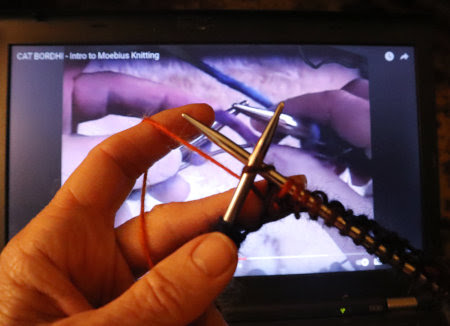
Mobius, also known as mobius strip, mobius band, or mobius loop, was named for German mathematician August Ferdinand Mobius, who while probably not the first to discover it, nonetheless gets the credit for it. It is considered a non-orientable surface because the loop contains a half-twist. Clear as mud? Me too, but it's fun to knit, even if it's a bit baffling. Maybe explaining why I'm calling it a "true" mobius will help.
Some instructions for making a mobius scarf say to knit or crochet a regular rectangular scarf, bind it off, give one end a half-twist, and then sew the two ends together to make a loop. A "true" mobius, on the other hand, knits the half twist into the scarf. After it's cast on, you start knitting and keep going. No beginning and endings; no rows to count. By the time you get to where you started, you've knit both edges of the scarf. So, you just keep knitting and knitting until you decide it's wide enough. Then bind off and it's done.
For my scarf, I found a lovely yarn in my stash that I was fortunate to receive from someone else's stash remnants purge. The yarn is beautiful and I thought would make a perfect winter scarf.
|
|
| A lovely space-dyed mohair wool blend worsted single yarn. |
|
|
| A stitch marker helps keep track of when the circle is complete. |
|
|
| Casting off |
© 2023 Leigh's Fiber Journal
| The Checquerboard socks are slow in the making |
| Chequerboard sock found after being packed away for awhile |


These won't win an award for speed knitting, but they're done! White is pretty plain and unexciting, plus it doesn't photograph all that well, but I've wanted some handknit white socks, so here they are.
(I always have trouble photographing white, but you get the idea.)