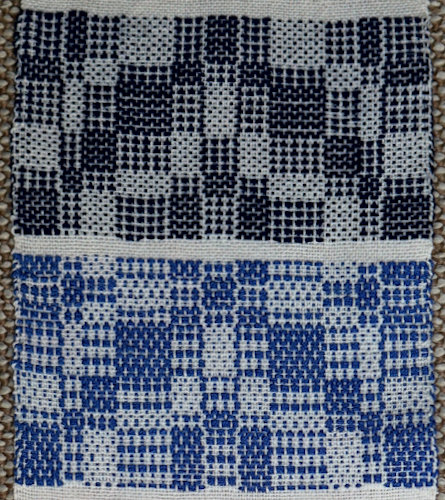
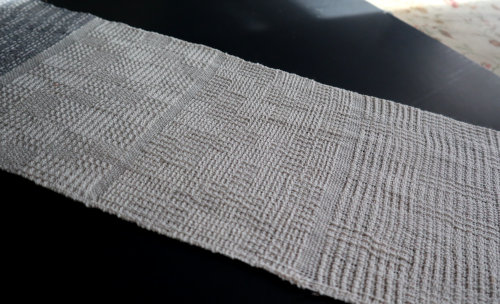
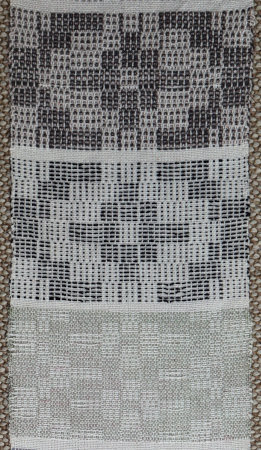
Showing posts with label Crackle. Show all posts

Friday, January 31, 2025

Pine Tree & Snowflake Crackle Bookmarks

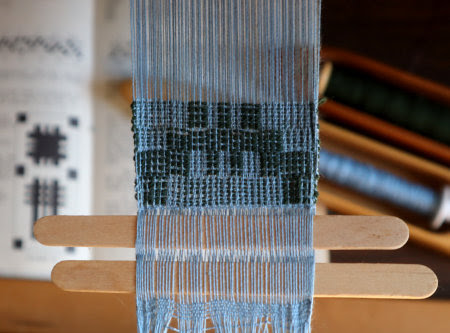
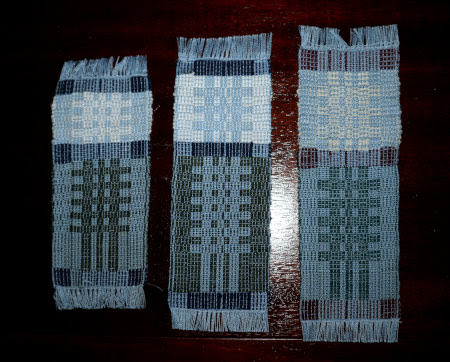
I had a yard-long warp and managed to weave three pine tree and snowball snowflake bookmarks. Atwater and Snyder called them snowballs, but I changed the name to snowflake because, as you can see, mine aren't solid like their diagrams. 

Fresh off the loom in the order woven (left to right). The middle bookmark is backside up.

Particulars

  • Pattern: Mary Snyder, The Crackle Weave (1961 edition) page 24, which was based on Mary Meigs Atwater's The Recipe Book Series I, Recipe No. 12.
  • Structure: 4-shaft crackle weave
  • Yarns (all cotton):
    • Warp: 20/2 cotton warp in light blue
    • Tabby weft: same as warp
    • Pattern weft: 
      • for the two on the left I used 6/2 in dark green and white
      • 10/2 for the one on the right I used 10/2 in medium green and natural
  • Warp ends: 100
  • Sett: 44 e.p.i.
  • Sley: 3-4-4 in a 12-dent reed
  • Threading: 
  • Treadling: ad lib

Notes and Observations
  • There wasn't a treadling draft so I experimented.
  • I also experimented with yarn weights and colors.
  • Of the pattern yarns, I like the heavier 6/2 better.
    • It made a firmer fabric, which would be more suitable for a table runner.
    • It made the pattern stand out more
  • I had a couple of warp yarn breakages, some of which I didn't fix because the sett crams the heddles so close together, making it difficult to rethread them. 
This was a good project and I gleaned good information for a possible future table runner in an adaptation of Atwater's coverlet pattern.

Pine Tree & Snowball Bookmarks: Planning

Monday, January 13, 2025

Pine Tree & Snowball Bookmarks: Problem Corrected

 Well, I got my setback sorted out. Turns out I needed to add 13 more warp ends to complete the threading pattern. Rather than unwind the warp and start over, just rethreaded the heddles from where the mistake was, and then weighted the additional warp bout in back. 


I don't know if it was lazy of me to do it that way, but it was certainly easier!

Then I tested out the sheds to make sure the pattern was symmetrical and now I've got it. 


Liftplan from the bottom:
1. Shafts 3-4
2. Shafts 1-3
3. Shafts 1-2
4. Shafts 2-3

Last time, I mentioned that there are no treadling instructions for the bookmark, so this gave me an idea of which sheds I need for the pine trees and snowballs. It appears that I'll only need sheds 3 (shafts 1-2) and 4 (shafts 2-3) for these, and shed 1 (shafts 3-4) for the squares between the motifs on the selvedges. 

I'm referring to sheds rather than treadles because this is a direct-tie table loom that requires a liftplan instead of a treadle tie-up. It I did have treadles to tie up, the numbers (1, 2, 3, 4) would refer to the treadles.

Now I can get started on weaving some bookmarks.

Friday, January 10, 2025

Pine Tree & Snowball Bookmarks: Setback

There was no treading draft for this pattern, so I began my weaving with a bit of experimentation to see what all the sheds did.


The bottom row is sheds 1, 2, 3, 4 consecutively for several rows, then moving up are rows for each shed, repeated with tabby in between the pattern picks. The pattern is supposed to be symmetrical from selvedge to selvedge, but as you can see, two of the sheds (B and C), are not. That, plus a threading error smack dab in the middle. 

I loosened the tension and tried to check the threading in the heddles, but it's too crammed to make an easy job of that. So I cut the warp right above the sample, removed the beater, and am making a more careful check. 

I figured it could be one of two things:
  • threading draft error
  • miscounting on my part

What I discovered, is that I had the wrong number of warp ends. I knew from Lucy Brusic (A Crackle Weave Companion) that Snyder's book contains some errors. But I could see that the threading draft was correct, so my next step was to count the warp ends in the draft. 


The instructions (The Crackle Weave, 1961 edition, page 24) called for 88 ends. Yet the draft counts out to 112, including selvedges and incidentals. In checking Syder's 1989 revised edition, I saw that the bookmark width and number of ends was omitted. So someone must have caught the error and omitted it, but it would have been helpful to indicate the correct number of ends required. 

So, mystery solved, but I'll have to add 24 more ends to the warp and rethread to correct that error in the middle of the warp. Fortunately it's a short warp and so should be doable. 

Monday, January 06, 2025

Pine Tree & Snowball Bookmarks: Planning

In my project planning post, I mentioned that I want to weave a pine tree and snowball table runner. For it, I'm thinking of adapting a coverlet pattern from Mary Meigs Atwater's Recipe Book.

Mary Meigs Atwater, The Recipe Book,
Series I, "Coverlets," Recipe No. 12.

It's a complicated pattern, however, and I've learned that the threading drafts in that book don't always jive with the image. Happily, Mary Snyder adapted the Atwater draft for bookmarks.

Mary Snyder, The Crackle Weave page 24, 1961 edition

Starting with this will give me a chance to better understand the threading and treadling, before tackling the larger project. Plus, I'm thinking that having a selection of bookmarks on hand will be nice for little gifts as needed.

Snyder has some good suggestions for yarn colors too, although the bookmarks call for a much finer yarn than I will use for a table runner. The bookmark call for 20/2 cotton warp at 44 e.p.i. With my 12-dent reed, I will sley it 3-4-4. Tabby weft is the same yarn as the warp. The pattern weft is heavier, so I'm going to start with 10/2s . My color choices are medium blue for the warp and tabby, white weft for the snowballs, and green for the pine trees.

Not the best representation of the green. Hopefully, it will look
more accurate when I photograph the bookmarks in progress.

I haven't decided about the little squares that separate the motifs. Maybe a red to give them a Christmasy look? Or black or blue? I'll have to experiment.

Currently, the loom is being threaded, so weaving will begin soon.


Related posts

Tuesday, December 17, 2024

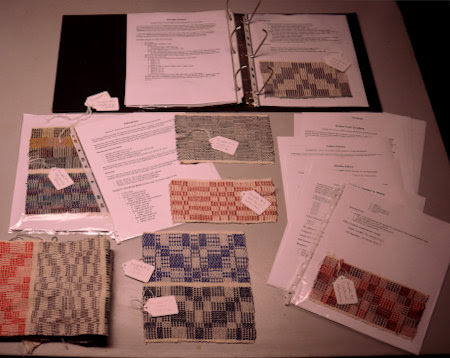
Crackle Sampler Notebook

As helpful as my blog journal is for recording information, my notebooks are truly invaluable. I love having books of relevant notes and accompanying samples. Looking back at some of the online workshops I participated in, I wish I'd made more notebooks. I wish I'd done a better job of making copies of the lessons and discussions. 

My current 4-shaft crackle sampler notebook catalogs the various manners of weaving crackle and will help me with future project planning. It's lovely to have a collection of real samples and how-to notes available.

It's a bit tedious to run off copies of the blog posts. I only need the text to accompany the live sample, but to get it seems to require a two-step copy and paste. Once off the blog to a text editor. Then from the text editor to LibreOffice, where I can turn it into a PDF to print out. I don't have a printer, so I do these when I make a regularly scheduled trip to the library. 

The reason for the intermediary step of copying to the text editor is to remove all the hidden formatting code in the copied text.

It's been a somewhat slow project, but it's giving me a chance to figure out what I want to do next. 


Related posts

Monday, December 02, 2024

Crackle Sampler Washed & Pressed

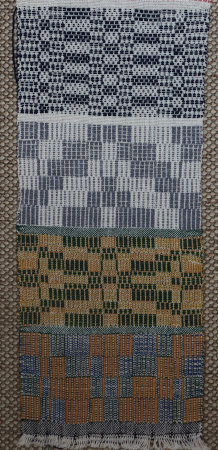
Samples #1-4
I ended up with 34 samples from my 4-shaft crackle manners of weaving sampler. Now that it's off the loom, washed, and pressed, I'm getting a better idea of what each manner of weaving has to offer.
 
The sampler particulars:
  • warp
    • 10/2 cotton
    • 160 ends
    • 20 e.p.i.
    • 10-dent reed threaded 2 per dent
  •  weft
    • 5/2 (or 10/2 doubled) cotton pattern weft
    • 10/2 cotton ground weft
    • Some samples used a 10/2 pattern weft
  • See introduction for profile draft, threading, and tie-up.
  • Width in reed: 8 inches
  • Finished width: 7 inches 

Shrinkage makes a difference, of course, both in fabric size and the look of the fabric. For example, sample #6 which is a twill treadled without tabby.

Sample #6 before washing

Sample #6 after washing

The summer & winter treadling was one I was interested in. If you recall, this is one I thought might be a contender for dining room draperies, to coordinate with my Blue Willow china. Wet finishing made a wonderful difference . . .

Samples 11 (top) & 12 (bottom), summer & winter manner of weaving

Sample 12 looks like it might do very well for that project and deserves a larger sample.

The woven as lace samples also improved with wet finishing. It's difficult to appreciate in a photo because the pleasingness of the effect is textural. Same color warp and weft makes it difficult to photograph. It needs the angle of light to see it in a picture. 

Samples #13, 14, and 15.

Bottom to top: samples 16, 17, 18

The shadow effects samples also interested me on the loom. The one on the bottom (on the right), #16 is called "Shadow-y." It doesn't have good color contrast between warp and weft, so I find it more difficult to appreciate. I'd like to try it again with contrasting colors. 

The middle sample, #17, Shadow Blocks, is okay, but doesn't inspire me, I think because it's flat looking compared to the top sample, #18.

#18 is Mary Snyder's Shadow Blocks and is much more interesting. I think this is because it has a more crackly look to it. Plus, using more colors offers more opportunity for color blending (which is what drew me to crackle weave in the first place). I chose two neutrals (dark gray and brown) for my two color wefts, and I think brighter colors would be really fun.

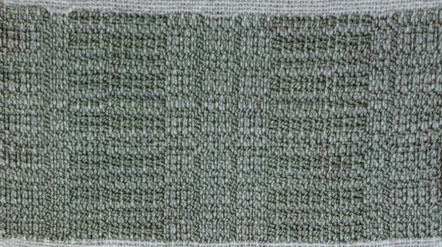
Another sample that I was curious to see wet finished is #27, lengthwise stripes. Here it is below, before and after wet finishing.

#27, lengthwise stripes on the loom

#27, lengthwise stripes after washing, drying, and pressing

I like that the stripes pop out more after finishing and I'm happy that the little background stripes remain. This one would be fun with various stripes being different warp colors.

Samples #29 - 32

I wove a lot of samples, and amazingly, I didn't exhaust the catalog of manners of weaving for crackle. But I've got a good collection and I'm getting important information about my yarn size and color choices. Some of them I'd like to weave again, to explore them on a larger project. Sampling is good to a point, but doesn't necessarily tell me how the fabric will behave on a larger project. 

My next step is to sew the edges of each sample to prevent fraying. Thankfully, I made good notes in my blog posts, and each of these will be printed out for a sampler book. Each sample will be secured with it's information and notes. I'll use the new photos to update my Crackle Manners of Weaving page. 

Between all that plus some sewing and mending, I have plenty to keep me busy for awhile.

Wednesday, November 27, 2024

Last Sample!

Sample #34 of my 4-shaft crackle manners of weaving sampler.

Finally, the end of my 5-yard sampler warp!


I had enough to eek out one more sample. For this one I decided to revisit my crackle stripes, this time with a lacy treadling as suggested by Susan Wilson. You can see my previous lace weave crackle samples here. This one is the 2-block lace. 

#34, lace lengthwise stripes

 It's kinda hard to see them though, isn't it? Here's another shot at an angle. 

Does that help?

I think I will add this to my lengthwise stripes sample post, to have all the information in one place.

The next step was to take the sampler off the loom and sew the ends to prevent unraveling. 
 
 
On the loom, the fabric was stretched tight, so it was hard to tell how well my yarn  choices were working. Off the loom, it's relaxed and softer, and I have a better idea. Next I'll wash it, which will make it look even better. I'm curious as to how the samples will look after that.

Saturday, November 23, 2024

Crackle Manners of Weaving: Honeycomb

 Sample #34 of my 4-shaft crackle manners of weaving sampler. 

Like swivel and petitpoint, honeycomb is a treadling system, and therefore applicable to a variety of threadings: typically overshot, but also M's & O's, huck, monk's belt, and even twill.

Once upon a time, I wove honeycomb on M's and O's threading (pictures here. This is one where wet finishing makes a dramatic difference to the fabric.) Even so, it's not one I was terribly interested in for this sampler. Like swivel and petitpoint it's an unbalanced weave that creates long floats on the back. 

Both Susan Wilson and Lucy Brusic have a section on honeycomb in their crackle books, but in both cases it's more of a description rather than instructions. But I found instructions in Mary Snyder's The Crackle Weave. And what was truly amazing was that I actually understood them! I gave up on this book when I first started experimenting with crackle because I couldn't follow what she was saying. Finally, (after 32 samples!) her book is starting to make sense.

Honeycomb is so called because it weaves honeycomb-like cells in the fabric. A heavy weft curves around cell-like shapes with plain weave in the centers. Long floats form on the back of the cells from the heavy outline weft.

Doesn't exactly look like bees' honeycomb, does it?
More like waves. Probably has to do with the threading.
  • For the most part, I followed Snyder's project #12, "crackle blocks woven in honeycomb manner," page 32 of the 1989 edition.
  • My loom was already warped, so there is a difference there in sett
    • Snyder recommended 10/2 warp with sett of 24 ends per inch
    • My warp is 10/2 with sett of 20 e.p.i.
  • Weft yarns are similar to her recommendations
    • tabby: 3/2 cotton (3 times heavier than the pattern weft)
    • pattern: 16/2 cotton
    • This is opposite of how it usually is. Usually, the pattern weft is heaviest.
  • Tie-up is the same as swivel
  • Tension should be looser than normal
  • Beat firmly
  • 4 cells possible with 4 shafts
  • There are many treadling possibilities (Bress pgs 130-136). The one I used is Snyder's variation A:
    • 1-3 (tabby a)
    • 2-4 (tabby b)
    • 2-3-4 (pattern)
    • 1-3-4 (pattern)
    • 1-3 (tabby a)
    • 2-4 (tabby b)
    • 1-2-4 (pattern)
    • 1-2-3 (pattern)
  • Creates a one-sided fabric with long floats on the back.

Lucy Brusic states that honeycomb really isn't worth the effort on crackle, and I have to agree with her. I much preferred it on my other sample on M's and O's threading.

Resources


Thursday, November 21, 2024

Crackle Manners of Weaving: Petitpoint

 
Originally, I was going to make one long post covering two related manners of weaving, swivel and petitpoint (which is a subcategory of swivel). It was a lot to wrap my head around, however, so I broke it down into two posts. You can read about swivel, including the similarities and differences, here.
 
 Petitpoint
  • A subcategory of swivel.
  • So called because it resembles petitpoint embroidery.
  • Uses the same 3/1 twill tie-up as swivel (here)
  • Unlike swivel, petitpoint adds tabby to the pattern and background wefts
  • Two shuttles and two colors 
    • pattern is one color and can be heavier
    • background and tabby are the same as the warp
  • Also like swivel, petitpoint has long floats on the back
  • In The Weaving Book, Helene Bress offers three ways to treadle it 
 
Petitpoint I. This treadle pattern is the one found in Wilson and Brusic (see "Resources" below).

#30 Petitpoint swivel I.
  • Block A
    • P: 2-3-4
    • B: 1-2-4
    • T: 1-3
  • Block B
    • P: 1-3-4                
    • B: 1-2-3
    • T: 2-4
  • Block C
    • P: 1-2-4
    • B: 2-3-4
    • T: 1-3
  • Block D
    • P: 1-2-3
    • B: 1-3-4
    • T: 2-4
  • My block order is D, A, B, C

Weaving Observations

  • Like swivel, this is somewhat complicated to weave on a table loom, because each shed requires manually lifting three shafts. 
  • Makes an interesting design.
 
Petitpoint II. From Bress page 99. The pattern treadling is still used, but the background treadling is replaced with tabby a (1-3) and b (2-4), with both following each pattern shot.
 
#31, petitpoint swivel II
  •  Block A
    • P: 2-3-4
    • Ta: 1-3
    • Tb: 2-4
  • Block B
    • P: 1-3-4                
    • Ta: 1-3
    • Tb: 2-4
  • Block C
    • P: 1-2-4
    • Ta: 1-3
    • Tb: 2-4
  • Block D
    • P: 1-2-3
    • Ta: 1-3
    • Tb: 2-4
Weaving Observations
  • As far as I can tell, it looks identical to variant I
  • Easier to weave that variant I
 
Petitpoint III. Easiest and quickest yet. Alternates pattern shots with tabby. 

At first I thought I would weave each block to square, but after one block decided it wasn't interesting enough to continue.
 

Instead, I rotated the pattern shots, one after the other, with tabby in between.
 
#32, petitpoint swivel III
  • Block A
    • P: 2-3-4
    • T: 1-3
  • Block B
    • P: 1-3-4                
    • T: 2-4
  • Block C
    • P: 1-2-4
    • T: 1-3
  • Block D
    • P: 1-2-3
    • T: 2-4
 
And one more. This one is a "what if I . . ." sample. Petitpoint I has pattern, background, and tabby wefts. What if I left the tabby the same as the warp, but used different contrasting colors for the background and pattern wefts?
 
#33. Pattern weft in pink, background in blue, and tabby in natural.
 
close up

It was definitely the most interesting sample to weave, and one I wouldn't mind playing around with more. Someday.

Tuesday, November 19, 2024

Crackle Manners of Weaving: Swivel

 
A heads-up: This (and the next in this series) will be long, technical, and likely boring, except for the pictures (hopefully). This is because I really struggled to understand this one. I had to piece together bits of information from five different books plus experiment a bit. I'm hoping that by being thorough, I won't be completely lost should I decide to revisit it again someday.
 
Originally, this post was going to cover two related manners of weaving, swivel and petitpoint, of which petitpoint is a subcategory of swivel (although, apparently, some say it's the other way around). Why it's called swivel, I have no idea.

Harriet Tidball classifies swivel as a weaving method rather than a threading system. This means it can be treadled on a variety of threadings. Swivel treadling with crackle threading is one of the variations.

Similarities between swivel and petitpoint

  • Weaves as small dots on plain weave on the front of the fabric, with long floats on the back. 
  • Two shuttles and two colors (pattern and background)
  • Uses a 3/1 twill tie-up, instead of a 2/2 twill tie-up (see "tie-up" in my sampler introduction.)
  • 1-3-4, 1-2-4, 1-2-3, 2-3-4 & tabby
  • With a table loom, I must lift the sets of shafts myself to make the shed.
  • This unbalanced tie-up is what weaves the design on the front of the cloth and leaves long floats on the back. 
  • Usually woven on twill threadings, which is why it works with crackle. (See "threading" in my sampler introduction.)

Differences between swivel and petitpoint

  • The difference (that I can tell) between swivel and petitpoint, is that swivel uses only pattern and background wefts. Petitpoint uses uses the same, with the addition of tabby.

Swivel

#29, crackle threading  treadled as swivel
  • alternates 3 shafts with 3 shafts 
  • one shed for pattern (p), the other for background (b, called “binder” by Bress)
  • treadled as drawn in (treadling follows the threading draft). From Bress:
    • Block A is threaded on shafts 1-2-3-2 and treadled
      • 1. p: 2-3-4, b: 1-2-4
      • 2. p: 1-3-4, b: 1-2-3
      • 3. p: 1-2-4, b: 2-3-4
      • 2. p: 1-3-4, b: 1-2-3
    • Block B is threaded on shafts 2-3-4-3 and treadled
      • 2. p: 1-3-4, b: 1-2-3
      • 3. p: 1-2-4, b: 2-3-4
      • 4. p: 1-2-3, b: 1-3-4 
      • 3. p: 1-2-4, b: 2-3-4
    • Block C is threaded on shafts 3-4-1-4 and treadled
      • 3. p: 1-2-4, b: 2-3-4
      • 4. p: 1-2-3, b: 1-3-4
      • 1. p: 2-3-4, b: 1-2-4 
      • 4. p: 1-2-3, b: 1-3-4
    • Block D is threaded on shafts 4-1-2-1 and treadled
      • 4. p: 1-2-3, b: 1-3-4
      • 1. p: 2-3-4, b: 1-2-4
      • 2. p: 1-3-4, b: 1-2-3
      • 1. p: 2-3-4, b: 1-2-4
    • no tabby
  • Yarns
    • background weft is the same weight and color as the warp
    • pattern weft is same weight as warp but a contrasting color

Notes & Observations

  • To be honest, I wasn’t sure I wanted to include this in my sampler at first. The sticking point for me was the long floats in the back. If crackle doesn’t have floats longer than three ends, is this really crackle??? None of the authors questioned it, and it does look intriguing, so I gave it a tr.
  • I think some interesting things could be done with color. Maybe thread each block in different colors and ditto with the weaving.
  • I like the look of it, but found it complicated to weave. With a table loom, I’m lifting three shafts for each throw of the shuttle and I found it difficult to keep track of. I worked out a system for keeping my place, but it was slow going.
  • The long floats on back limit the use of the fabric. It would best serve for things that either could be lined, like vests and jackets, or which displayed only one side of the fabric, such as throw pillows or upholstery.
With a hand mirror, you can see the long floats on the back.

Resources


Sunday, November 17, 2024

Crackle Manners of Weaving: Lengthwise Stripes

Samples #27 & 28 of my 4-shaft crackle manners of weaving sampler. 

Lengthwise stripes are attractive and easy to weave. Using different warp colors is one way to do it, but in this sample, the stripes are created with pattern weft. The tie-up is for 2/2 twill, so it's just a matter of choosing one pair of shafts to lift for every shot. Tabby is thrown in between to stabilize the fabric. My sample was done with shafts 2 & 3, just because I liked the location of the stripes with my particular threading.

#27, lengthwise stripes on the loom

The wider brown stripes in the pattern blocks, of course are dominant. But what I find interesting, is the tiny stripes in the background blocks. This may change with wet finishing, which will shrink the fabric somewhat, and is something I was curious about.  

#27, lengthwise stripes after washing, drying, and pressing

With a different threading, I could change the width and location of the stripes. I could even make them different colors, to add more interest.

Another idea for stripes comes from Susan Wilson, who included lengthwise stripes in her lacy manners of weaving section. 

#28, lacy lengthwise stripes

It's kinda hard to see them though, isn't it? Here's another shot at an angle. 

Mary Snyder's book has an exercise in creating a variety of crackle stripes. See resources below for the page number

Resources


Thursday, November 14, 2024

Crackle Manners of Weaving: Mixing Drafts

 Samples #25 & 26 of my 4-shaft crackle manners of weaving sampler.  

One of the points Lucy Brusic emphasizes in her A Crackle Weave Companion is that drafts can be mixed and matched. In chapter two, "Rethinking Crackle," she states,

"New Crackle patterns can be evolved simply by using the treadling of one Crackle pattern with the threading of another." Lucy Brusic, page 14

She showcases numerous examples of this as she discusses how to choose compatible pairings. Two somewhat universal treadling patterns are Scandinavian Favorite and Blooming Leaf. These are the two I chose for my sampler. 

  • Both treadling drafts are found in Marguerite Davison's A Handweaver's Pattern Book.  
  • Both are woven in overshot manner (pattern-tabby-pattern-tabby).
  • Blooming Leaf as a whole draft is not one that particularly draws my interest, but I have done several table runners in Scandinavian Favorite variations. You can see my samplers here. 
  • The particulars for my sampler threading and tie-up can be seen here.
#25 treadled as Blooming Leaf (Davison page 201)

#26 treadled as Scandinavian Favorite (Davison page 200, variation I)

The Blooming Leaf treadled sample doesn't look anything like the complete Blooming Leaf draft in the book because my threading is different. But Scandinavian Favorite looks similar because my sampler is threaded in a diamond pattern anyway. I could experiment with others, but I'm not sure this manner of weaving is something I would be interested in pursuing in the future. Still, it will make a good addition to my 4-shaft crackle sampler.

That said, I now find myself checking how much warp is still wound on the back beam. I've worked my way through most of the ideas presented in Brusic's and Wilson's books, at least the ones I want to try. Some ideas need a different threading, and some don't interest me as much. I'm getting anxious to get this sampler off the loom and wet finished, so I can see how they turn out and which ones I'd like to explore more.


Tuesday, November 12, 2024

Crackle Manners of Weaving: Pictorial

Sample #24 of my 4-shaft crackle manners of weaving sampler. 

The term "pictorial" crackle comes from Lucy Brusic's A Crackle Weave Companion (pages 52 to 62). While not terribly detailed, crackle is capable of weaving recognizable albeit stylized shapes. Brusic lists a number of them:
  • flower patterns
  • church (ecclesiastical) motifs
  • cottage windows
  • pine trees and snowflakes
Most of these I've already woven in various projects, and I'll put photos of them at the end of this post. The one I'm particularly interested in for this sampler is the pine trees. Pine trees and snowballs were a favorite when I wove them on eight shafts in Summer & Winter: According to Harriet Tidball, crackle is the only structure that can weave pine trees on four shafts. In looking through my books, I found three designs for pine tree motifs in crackle.

Mary Snyder, The Crackle Weave page 23, adapted
from Mary Meigs Atwater's The Recipe Book.

Mary Meigs Atwater's The Recipe Book,
Series I, "Coverlets," Recipe No. 12.

Several designs from Harriet Tidball's The Weaver's Book page 131

Because my loom is already threaded in a particular pattern I can't weave any of the above for the sampler. Nor can I try the snowflakes. But considering that loom woven pine trees are highly stylized anyway, I decided to see what I could do. 
 
sample #24

Okay, not one I'd do on this threading again, but I liked giving the possibility a try and I'm curious as to how wet finishing will tidy it up. I think tree motifs have a lot of possibilities: small towels, table runners, place mats, napkins, scarves, gift bags, etc. Maybe add some beads and embroidery to make Christmas and fruit trees.

As promised, here are my other pictorial crackle motifs from previous projects:

Mary Snyder's pine tree

Mary Snyder's snowflake

Church weaving as another table runner.

Cottage Windows table runner