Showing posts with label weaving equipment. Show all posts

Tuesday, January 16, 2024

Reeds For My Table Loom

Last month I was wishing I had some different size reeds, and my dear friend Terry came to the rescue. Terry was the previous owner of my table loom and I'm weaving again because of her! When she managed to rummage up two new sizes to fit it, I was thrilled beyond words. 

8 dents per inch and 12 dents per inch

So, now I have three reeds in different sizes: 8, 10, and 12. The 10 and 12 are probably the most common sizes, with 8 next. Lots of threading possibilities now!

Not much fiber blogging because I'm still working away on my mending pile. I'm gradually getting seams and waistbands repaired, holes mended, and jacket zippers replaced. Being utilitarian mending, none of it seems blog worthy. I have good audiobooks to listen to and am making good progress on my pile. The new reeds are giving me a bit of a boost to get it all done! You can bet I'm going to be planning a new project as I work to finish that mending pile. :)

Sunday, December 03, 2023

Of Fat Yarns and Skinny Reeds

 So far, my projects in crackle weave have been woven in traditional (overshot) manner (table runner 2 and table runner 3). It's time to have a go at different way to weave crackle. Since I still have some time before family Christmas get-togethers, I thought about a scarf for my son in one of his favorite sports team's colors.

For the yarn, I chose a low-pill acrylic, so it will be machine washable. 

I've not used these before, but I have woven scarves and blankets in regular acrylic yarns and know how easily they pill with repeated washing and drying. It doesn't take long for it to look shabby. But, I think acrylic yarns are a plus for folks not interested in hand washing and drying wool (which can also pill). Maybe the low- and anti-pill yarns are a good compromise. 

My current concern is the size of the yarn versus my loom. Specifically the reed. 


The yarn measures 10 wraps per inch. 


So for plain weave, it should be sleyed at 5 ends per inch, which would be every other dent in my 10-dent reed. That's easy enough, but the question is how the yarn fits in the spaces. Yarn is squishy so I can make it fit, but I don't want too much rubbing on the reed as the shafts are raised and lowered and the warp advanced. I don't want frayed looking yarn in a brand new scarf.

The best answer to this is to buy another reed, one with fewer dents per inch. This is extremely tempting. Already on my wishlist is a 12 dent reed, after discovering that the 2-2-3 threading for table runner 1 created lines in the plain weave where three threads were crammed into one dent. My table loom takes a 24-inch length reed, and these run around $100. This isn't an outrageous price, but enough for me to rein in my impulsiveness in deference to other financial priorities.

Anyway, I'm going to give it a go with this reed and see what happens.

Friday, October 27, 2023

Table Runner 1 Is Done


Project Particulars:

  • Pattern: Fibonacci stripes in a 2/2 twill and reverse
  • Yarn: 8/2 cotton
  • Sett: 24 e.p.i.
  • Width on loom: 17.5 inches
  • Woven length on loom: 30 inches
  • Finished width: 15.75 inches
  • Finished length: 28 inches


Weaving Notes

Noteworthy 1: When I was just getting started and weaving the plain weave header, I noticed that there were warp stripes appearing. They're especially noticeable in the dark gray warp sections.

Upon a closer look, I discovered that these are the result of the way the reed is threaded. I only have one size reed, which is 10 dents per inch. So far, I've woven my samplers and dishtowels at 20 ends per inch, or two per dent. The sett for the table runner needed to be 24 per inch. That meant I had to thread the reed in a 2 - 2 - 3 sequence. The result is that where there are three threads in a dent, they are bunched up and formed stripes in the plain weave header. 

Thankfully, this wasn't a problem when I wove the twill.

Still, it's something to keep in mind and perhaps consider purchasing a 12 dent reed in the future.

Noteworthy 2: As I measured the project length on the loom while weaving, I allowed a couple of extra inches beyond my targeted project length for take-up. When I got it off the loom it was no longer under tension and so was shorter than I expected! Thankfully, length is arbitrary, and so this is one of those "don't point out the mistakes and no one will notice" thingys!
To compensate, I used the plain weave headers like borders for the hems. 


I was able to get my targeted length and I'm satisfied with how the plain borders highlight the twill pattern, Who's to know it wasn't planned? 

Now on to plan table runner number two.


Related Posts:

Monday, September 25, 2023

A New Shuttle to Help With Two Things

Before I started weaving the overshot-fashion dishtowel of my twill gamp, I wanted to review yarn sizes. My warp was 8/2 and I needed a heavier yarn for the pattern weft. It's that heavier yarn that brings out the pattern. Of course, recommendations vary somewhat, but something I ran across was the idea to simply double the 8/2 to effectively make an 8/4 pattern weft. Since my stash is mostly 8/2s and 10/2s, that idea was certainly appealing. Yarn has gotten so expensive since I started weaving again, that I'm glad to use what I've already got! I can do this yarn doubling a number of ways: winding two 8/2s on the bobbin together, using two individual shuttles, or 

Double bobbin boat shuttle by Handywoman.

I found it on Etsy, where I had a $5-off coupon. This shuttle will expand my options for pattern weft as I can now easily double what I've already got without having to buy more yarn.

It came with two plastic bobbins!

It's so pretty that I just had to share it. The shuttle is expertly handcrafted, beautifully finished, and reasonably priced. I had a choice of woods and chose cherry. I especially like it because it is compact: 12-inches long and only 1-inch high, but it holds standard 4-inch bobbins. 

It was designed with rigid heddle looms in mind, which are smaller than floor looms and so benefit from equipment suited to them. I don't have a rigid heddle loom, but my table loom is small as well, and I find that using my taller shuttles means that it isn't long before I can no longer pass the shuttle through the warp shed. This low profile shuttle is not as tall as the more expensive brands, so it will give me a little more weaving room before I have to advance the warp.


Janet's shop on Etsy is here, but if you visit her website - Handywomanshop.com - you'll find a greater selection of items, more choices of woods, and better prices. She carries handcrafted weaving and spinning equipment and tools, including some amazingly unique shuttles, and even weaving themed jewelry!

Even though I wasn't planning to buy more equipment, this shuttle is something I'm glad I bought. It will help with both my yarn stash and my table loom. Many weave structures use a heavier pattern weft—including Summer & Winter, one of my favorites—so I know this new shuttle will get plenty of use in the future.


Related post:

Monday, September 11, 2023

DIY Weaving Aids

Before I got started on the third dishtowel in my twill gamp, there were a couple of things I wanted to address to help me with my weaving. 

The first was a way to put my lever sequence in a convenient place. I write this out on a card to follow while I'm weaving. Previously, I laid the card on the table, but attaching it to the loom near the levers is much more helpful.


The second was a way to keep track of where I am in that sequence. 

This set of beads has holes from side to side (the others went top to bottom). And they fit on a 0000
double pointed knitting needle. The elastic holds it & the beads move easily when I change levers.

People often use numbered beads for the treadling sequence, but with direct tie-up and levers, I decided to number the sequence on my card and use the beads to correspond to that. 

Little things can make a big difference!

Does anyone else have some simple weaving aids they'd be willing to share? 

Tuesday, September 05, 2023

A Raddle For My Table Loom

The first two warping adventures on my table loom have been front to back. The was how I learned to warp a loom, and it's the first method shown in Deborah Chandler's Learning To Weave. I later switched to warping back to front, but since I'm just reacquainting myself with weaving, starting at the beginning seems like a good idea. Plus, I need a raddle. 

A raddle is basically a yarn holder for warping back to front. It's purpose is to evenly distribute the yarn across the back beam and keep it at the proper width during the beaming process. Otherwise, the yarn will tend to bunch up and make a mess. 

Raddles need to be sized for the loom. They are easy enough to make, but the one I wanted is the "special raddle" shown in Peggy Osterkamp's Warping Your Loom & Tying On New Warps.


I bought the materials and Dan assembled it for me.


One tidbit; Lowe's didn't have enough #12 eye screws, so I ended up going to Home Depot for the rest. They are made by different manufacturers; one makes them from zinc, the other from stainless steel. So even though they are technically the same size, they are not actually the same size! That won't make a difference in using the raddle, but I thought I'd mention it in case anyone else decides to make one of these. 


The appeal of the eye screws is that after the yarn is distributed across the raddle, a rod is run through the eyes to keep the threads from jumping out! Yes, that happens and can make a mess of things. I used to use rubber bands, but I like this idea much better. 

I still need to get the rod and a way to attach it to my back beam, but it will be ready to go for my next warp.


Related post:

Tuesday, December 08, 2009

I Have Pirns!

By Leigh

4, new to me pirns
These are for my bargain shuttle. They were passed on to me by Barb, after they were passed on to her. I feel equipped!

Now, I freely confess that it will be awhile before I get to try my new shuttle. I'm still cutting rags for the rag rug I'm planning for the bedroom, and that will be the first project on my loom once I can get back to weaving. But I will definitely be learning to use it in the not so distant future.

So, a heartfelt thanks to Barb, and also to everyone who left me helpful and encouraging comments about my new shuttle. All are very much appreciated.


Related Posts:
My $6.93 Shuttle

Monday, November 23, 2009

My $6.93 Shuttle

By Leigh

I was browsing a thrift shop this morning and found this...


Of course I bought it! (Click pic for a little bigger). It cost me a total of $6.93 including tax and is in excellent shape. I know absolutely zilch about end-feed shuttles, so I need your help! Did I just buy a pretty ornament for my studio? Or can I actually weave with it? It has no identifying markings, but stamped on the bottom are these: SH (or 5H) 852 on one side, and M 3394-37 on the other. It's 16.5 inches long. I'm assuming it's an industrial shuttle (???)

Help?

Friday, October 24, 2008

Color Coding Steel Heddles: Readers' Suggestions

By Leigh

This is a follow-up to my last post, Color Coding Texsolv Heddles. Connie asked about ideas for doing the same with steel heddles. I didn't try this when I had a loom with steel heddles, but there were some excellent ideas in the comments. Here they are:
Janice said, "I have large-eye wire heddles on my loom. In order to see them I painted above and below the eye where the twisted wire part of the heddle is. And, every 10th heddle I painted around the eye as well. It took a few days to do all the heddles, I put two coats on them, but they are really easy to see, now, and they look pretty too."
Trapunto suggested, "...a dab of white out or nail polish for metal heddles? Say, on every other shaft?"
Amelia said, "A local friend just used fingernail polish on her twisted eye metal heddles .... I decided to go with permanent marker on mine"
Phiala had some good advice ..... "I would try either the enamel paint used by modelmakers .... or the new alcohol inks intended for use on non-porous surfaces. The paint would be bright and opaque, while the ink would be less-visible but easier to apply and use because it doesn't produce a raised surface.... In either case .... degrease the metal before applying the colorant, either with one of the degreasers sold for painting, or just washing carefully."
Kimmen (no blog) says, "I went to the local beauty supply place and found a bunch of wildly colored nail polishes for $1/bottle. Worked fine on the metal heddles, and was less expensive than model makers paint.

You really only need 3 colors- leave 1 harness plain, then paint the next 3 different colors. The 5th harness is plain, and repeat the colors..... the color repeats are 4 harnesses apart, and you wont mix them up..... I used repeated the colors on other looms and find I like that better, especially when you are doing patterns that lift in pairs. It's easier to figure out the pairings, and I can color code my draft easily."
Meg in Nelson offered, "I tied embroidery floss at the top of every 10th heddle, through the loop. Though individual heddle eyes are not color-coded, if you shake the shaft a bit while threading, it's easy to know which shaft you're on. This was my 4-shaft loom, and Shaft 1 has red marks, Shaft 2 blue, Shaft 3 yellow and Shaft 4 green. "
Neki Desu suggested, "Craft paints such as Pebeo or even better Lumiere work well. Just paint the eye."

If anyone has other ideas, please let me know and I'll be glad to add them!


Related Posts:
Color Coding Texsolv Heddles

Monday, August 20, 2007

Alpaca Tri-loom Teddy Bear Shawl

One of my daughter's teddy bears models the shawl.By Leigh

I am pleased to report that my third alpaca project is complete. Cally was curious as to what I had in mind when I said "teddy bear shawl." She had several very good ideas, but her first guess was correct. I wanted a small shawl for a teddy bear!

To actually do this however, I had a couple of challenges facing me. The first was to find my tri-loom, which had been packed away a couple of moves ago. That was fairly easy. The second was to figure out how to adapt it to make a smaller triangle, because, as you see below, it is a rather large size loom, with a six and a half foot weaving width.


My tri-loomFor those of you not familiar with these, a tri-loom is a type of continuous yarn loom. The beauty of it is that the weaver warps and weaves at the same time. In fact, they make an excellent first loom for anyone who is interested in trying their hand at weaving. Mine was handcrafted as a gift from my son when he was in high school. He was never particularly interested in woodworking, so the fact that he wanted to make it for me makes it quite special.

Since my tri-loom is not an adjustable one, but I was hoping that somehow it could be modified without having to make another, smaller tri-loom. Fortunately I have a husband who is quite clever when it comes to this sort of thing. This is what we came up with .....

Tri-loom modified for a smaller project.In this photo, I have already marked the nails along the top with bits of yarn. These are for the color changes in the shawl. Not being mathematically minded, I've had trouble in the past getting my colors changes where I wanted them. I always work it out on paper first, but I have learned to count it out and mark the nails before I begin as well.

Weaving starts with a center pull ball of yarn, in this case my bulky handspun alpaca, and a slip knot. There are excellent instructions with photos for this type of weaving here, so I won't go into detail, but will give you the gist of it.

Weaving on a tri-loom.The loom has the same number of nails along each side of the triangle. On the top (hypotenuse), they are spaced at every half inch, along the legs of the triangle, they are three-eighths of an inch apart. Weaving starts on one side and works back and forth. What is woven on one side of the loom, is automatically woven on the other side as well, so that the weaving works from the sides inward. Above, I am weaving the yarn over one and under one in a plain weave. Twill and leno lace weaves are also possible.

Weaving with a locker hook.Most of the weaving can be done with one's fingers, but I do find that a crochet or locker hook very helpful when I get toward the center and the open space for working the yarn through gets narrower. I like the locker hook because it has a hook like a crochet hook at one end, and a large eye, like the eye of a needle at the other end. This is sometimes convenient for working threads through or correcting mistakes.

Color changes are a simple matter of tying the two colors together on one side and weaving them together on one side. A better explanation with photos can be found here. My light colored yarn is from the same fleece as I used for the knitted alpaca cap.

The nature of tri-loom weaving is that the two halves are identical. Whatever color changes are created on one side, are mirrored on the other. This means that one only has to design half a triangle! Lovely plaids including tartans can be easily designed for this type of loom.
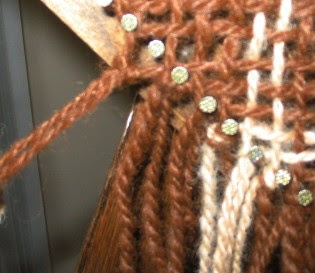
Tying on the fringe.Once all the nails have been used up and the weaving is done, the shawl is fringed. Where ever the color of yarn was changed, these two yarns are knotted securely at the nail with an overhand knot. You can see one of these on the right. Other fringes are added at each nail with a length of yarn and a lark's head knot. Only the two short sides of the loom are fringed.

Once all the fringes have been added, the shawl is ready to remove from the loom. This is done the same way pot holders are taken off of their little square looms, with a chain stitch across the top.

Chaining offAfter that, the shawl can be gently lifted off of the remaining nails.

Off the loom & ready to wash.Now it is ready to wash and then I can trim the fringe. You might be able to tell from the above photo, that the fresh fabric is still quite open, even though I used bulky yarn. Before washing it measured 33 inches across the top, exclusive of fringe. The two shorter sides were each 25 inches. I did full it a bit, so that after washing it was 30 inches across with 21.5 inch sides. I trimmed the fringe to about two and three-quarters inches.

View from the back.The finished fabric is still somewhat open, but I think the teddy bear is happy with it.


Related Posts:
2nd Summer Project - Alpaca
Alpaca Project #2
Last of the Alpaca Projects
2 Past Tri-Loom Projects

Tuesday, August 07, 2007

A Few Answers to A Few Questions

I've had a few questions over the past several posts, so I thought I'd set one post aside to try and answer them. I have to say that your comments are always very encouraging to me, and your questions help me to learn and grow too.

Donna was curious about the cloth protector on my loom, so these photos are for her. I had never heard of a cloth protector (aka cloth cover board) until I got this loom. In fact, if it hadn't been for the Glimakra set-up video I might not have realized what it was. Here is a shot that shows it in use. You can see that it is attached in front of the breast beam.

Front of loom with cloth protector in place.
You can click on the photo to biggify the image. On my loom, there are slots in front of the breast beam on both sides, shown below.

Closeup of slot for cloth protector.
The cloth protector simply slides down into these slots. Obviously this is done after the front apron rod has passed over the breast beam.

Closeup showing the protector being slid into place.
I think it is very beneficial for wide projects. I tend to tuck the bench up under the loom as far as I can when I weave, and this results in leaning on the fresh fabric as I throw and catch the shuttle. The cloth protector protects it from my leaning and possibly rubbing against the cloth.

Speaking of width, Marie asked about the width of my loom and the afghan. The widest I can weave on this loom (a Glimakra Standard) is 59 inches. The warp's width in the reed for my afghans has been 44 inches. After they're off the loom and have been washed, they are 38 inches wide. My digital camera may have something to do with how huge they look on the loom!

Charleen asked how I like weaving those wider fabrics. I have to say, better than I thought I would. I'm not sure that I would have chosen such a wide loom, except that it came up for sale at the right time. Now however, I'm delighted with the possibilities. True, I do have to stretch more to throw and catch the shuttle, but I chalk that up to "exercise." One thing that has taken some getting used to is that the beater has to be pushed back and held open for the shuttle to pass through the shed. This is because the Glimakra has a hanging beater, so I am always working against gravity. I understand that it is possible to get such a rhythm going that one can weave quite fast as the beater swings back and forth. I don't expect to get to this speed anytime soon however :)

Lastly, Cathy was interested in how I tie on new warps. I promised her that I will take photos of the process when I start my next Christmas afghan.

Hopefully I got everything answered. Next up will be another alpaca project!

Monday, July 30, 2007

Ski Shuttle & Afghan Progress

I've made excellent weaving progress. Here's why.......

A ski shuttle is a very useful piece of equipment.
A ski shuttle. I've used stick shuttles and boat shuttles, but it wasn't until I started weaving the Project Linus blanket that I thought about getting a ski shuttle.

My longest boat shuttle holds 6 inch bobbins. For a 42 inch project on the loom using a worsted weight knitting yarn for weft, that's about 3 inches or so of weaving. Stick shuttles hold more, but blankets and afghans are too wide to pass them through the shed easily. My brand new 19.5 inch ski shuttle on the other hand, holds enough yarn for about 12 inches worth of weaving. No comparison!

So, with a little bit of snoopervision .....

Catzee discovers a nifty kitty perch.
....... the first Christmas afghan in zig zag twill is finished........

The first zig zag twill afghan completed.
I feel like I'm making good progress.