Showing posts with label Summer and Winter. Show all posts

Thursday, October 31, 2024

Crackle Manners of Weaving: Woven as Summer & Winter

Samples #11 & 12 of my 4-shaft crackle manners of weaving sampler.

Summer & winter (S&W) combined with crackle is mentioned by both Susan Wilson (Weave Classic Crackle & More) and Lucy Brusic (A Crackle Weave Companion), but they approach it differently. Brusic refers to crackle treadling on S&W threading (page 44 of her book). It's an idea she gets from Mary Snyder's The Crackle Weave), while Wilson discusses S&W treadling on crackle threading (pages 36-38). Since my sampler is threaded for crackle, Wilson's is the option I chose. 

I did a study on summer & winter years ago (list of posts here), so I had my own notes to review. I focused on the treadling, of which there are six classic ways to treadle the pattern weft in S&W (You can see examples in this post). All use tabby:
  • 1-2-1-2
  • 2-1-2-1
  • 1-2-2-1
  • 2-1-1-2
  • 1-1-1-1
  • 2-2-2-2
Wilson discusses two of them in her book:
  • 1-2-1-2
  • 1-2-2-1
The difference is in how the pattern weft threads line up, either alternating or stacked in pairs.
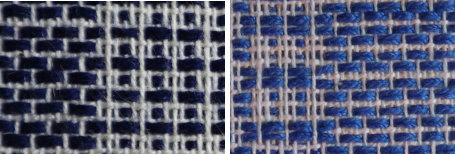
Left: treadled 1-2-1-2. Looks like alternating bricks.
Right: treadled 1-2-2-1. Looks like stacked bricks.

This is using the standard 2/2 balanced twill tie-up.

Numbers in right-hand column indicate shafts.
Numbers along the bottom indicate treadling.

Here are the samples.
 
Sample #11: 1-2-2-1 S&W treadling

Sample #12: 1-2-1-2 S&W treadling

Both samples use 10/2 doubled for their pattern wefts. By sample 12, I had figured out which shed to use for smoother looking transitions between the blocks. Consequently, I like the second one better. 

No matter what I'm weaving, my mind is always busy wondering. Some of my thoughts are creative curiosity (what if I changed this? or tried that?). Some of them contemplate practical applications (what project could I use this for?) For these samples, I'm thinking ahead to a (probably distant) future project, which is to weave drapery fabric for my dining room windows. What I want, is something to coordinate with my Blue Willow dishes. 

The Scandinavian Favorite table runner I wove last year.

Blue Willow has an intricate blue and white border pattern around the edges.


I've been looking for something that would compliment that, and I'm thinking crackle threading with summer and winter treadling could work very well. I'll add it to my list of possibilities.

Sunday, November 06, 2011

Hemming Dishtowels

I'm keeping my hat in the crafting ring by hemming the Summer & Winter dishtowels I wove in ....... 2007! I posted about them here, "Summer & Winter - 1st Dishtowels", and here "Summer & Winter - 2nd Dishtowels". They've been sitting in my trunk of handwovens all this time, just waiting for me to do something with them. Now that we're working on my kitchen remodel, I've discovered that they are a prefect match for my new kitchen colors!

New kitchen cabinet & handwoven dishtowels, yet to be hemmed

I wrote a post on this blog a long time ago, about machine hemming dishtowels (How Do You Hem Your Handwovens? along with a reader comment motivated follow-up, Hemming Handwoven Fabrics). These however, must be hand hemmed because my sewing machine has a broken bobbin case, and I haven't done any sewing lately to motivate me to replace it. Even so, I find handwork relaxing after a long day of gardening or working on the kitchen. :)

Hemming Dishtowels © 6 November 2011
by Leigh at Leigh's Fiber Journal

Sunday, March 07, 2010

"Catzee's Cloth" Made the Complex Weavers Journal

If you can get your hands on a copy of the February 2010 Complex Weavers Journal, turn to page 13. On the bottom half of the page, featured as one of the participants of the 2009 Tied Weaves Study Group, there I am. Or rather, there's the Summer-and-Winter fabric I wove...

Both sides of Catzee's Cloth...inspired by my tortoiseshell cat, Catzee. The write up includes a black and white photo of a sample and the draft.

You can see color photos and read more of the details of the project on my following posts:

Of course it's an honor to be "published," even if it's only as a contributing member of a study group. But this sample is special to me because of Catzee.

She disappeared at the end of last August. In spite of turning the world upside down to find her, we never did, nor have a clue as to what happened. I have grieved over her more than I ever have any other cat. I still have to catch myself, and not allow the sadness to overwhelm me again, by focusing on happier thoughts.

Anyway, I just wanted to share this with you. I learned a lot by participating in the study group, and plan to do another someday, whenever we finally get settled and establish a routine on the homestead. Even though this blog isn't very active, I still appreciate every one of you who visits, especially those of you who are regulars and visit my homestead blog too! Thank you!

"Catzee's Cloth" Made the Complex Weavers Journal photos and text are © 7 March 2010 by Leigh at Leigh's Fiber Journal.

Thursday, November 12, 2009

Shams And Rags

By Leigh

I finished my quilted pillow shams!

Machine quilted pillow shams from bedsheetsThey aren't perfect, but I think they look well enough with the comforter.

I've also been cutting rag strips for the matching rag rug.

Matching rag rug rags strips also from bedsheets.
If you recall, this is going to be a summer & winter polychrome rag rug. This means that I will use a S & W threading, but will throw two different colored pattern shots between tabby shots. The whole thing is straightforward enough that I don't need to make a full drawdown for it. The threading will be a 2-block (4-shaft) summer and winter.

Polychrome threading draftMy sett will be 16 epi, and I want the squares to be the same size as those in the shams, 4 inches. That means each square will have 64 ends. With a threading unit of 4 ends, each block will be 16 units. I haven't calculated the width yet, probably four feet, for which I would need about 12 blocks and 768 ends. Length needs to be about 6 feet, which will probably require miles of rags!

Treadling will alternate two colors per block, following the same sequence as my pillow shams:

Pattern shot - blue
Pattern shot - green
Tabby a
Pattern shot - blue
Pattern shot - green
Tabby b
Repeat for four inches

Pattern shot - green
Pattern shot - brown
Tabby a
Pattern shot - green
Pattern shot - brown
Tabby b
Repeat for four inches

Pattern shot - brown
Pattern shot - blue
Tabby a
Pattern shot - brown
Pattern shot - blue
Tabby b
Repeat for four inches

Repeat

Rag cutting is rather slow going, I admit, but I can't get to my loom anyway, until we get the dining room floor down (which is next on the indoor project list). I started out measuring the width of the rags, but quickly abandoned that in preference to the eyeball method. It's faster and it will be close enough!

To be continued ........ one of these days.


Related Posts:
A Little Quilting
Summer & Winter: Polychrome Rug 1
Summer & Winter: Polychrome Rug 2

Tuesday, July 21, 2009

Beaded Fringe Scarf

By Leigh

Ta-dah! I've actually finished something! My summer & winter beaded fringe scarf....

Finished S&W beaded fringe scarf
To relax after working hard all day, Dan and I have resumed a long time habit - he reads aloud while I do handwork. He just finished reading Little Britches by Ralph Moody to me, and I just finished my scarf.

I've already written quite a bit about this scarf. You can find the project details here, and details about the fringe, here.


Related Posts:
Differential Shrinkage Fail
Beaded Fringing

Friday, July 03, 2009

Beaded Fringing

By Leigh

I confess. I haven't done anything with those socks. The suggestions and tips you all gave me were extremely helpful, but the fact of the matter is that correcting them will require too much thinking. I'm simply too busy to do much thinking these days.

However, thanks to some very cool fringing instructions over at Lynette's blog, I have this to show......

You may or may not recall that this is the cotton and rayon, summer & winter scarf I wove in an unsuccessful attempt at differential shrinkage. I still liked it however, especially the reversibility.

This is the first time I've tried working with beads like this. The method is easy but I confess thought that it is slow going because I am twisting the fringe by hand. Someday I'll get a fringe twister, but probably not any time soon. Even so, it's a relaxing activity in the evenings, doesn't require too much energy or brain power, and I'm liking the results. I don't usually wear scarves, but this one I think I actually will.

Posted 3 July 2009 at http://leighsfiberjournal.blogspot.com

Related Posts:
At Last, Actual Fiber Content :)
One Thing Leads To Another
Differential Shrinkage Fail
Slo-Mo Fringe Twisting

Thursday, April 30, 2009

Differential Shrinkage Fail

By Leigh

Remember Catzee's Cloth? (If not, click here.)

Remember how surprised I was when I wet finished the fabric and the yarns shrank at different rates, so that the fabric sort of bubbled? (If not, click here.)

Remember how I didn't like it but decided to try and do it on purpose for another project? (If not, click here.)

Remember how I researched rayon and cotton yarns and read that they don't shrink at the same rate and so thought they would be a good choice for an experiment in differential shrinkage? (If not, click here which, BTW, is the same post as the above.)

Well, I did it and the results are in.

Before wet finishing .....

After wet finishing .....

Both yarns shrank the same! My experiment was a flop.

Project Particulars:
  • Weave structure - summer & winter
  • Treadling - "O's" (see Summer & Winter: Treadling)
  • Yarns -
    • Warp & tabby weft - 10/2 unmercerized cotton
    • Pattern weft - 8/2 rayon
  • Sett - 16 epi
  • Picks Per Inch - 16 tabby & 16 pattern
  • # ends - 244
  • Reed - 8 dents per inch
  • Sley - 2 per dent
  • Wet finishing - cold water wash and hot machine dry
  • Measurements before washing - 53 x 8.75 inches
  • Measurements after washing - 48 x 7.75 inches
So much for that experiment.

At the moment this is just a scarf sized sample. Even though it's a little heavy for a summer scarf, I may go ahead and twist the fringes to finish it off. Might as well make the best of it. :) [UPDATE 3 July 2009 - Click here to see what I did.]


Related Posts:
An Unexpected Wrinkle
One Thing Leads to Another
Beaded Fringing

Tuesday, April 07, 2009

One Thing Leads To Another

By Leigh

My samples for the Complex Weavers Tied Weaves Study Group Sample Exchange are ready to go.

Each one is attached to a weaving record sheet which includes the draft on the back, plus a write-up of how I developed the idea. Because my barcode name draft was too large to print out, I included only part of that, but added a complete profile draft. I called my draft "Tortie Trails," in honor of its source of inspiration.

Initially, I planned to move on to something else entirely after I mailed the samples. However, this image .....

How it shrunk after washing & drying..... got me thinking along other lines. I didn't intend for the sample to shrink like that, but the unexpected result made me wonder if I could do it on purpose.

This sample is a 10/2 unmercerized cotton for warp and tabby weft, and an 8/2 rayon for pattern weft. I read that rayon tends to shrink more than cotton, so hopefully this will give me a similar effect to Catzee's cloth. This one is more in the proportions of a scarf, so if it works, I can wear it!

As with many of my sources of inspiration, one idea leads to another. The result of this is that my weaving experience seems more like a journey than a classroom experience. But it's hard not to follow the evolution of ideas. In fact, I doubt I could do it any other way.

Posted 7 April 2009 at http://leighsfiberjournal.blogspot.com

Related Posts:
An Unexpected Wrinkle
Poll Results & Test Press

Sunday, March 29, 2009

Poll Results & Test Press

By Leigh

As of this afternoon, here are the results for the Catzee's Cloth poll:

  • I love it! Leave it as is - 43 votes (57%)
  • Yuk! Iron it quick! - 33 votes (43%)
I've always assumed that beauty is in the eye of the beholder, but most of us will agree that an unexpected outcome can throw any of us for a loop. Because of this, I was also interested in your comments on this.

One consideration is planned usage. Though it looks like a scarf, I wove it for cutting up into exchange samples. Consequently all the weft ends are hanging out of the selvedges rather than being woven in (I changed weft color with every treadling block.) I need a total of twenty samples for the exchange, but it won't take all of it. While I was weaving away, I thought about using leftovers for a vest.

I like this pattern.....

A possible use for Catzee's ClothMaybe version B with a black velvet collar?

With that end in mind, I decided to go ahead and press a section of the bumpy cloth to see what could be done with it. Here's how that turned out .....

Close-up after wet finishing & pressing
It smoothed out nicely. Bettina did make a good point in the comments however, that it will likely want to bubble up again after washing. I don't figure that samples will be washed, and my vests are more likely to get dry cleaned, so that may not be a problem.

Lynette brought up another good point, that of visual competition between the shrinkage texture and the color pattern. For this sample, the focal point is the tabby-like stripes against a tortoiseshell-like background. (See Inspired By Catzee.) The bubbles and dimples from the differential shrinkage should probably be a design feature on its own.

So I've come up with a plan. I'm going to press out Catzee's Cloth, and then experiment with differential shrinkage on a scarf. I will still weave it in summer and winter, just in simpler colors.

The interesting thing about all this is that I never expected to take this direction in my weaving. But thanks to this happy accident and all your encouraging comments, it's a step I'm going to take nonetheless.


Related Posts:
Inspired By Catzee
An Unexpected Wrinkle
One Thing Leads To Another

Thursday, March 26, 2009

An Unexpected Wrinkle

By Leigh

My Catzee inspired fabric is off the loom.

Both sides of Catzee's ClothI think it looks pretty neat and am happy with it. I'm going to call it "Tortie Trails."

However, after machine washing and drying, it did this.....

How it shrunk after washing & drying.This is the result of mixing the type and fiber content of my yarns. I used both mercerized and unmercerized cottons, and rayon. As a design element, this is referred to as "differential shrinkage," where the different yarns shrink at different rates as a result of wet finishing.

My problem is that differential shrinkage is not really my "thing." I find traditional methods and effects personally more appealing.

What to do. What to do. This is supposed to be for my Complex Weavers Tied Weaves study group. So tell me ....


view results
Free vote poll

I've not tried a poll like this before so I'm not sure how this will work. I am interested in your opinion, so this may be a fun way to see what you all think.

[For poll results and what I decided to do, click here.]

Posted 26 March 2009 at http://leighsfiberjournal.blogspot.com

Related Posts:
Poll Results & Test Press
Inspired By Catzee
Catzee's Cloth
One Thing Leads To Another
"Catzee's Cloth" Made the Complex Weavers Journal

Friday, March 13, 2009

Catzee's Cloth

By Leigh

OK. I admit it. This is a rush job of a post, but if I don't do one now it will be days before I can get to it!

I just wanted to share that my Catzee barcode weaving is underway.

8-shaft S&W sampleIt is a 6-block summer & winter draft and overall I am happy with it. As inspired by my tortie Catzee, it has a somewhat tortoiseshell plaid look with random tabby-like stripes. Here's a close up ......

Close-up shot showing the color variations in the cloth.I used half of the draft for the threading, and the other half for the treadling. I have three colors in the warp, which rotate through the threading blocks. I am using the same three for the tabby weft, changing colors with each block. The lightest color is a slightly slubby rayon and I'm not sure if I like the effect, but oh well. What I do like is the subtle color blending that can be achieved by changing tabby colors. The black pattern weft is only slightly different in size (a 7/2 as opposed to the rest being 8/2s).

Now, off I go! I hope you all have a wonderful weekend.

Posted 13 March 2009 at http://leighsfiberjournal.blogspot.com

Related Posts:
Inspired By Catzee
An Unexpected Wrinkle
"Catzee's Cloth" Made the Complex Weavers Journal

Thursday, March 05, 2009

Inspired By Catzee

By Leigh

Way back when I first started playing with barcodes as stripe patterns, my first barcode was "Catzee", the name of one of my cats.

Catzee's very own barcode.At first it was simply a word for an experimental barcode. But when I considered her lovely tortoiseshell coloring .....

Little Cat Zee...... the wheels started to turn.

Considering my recent self-revelation about designing and weaving summer & winter, I decided to use that barcode for my next S&W project. I also considered that even though the draft I had in mind (similar to my Fibonacci S&W) was easy to do out of my head, this would be a good way to begin learning DB-Weave weaving software.

Using the entire barcode resulted in a pretty wide draft, of which the screenshot below shows only shows part. You can click on the drafts to enlarge them (they're pretty big).

Catzee barcode in an 8-shaft S&W draft.With the Fibonacci drafts, I only had four shafts to work with (and no weaving software). Now I have eight, so the patterns can be much more complex. Interestingly, the draft hints at Catzee's vague ginger tabby stripes.

Adding color to the draft made it much more interesting.....

Experimenting with Catzee-like colorsOf course, I don't have these colors to work with, but it gave me the gist of what it might look like.

These are my actual yarn choices .....

A variety of 8-2 mercerized cotton & rayon yarnsThey are the closest Catzee-like colors I could find in my stash. The golds and cream will be the warp and tabby weft. The black will be the pattern weft. I would love to be able to use the black chenille for this, but will sample first. The second black cone of cotton is on stand-by.

And of course, since this piece is inspired by Catzee, she reserves full rights to snoopervise the entire project.

Catzee loves helping with "string".
Posted 5 March 2009 at http://leighsfiberjournal.blogspot.com

Related Posts:
"Catzee's Cloth" Made the Complex Weavers Journal
Catzee's Cloth - progress
An Unexpected Wrinkle - what happened after washing
More Weaving Software That Can Run on Linux
Stripes! - creating with barcodes
Summer & Winter: A Basic Definition

Thursday, February 12, 2009

Loom Doodling With The Pine Trees

Before I removed the warp from my Pine Tree Table Runner, I wanted to weave a few mug rug size samples of an idea I've had on my mind.

Do you remember my first warp painted project? I took a break from my summer & winter explorations for that, and the entire time I was weaving I was wondering about combining the two. These little samples did that.

4 S&W mug rugs with variegated warp.The fun part was making up the treadling as I went along. In fact, I wish I had put on a little longer sample warp. That warp BTW....

The yarns I used.....wasn't actually painted. It was dip-dyed last summer when I was first working with Procion MX dyes. They were part of my experiments with PMX exhaust, and they suited these samples. I used a solid turquoise tabby weft for the first three, and then switched to the dip-dyed yarn for a tabby weft for the last one (bottom left).

I learned several things from these.

Firstly I was reminded how different S&W can look with a heavier, softer pattern weft. I have tended to use pattern wefts just a little heavier than the tabby. This one was a soft, 3/2 cotton which covered the warp (8/2 cotton at 16 epi.). This brought definition to the pine trees. Good to remember for weaving picture patterns like this.

Secondly, I learned that as much fun as it was to weave those pine trees, shapes are not what I enjoy about S&W. These can be accomplished in other ways; in fact I've moved double weave closer to the top of my "to-do" list.

What I have loved about S&W is what a weaver can do with color. Remember these (click here) dishtowels? They held hours of fascination for me. Not because they are geometric shapes (modern is not my style of art), but because of the blending of the colors.

So. I set out to explore one thing and learned something else. I love it when things like that happen and now I'm all the more ready to get started on my next project. What will it be? Stay tuned ..........


Related Posts:
Back to the Pine Trees
Summer & Winter Pine Tree Table Runner

Tuesday, February 03, 2009

Summer & Winter Pine Tree Table Runner

By Leigh

Here it is, off the loom, wet finished, and ready to use. The pine trees ..........

Summer & Winter Pine Tree motifAnd the snowflakes / birds nests ..............

Summer & Winter mystery motifThe project particulars:

  • Draft: adapted from Carol Strickler's A Weaver's Book of 8-Shaft Patterns (#549 page 155)
  • Warp: 8/2 unmercerized cotton in navy blue
  • Weft:
    • tabby: 8/2 unmercerized cotton in navy blue (different cone)
    • pattern: 5/2 mercerized cotton in light green
  • Sett: 16 epi
  • PPI - 18 pattern ppi and 18 tabby ppi
  • Total warp ends: 220
  • Width on loom - 13.75 inches
  • Width off loom - 12 inches
  • Width after washing - 11 inches
  • Length on loom - 2.5 yards (total warp length, tied on)
  • Length off loom - 72.5 inches
  • Length after washing - 63.5 inches
  • Wet finishing - cold water wash and hot dry
Because of the finished length I really couldn't get a good photo of the entire thing. Plus it's a little too long for either my dining table or my hutch.

What I learned:

1. That it would be easier to see mistakes if I had woven with the "winter" (dark) side up. After it was off the loom, I discovered a treadling error, which wasn't nearly as noticeable on the side I looked at as I wove (summer, light side.) I don't quite understand the structure well enough to correct this with needlework, so there it remains. You can see it in the bottom photo if you look closely.

2. That to weave the profile draft in the book, I had to weave each block with four pattern shots (plus their tabby shots.) To put it another way, I had to weave each profile block with two units of the designated threading. If I wove with only one unit per block, the result was very squatty looking pine trees. I got a glimpse of this when I doodled with the draft on DB-Weave, but what was actually happening didn't sink in until I started weaving.

3. About that skeleton tie-up. I've tried it two ways on my 8 shaft countermarche Glimakra.
This way ............

revised CM  skeleton tie-up........... which puts tabby treadles on the extreme left (1 & 2) and the tie-up treadles (3 & 4) next to them. Also this ...............

Countermarche skeleton tie-up.......... which puts tie-down treadles on the left and tabby shafts on the right. I changed because I was having trouble keeping track of the treadling order the first way. However, I had the same problem with the second tie-up as well! What I've learned is that I have to find a better way of keeping track of which tie-up treadle is next, without losing the pattern treadle. I don't have it all figured out yet, but I'm learning from my experience in spite of myself.


Related Posts:
Back to the Pine Trees
Snowball, Star, or Snowflake?

Thursday, January 22, 2009

More On Motifs

By Leigh

When I wrote my last post, "Snowball, Star, or Snowflake?," I was tossing around terms to describe the picture I was seeing in the motif I am weaving; something like a Rorschach ink blot test. But in the comments, Patrick and Jane are correct. "Star" and "rose" are specific weaving terms referring to treadling patterns, commonly found in overshot.

Both stars and roses are block designs and in fact, they are threaded the same. The difference is in the treadling.

I've not woven much overshot so I don't have any photos to show you, but I can graph examples ...

Star

Rose

Bother are threaded the same: A-B-A-B-A. The star is treadled as-drawn-in (i.e. in the same order as the threading): A-B-A-B-A. To convert it to a rose, the treadling is inverted: B-A-B-A-B.

In doing a little more reading about this, I learned that "star fashion" means to treadle as-drawn-in. "Rose fashion," on the other hand, means that the blocks are exchanged in the treadling order, B instead of A and A instead of B.

Now. Back to my own summer & winter table runner with the motif in question (which is technically neither one of the above). Jane, who has a beautiful antique coverlet with the same motif, did some research and found one resource which labeled it "birds nest." You can see a photo of it in this article.

What is interesting is that in all three examples: Jane's, mine, and the one in the article, the birds nest motifs are identical, but the pine trees are different. That's what makes designs like these so exciting. A lot can be done with treadling alone.

However, the question of the hour remains the same. Does this...

Leigh's S&W table runner on the loom..... look like a bird's nest? I have to admit that I'm still leaning toward that snowflake, but I'll let you decide for yourself. ;)

Bibliography:
  • The Weaving Book: Patterns and Ideas, Helene Bress, Charles Scriber's Sons, New York, 1981
  • The Complete Book of Drafting for Handweavers, Madelyn v.d. Hoogt, Unicorn Books and Crafts, Inc., Petaluma, CA, 1993
Posted 22 Jan. 2009 at http://leighsfiberjournal.blogspot.com

Related Posts:
Snowball, Star, or Snowflake?
Summer & Winter Pine Tree Table Runner

Monday, January 19, 2009

Snowball, Star, or Snowflake?

By Leigh

This is the next section of the same draft as the pine trees.

Leigh's S&W table runner on the loomIt is the sort of motif that seems to be common with the pine tree draft. My question is,what is it? Different drafts of the same sort sometimes call them "snowballs" also "roses." I'm not sure what this one looks like. Certainly not a snowball, and doubtful it looks like a rose. Maybe more of a star or a snowflake (my terms), but not quite.

At any rate, they use the same threading draft as the pine trees; they are simply treadled differently. I like the way this version looks (from Carol Strickler's A Weaver's Book of 8-Shaft Patterns, #549 page 155), and if you're glancing at it from your galloping horse, you won't notice the treadling error. Nor the inconsistent beat.

My plan for this table runner is to weave three of these in between pine tree borders.

Posted 19 Jan. 2009 at http://leighsfiberjournal.blogspot.com

Related Posts:
Back to the Pine Trees
More On Motifs
Summer & Winter Pine Tree Table Runner

Saturday, January 10, 2009

Back to the Pine Trees

By Leigh

"Back to the pine trees" literally or figuratively? In terms of weaving, a little of both, I think. I have been very busy with family activities and guild business (is anyone else's guild faced with budget problems this year???) Consequently I have really missed weaving. Every day I've looked at my warping board with it's partially measured warp and thought, "tomorrow I'll finish that." Well, you know the saying, "tomorrow never comes," so I finally had to say, "today I'll finish that"!

Here's my modest progress so far

S&W pine tree draft in navy & light green.This is going to be a table runner in a summer & winter pine tree draft adapted from Carol Strickler's A Weaver's Book of 8-Shaft Patterns (#549 page 155). It the same pattern as Jane's antique coverlet.

This is not a brand new project for me, rather it is a second try of this (click here) project, which I ended up cutting off the loom unfinished. I had too many warp ends break the first time. This time I've tied-on a stronger 8/2 cotton, one that I've used before as warp so I know it won't break. The old, weaker navy warp has turned out to be fine for weft. The two navies are slightly different, but together give more color depth to the final cloth.

Even though my first go-round with this pattern was a warp disaster, it still serves a useful function as a sample for my project book. And so far there's been no warp end breakage and I'm really happy about that!

I've missed weaving.

Posted 10 Jan. 2009 at http://leighsfiberjournal.blogspot.com

Related Posts:
Abandoned Warp - the predecessor to this project
Snowball, Star, or Snowflake? - the next motif in this project
Summer & Winter Pine Tree Table Runner
Tying On A New Warp

Tuesday, December 16, 2008

Abandoned Warp

By Leigh

What could have been a good project, if it wasn't for the warp.I have abandoned this project. In less than six inches of weaving I've already had five warp ends break. That's going on one repair per inch! With an intended project length of about 48 inches (times two), that is not acceptable.

This was to be a Pine Tree Table Runner in summer & winter. I adapted the draft from Carol Strickler's A Weaver's Book of 8-Shaft Patterns (#549 page 155).

I bought the warp as a mill end, about 7 or 8 years ago at Holly Bee in Valdese, North Carolina (back in the days when they had a shop and sold weaving yarns). It's an 8/2 unmercerized cotton, and I think I paid only a dollar or two for it. It would be okay weft, but it is too weak to be warp. And there's only so much frustration a body can endure.

Posted 16 Dec. 2008 at http://leighsfiberjournal.blogspot.com

Related Posts:
Summer & Winter: A Basic Definition
Summer & Winter: Structure & Theory

Wednesday, November 12, 2008

S&W Samples 2: Tabby Treadling Order

By Leigh

This has been an interesting experiment. The focus of summer & winter is usually on the four classic patterns which can be treadled (1-2-1-2, 1-2-2-1, 2-1-1-2, and 1-1-1-1). For this next set of samples however, I experimented with how each of these looked depending on which tabby treadle I started with. Let me show you what happened.

The first sample is the 1-2-1-2 pattern treadling order.

It didn't matter which which tabby treadle I started with, there was no noticeable difference in either the pattern or ground cloth. The result looked the same.

With the paired treadlings (1-2-2-1 and 2-1-1-2), there was a difference, depending on which tabby I started with. You can see it in the ground cloth.

This next sample was the effect of leading with the "a" tabby (shafts 1 & 2)......

If I started with the "b" tabby (remaining shafts), this is what it looks like.....

The effect is more striking if we step back a bit ...

Notice the ground cloth. I got a pink (tabby thread) diamond effect by starting with tabby a (top sample). I got a brown (pattern thread) diamond by starting with tabby b (bottom sample).

In her Summer & Winter: A Weave for All Seasons, Donna Sullivan explains why this happens.

The difference occurs because each tie is used twice in sequence. If the 1-2 tabby falls between the two members of a single pair, the pattern wefts in those sheds will "cuddle" together. If the 3-4 tabby occurs in this position, the pattern wefts will be pushed slightly farther apart, and slightly closer to the nearest weft floats in the adjoining pairs.1

You can see that happening in the close-up photos above. The effect, though subtle, is something I'll keep in mind.

The effect of tabby order with the last treadling, 1-1-1-1, was the same as with the 1-2-1-2 order I showed you first, i.e. no difference.....

However, when I tried the same exercise with the other pattern shed, 2-2-2-2, I discovered that it was the pattern itself which was effected. Notice the columns in the photo above: four fat, nicely defined, straight pattern columns are treadled, along with narrower, less well defined columns in the ground cloth.

Compare those with the columns in this 2-2-2-2 pattern treadling below....

Notice there are five pattern columns, with some variation in width. I don't know if you can see in the above photo, but the two outermost columns are formed with 2-thread weft floats, as opposed to the 3-thread floats which form the three center columns (the same as in the 1-1-1-1 sample) . It is the edges of the pattern blocks which are effected. This is why the 1-1-1-1 treadling is usually preferred, and is significant enough to keep in mind while designing.

I have to say that this was an informative exercise, which also shows one of the benefits of sampling. I plan to add these samples to my S&W notebook.

Posted 12 Nov. 2008 at http://leighsfiberjournal.blogspot.com

1 Summer & Winter: A Weave for All Seasons, Donna Sullivan, (Interweave Press, Loveland, CO, 1991) p. 16

Related Posts:
Summer & Winter: A Basic Definition
Summer & Winter: Treadling
S&W Samples 1: Traditional Treadlings