Showing posts with label huck. Show all posts

Sunday, March 04, 2007

Huck Dish Towels Finished

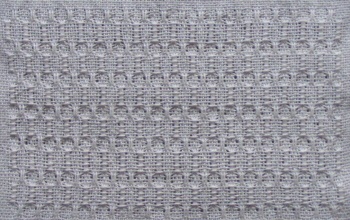
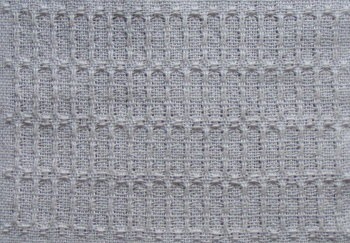
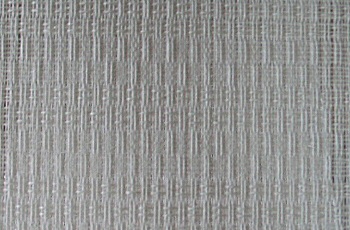
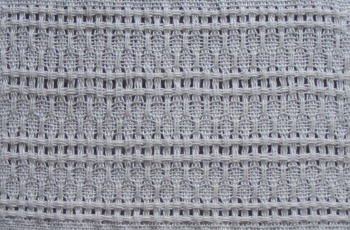
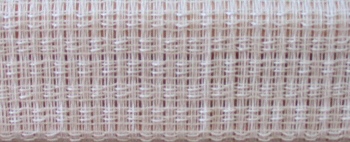
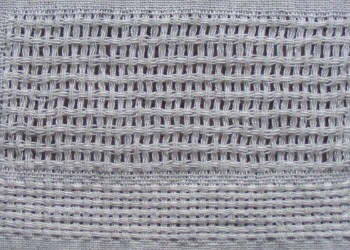
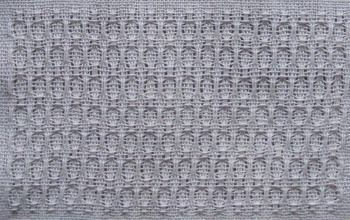
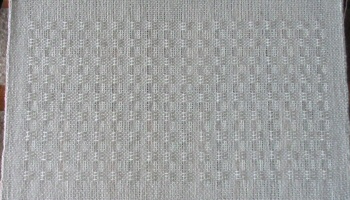
I've spent this afternoon finishing up my second set of huck weave dish towels. (Kathy, these are all from The Best of Weaver's Huck Lace, so I think you'll be pleased with the book :) If you mouse-over the photos, you'll find out which weaves I used from the book.)

Lacy huck border, page 6, treadling E.
Huck boxes with 2 color weft, page 7, treadling F.All of your comments on measuring weaving length were much appreciated. Quite a few of you use cash register tape, which seems a very nifty trick. This time though, I decided to use Charleen's method of knotted string, though I did adapt it a bit.

Experimenting with a knotted measuring string.I secured one end of the string with a t-pin, and passed it under a few warp ends every time I advanced the warp. When I got to my knot, I threw a few shots of plain weave and started all over again. Happily, the lengths of my towels are quite consistent. A happy improvement from the first set.

Lattice huck, page 8, treadling J.What wasn't consistent, was the shrinkage after washing and drying them. The yellow weft did not seem to shrink as much as the green warp. It is most noticable in the detail below, which looks a bit sloppy.

More huck boxes, yellow (non-shrinking) weft only, pg. 7, treadling F.Of course, this means that the weft wasn't cotton, as I'd thought! I admit that I have a lot of mill ends and odd cones, some of which aren't labeled. Even so I thought I knew the fiber content of most of what I have. Obviously I don't. My guess is that the yellow is rayon. I've not heard of anyone using rayon for dishtowels before, so I'm not sure how well it will work with the cotton. Any guesses????? I'll have to let you know!!!

Ah well. Live and learn.

© 2007 Leigh's Fiber Journal

Friday, March 02, 2007

Finishing Up the Huck (For Now)

My goal for this weekend is to weave off the huck dish towel warp which is on my loom. The Online Guild is doing a Summer and Winter Weaving Workshop this month, and I want to participate in it. So it is with some reluctance, that I leave my huck and lace weaving experiments aside for the moment.

One of the huck dish towels on Leigh's loom.All these photos are of work still on the loom, so I have yet to discover how they look after finishing. The fabric washing is one of the delights of weaving huck; it transforms it!

Another treadling.I'm weaving from The Best of Weaver's Huck Lace. I used a dark green warp and golden yellow weft in the above two. In the one below, I used both yellow and green weft shots to see how the 'boxes' would look in one color.

I had actually intended to get a lot more weaving done this month, but February turned out to be a 'catch-up' month, and I've spent a lot of time at the computer.

One thing which needed to be done was an update to the Online Guild's public website. This is finished and will be uploaded soon.

The other thing was organizing a Study Group as a continuation of the Computer Design Workshop. We finally decided to do this with a private group blog, which was something new for me. It's proving to be an excellent format for this group however.

So, off I go to my loom. Even though my intentions are good, I think I work better with externally imposed goals. What would I do without them.

© 2007 Leigh's Fiber Journal

Saturday, February 24, 2007

Another Warp for Huck

After losing my last warp, I decided to make the best of it and make a few changes with a new warp. My first set of huck dish towels proved to be smaller than I'd planned after shrinkage, so I increased the warp ends to 400.

Also, since I am still fine tuning my back to front warping, I decided to secure the lease sticks to the raddle, to keep them in place while weaving.

Lease sticks in place behind the harness.
I don't know yet whether or not this is a good idea. I've tried weaving without the lease sticks, which can be a nuisance if I break a thread, or want to tie onto that particular warp. I've also used some narrow dowel rods in place of the lease sticks while I wove, these being free floating so to speak, so that they worked their way toward the castle as I beat the weft shots in. I would have to push them back every time I advanced the warp. I usually don't leave the raddle in, but this seemed to be the best way to secure the lease sticks. Time will tell.

I also discovered a threading error as I was weaving my header.

A double threading error.It doesn't seem to matter how carefully I check the warp as I thread, I often end up with a threading mistake anyway. In the past I'd have untied the whole thing in order to correct the mistake, then having to re-tied and re-tension. This time I didn't feel like doing that.

Clipping the wayward threads as close to the knot as possible.So I isolated the erroneously threaded ends and cut them.

Weaving each end back in.Needle wove them back through the header in the proper spot......

Wrapping the ends around a t-pin to secure them....... and secured them with a t-pin. This has worked very well! After I wove the first few inches, I removed the t-pin and the ends were secure.

Of course, I'm sure I'm not the first weaver to do this. In problem solving there are usually only so many reasonable solutions. As long as I can find at least one of them I'm happy.

© 2007 Leigh's Fiber Journal

Sunday, January 21, 2007

Huck Towels 3

By Leigh

My huck dishtowels are off the loom, washed, and hemmed. They were woven from cotton 8/2; white warp and blue weft. The drafts were huck variations from Helene Bress's The Weaving Book. The washed fabric is nice and sturdy.


Unfortunately, except for the first two photos in this post, the colors are not true in the rest of the pictures. I found that the flash washed them out, but with dark rainy skies today, the natural light was poor.

In evaluating them, there are two things which I will do differently with the next batch: selvedge treatment and size.

With these towels, I didn't use a floating selvedge warp end. I'm not really sure why, except for some vague sense of wondering "what if." For the warp huck sample it didn't matter as the selvedges were threaded for plain weave. But as you can see for the sample at the left, the selvedges did their own thing. Even so, it made for an interesting bound edge with a scalloped effect. How well they hold up will be a matter for wash and wear to tell.

For the size, I allowed 20 percent for draw-in and shrinkage, aiming for a finished width of 15 inches. The actual width is 14 inches. This dismayed me at first, because no commercial dishtowel in the stores are this narrow. However, when I measured my own dishtowels, they are in fact narrower than 14 inches. Obviously the ones in the stores are not pre-shrunk.

When it came to length, I totally blew it and ended up with anything from 17.5 to 22 inches after shrinking. My current method is to measure each time I advance the warp and mark the spot, simply keeping a tally of inches. How in the world I go so many different lengths is beyond me. I blame it on too many distractions! However, next time I'm going to try Charleen's idea of using a knotted string.

So, my solution was to simply pronounce the shorter ones "placemats"! It is a mix and match bunch of place mats to be sure, but the sizes work.


Huck has been a good structure to weave with other things going on. It's easy to thread and quick to weave. And I like the way it looks too.


Related Posts:
Lace Sampler - Huck
Huck Towels 1
Huck Towels 2
Another Warp for Huck
Finishing Up the Huck (For Now)
Huck Dishtowels Finished
Leigh's Fiber Gallery: Dishtowels

Monday, January 15, 2007

Huck Towels 2

By Leigh

With the workshop in full swing, I am spending more time at the computer than at the loom these days. That doesn't mean that progress isn't being made however.

Huck towel on the loom.  8/2 cotton, white warp & royal blue weft. So far I've woven 5 and 1/2 huck dish towels, each in a different variation of huck, and I'm enjoying every relaxing minute of it. All the drafts were taken from Helene Bress's The Weaving Book.

After my rough start, I had hoped the weaving would move along quickly. And it has for the most part, though I haven't been without problems.......

Unintentional weft loops at the selvedges!I couldn't live with these uninvited weft loops, so I unwove those several inches and tried again.

One thing I'm puzzling over is my selvedges. Not because the are especially unsightly, but because my originial idea of plain weave edges has gone by the wayside as I've experimented with different variations of huck. I reckon this is a limitation of having only 4 shafts to works with. I did not use floating selvedges and the result is that they are being bound by the weft. See what I mean.......

One huck variation.
Another huck variation.
I'm not sure how much of a problem this will end up being with dish towels. At the moment I've taken on a "wait and see" attitude. It will be in the using and the washing that I'll see how well they ultimately stand up.

In the mean time, I've happily weaving away as I have the time, and am looking forward to seeing how these look after they are washed.


Related Posts:
Lace Sampler - Huck
Huck Towels 1
Huck Towels 3
Another Warp for Huck
Finishing Up the Huck (For Now)
Huck Dishtowels Finished
:)

Friday, January 05, 2007

Huck Towels 1

By Leigh

After several days of feeling exceptionally unproductive, it feels so good to be weaving again.

After enjoying the Online Guild's Lace Weaves Workshop so much, I decided to start again at the beginning and spend some time on each lace structure, exploring to my hearts content. In addition to my workshop notes, I acquired 3 new books: Lace and Lacey Weaves by Mary E. Snyder, The Best of Weaver's Huck Lace, edited by Madelyn van der Hoogt, and The Key to Weaving by Mary E. Black. Plus I have Helene Bress's The Weaving Book, which has an entire chapter on huck, and this is where I wanted to start.

Today I was finally able to start weaving my first huck towel, and at the moment this is where it stands:

I put on 5 yards of white 8/2 cotton for the warp and am using the same weight in royal blue weft for the weft. My sett is 20 ends per inch.

The threading is simple and should have been no problem:

4 4 4 4 4 4
3 3 3 3
2 2 2 2 2 2
1 1 1 1 1 1 1 1 1

Etc., with plain weave selvedges.

However, I kept losing and misplacing warp ends, don't ask me how! First, I discovered two of them hanging loosely off the warp beam while I was in the middle of sleying. Fortunately I didn't have to rethread the whole thing, I just worked from where the mistakes were to the edges.
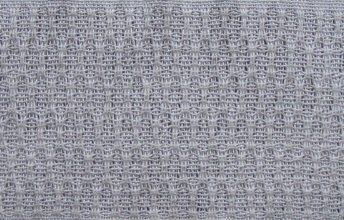
Then after I finally got the warp sleyed, I discovered that I had an odd number of ends. I should have had 360, but I counted and recounted only 359. I never did figure out where that missing one got too, it's probably wrapped around the warp beam somewhere. Since I never could find it, I measured off another 5+ yard thread, weighted it with a film canister filled with fishing weights, and tied it on.

Feeling confident that everything was under control, I knotted my warp bundles and started lashing them onto the front apron rod. I tensioned it and was ready to weave the header when I realized that one lone warp end wasn't behaving like the rest. It was popping up off the nice neat plane the rest of the warp made. A quick investigation revealed that somehow this one had missed the heddle altogether. OK. I figured I only had to untie up to that spot and shift everything over by one heddle. Fortunately that didn't take too long.

Now fast forward to where I gotten to before and start weaving the header. Drat, now I discover that 2 warp ends are crossed at the heddles. Hmm. What's the easiest way out of this one. I wasn't in the mood to unlash and untie anything again, so I cut them, pulled them out, uncrossed them, rethreaded, resleyed, and fastened them down with a T-pin.

All this has taken place over several days, as I always have to stop and study any given problem. I am slow to think it through.

One of the reasons I wanted to start with huck is because it is so relaxing to weave. The threading is quick and the weaving rhythm develops easily. I figured with the Computer Design Workshop in full swing, this would offer a creative, productive distraction which wouldn't require intense concentration. Well, hopefully that's where I am now. Relaxed. Creative. Productive. Time will tell.


Related Posts:
Lace Sampler - Huck
Huck Towels 2
Huck Towels 3
Another Warp for Huck
Finishing Up the Huck (For Now)
Huck Dishtowels Finished

Wednesday, November 22, 2006

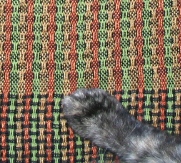
Colored Huck Lace

Little Catzee paw on huck.By Leigh

One thing about me and weaving, is that I can't not think about color. As much as I loved weaving the white huck and huck lace samples, my mind was constantly rehearsing "what ifs" with color.

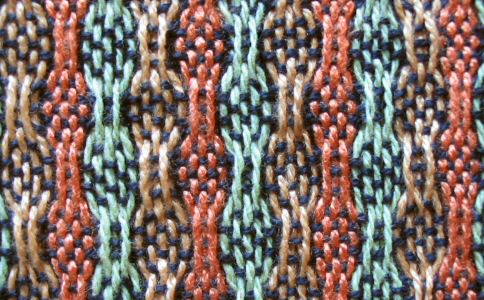
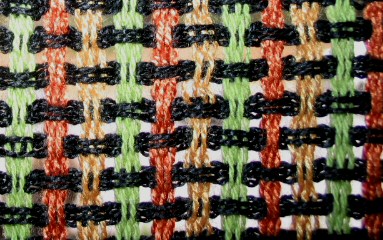
So before moving on to the Spot Bronson and Bronson Lace portions of the workshop, I tied on some colored cotton and experimented a little. These are all in 8/2s cotton, sett at 20 epi. The warp alternates stripes of orange, green, and gold. The weft is black.

Huck warp spots:

Huck warp spots in color.Close-up:

Close-up of the huck warp spots.And I was just as intrigued with the back.......

The back of the huck sample, looking nice too........ as the curves are even more pronounced.

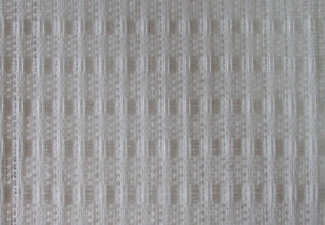
In order to show off the lacy holes, the huck lace was a bit more difficult to photograph, particularly a close-up.

Stepped back:

Colored huck lace sampleFirst close-up:

Huck lace close-up, looking like a solid fabric.Against a solid background, it looks more like solid cloth, but against the window, which allows in the light, I needed to use the flash, which washed out the color:

2nd huck lace close-up, taken against a window.Well, I'll have to add photography to the list of things I plan to study some day. [And I did! Follow this link to take a peek at Leigh's Photography Journal.]

With our American Thanksgiving tomorrow, a house full of company, and a family birthday this weekend, I won't be online much. But I've finished knitting the back to my Rare Breed Sweater and hope to show you that on Monday. See you then!


Related Posts:
Lace Sampler - Huck
Lace Sampler - Huck Lace 1
Lace Sampler - Huck Lace 2

Monday, November 20, 2006

Lace Sampler – Huck Lace 2

By Leigh

These are the rest of the photos from my huck lace sampler. All are woven in 12/2 cotton, sett at 24 epi.

On the loom:
After washing:


On the loom:
After washing:

This last one was a bit of a challenge for me. One of the lessons in the workshop involved an introduction to designing huck lace. The assignment included figuring out the treadle tie-up for a couple of drafts. Having never learned how to do this, I was stumped! After quick plea for help to the Guild's message board, I was able to work it out and was rewarded with a very nice design. Here it is on the loom:

And after washing.


As intrigued as I am with this weave structure, I can't stop my mind from wondering "what if...." about color. So my plan is to take a brief detour before moving onto the next lace structure, and try a couple of color ideas with huck and huck lace.


Related Posts:
Lace Sampler - Beaming The Warp
Lace Sampler - Huck Lace 1
Colored Huck Lace

Saturday, November 18, 2006

Lace Sampler – Huck Lace 1

By Leigh

My first lace sampler is off the loom.

As fascinating as it was to watch the patterns appear before my eyes, little did I know the transformation that was in store for me. And all because of ....... washing.

When I first started weaving I was terrified to toss my handwovens into the washing machine. But I gradually got braver, and with much relief discovered that depending on the fiber content of the yarn, things actually hold up quite well.

All these samples are woven in cotton, which responds to machine agitation, and wow what a difference it makes with huck lace.

After weaving sections of huck warp and weft spots, I wove a section of huck lace. Actually I wove two sections, as I was worried that I beat the first section in too hard.

On the loom:
Huck lace on the loom.
After washing:
Huck lace after washing.After washing, I was surprised that my first section (bottom) looks the best. I beat that one as for a balanced plain weave and it definitely turned out better. The one on the top wasn't beaten in as hard, and the integrity of the lace looks compromised and sloppy. Chalk one up for sampling first!

Here are more before and afters.

On the loom:
On the loom.
After washing:
After washing

On the loom:
On the loom.
After washing:
After washing
For the rest of my huck lace photos, click here.


Related Posts:
Lace Sampler - Beaming The Warp
Lace Sampler - Huck Lace 2
Colored Huck Lace

Thursday, November 09, 2006

Lace Sampler – Huck

By Leigh

Yesterday I was able to start weaving on my sampler. The workshop is going to explore five weave structures. Besides huck, we will learn huck lace, spot Bronson, Bronson lace, and Swedish lace. The five yard warp I have on the loom will give me an opportunity to learn and explore these. It will require some cutting and rethreading, but that will be better than dealing with separate warps for these!

First on the list is huck. Huck is not technically a lace weave, but it will lead into huck lace, so it's a logical place to start. Also known as spot weave, it is actually a loom controlled textured weave which creates spots of either warp or weft floats. Harriet Tidball (The Weaver's Book) classifies it as a grouped thread or linen weave.

Helene Bress has an entire chapter on it in The Weaving Book: Patterns and Ideas. From her book and the workshop notes, this is what I've learned about traditional huck so far:
  • It consists of short warp or weft floats on a plain weave background.
  • Warp and weft are the same or similar yarn.
  • It requires a minimum of four shafts; two for the pattern blocks and two for the plain weave.
  • The blocks are treadled the same number of times as there are warp ends.
  • How and where the spots form depend on the treadling.
My first two samples (just to get warmed up). These are 12/2s cotton set at 24 epi.:

Huck woven warp spots.
Huck woven weft spots.And my third:
Alternating spots on both blocks A and B.The pictures are not exceptional. The flash washed the pattern out and natural light doesn't show it off that well either. We've been assured that is will look better once they are off the loom and washed. You can see how the different times of day effect the color.

I really enjoyed weaving these and can't wait to try the next samples. There are several variations to explore. I'm envisioning blouse fabric and curtains. It is fascinating to me to watch the pattern reveal itself before my eyes. It's almost as much fun as experimenting with color! (Oops, I can't believe I said that. Do note the “almost” :)

I admit that I can't help but wonder how color would effect these. But I'll save those experiments for later. For the moment, I'm content to follow the plan.


Related Posts:
Lace Sampler - Beaming The Warp
Lace Sampler - Huck Lace 1
Lace Sampler - Huck Lace 2
Colored Huck Lace
Huck Towels 1