Showing posts with label wool combing. Show all posts

Saturday, December 06, 2008

What's On My Wheel? Pol-paca

By Leigh

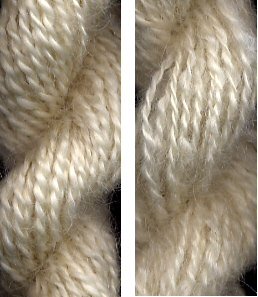
Okay, so technically there isn't any such thing as "pol-paca," but it does seem the easiest way to describe the Polwarth and Alpaca blend that I'm spinning. Here is one of the finished skeins...

I'm spinning an eyeball 50/50 blend of the Polwarth (a gift from a friend a long while back) and Huacaya Alpaca (the same that I used for my Teddy Bear Shawl).

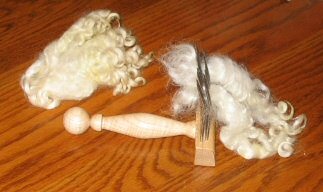
You may remember the next two photos from an earlier post. In the next one, the Polwarth is on the left, the alpaca is on the right.

Staple length is 4 to 5 inches for both. You can read my complete assessment of the Polwarth in this post.

I am blending the two fibers the same way I blend colors on woolcombs as seen in this post.

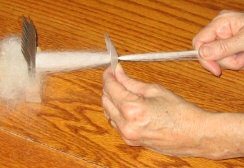
Spinning off the combI find it faster to simply spin it off the comb rather than to diz it into top.

My plan is to use this to weave fabric for a winter jacket or coat. I don't have the details figured out yet, but I do think about it while I spin. Since I want the coat to be solid color, I'm thinking that the interest will have to be in the weave of the cloth, as well as the garment design.

I've only got three skeins finished so far, and while I don't know the exact yardage I'll need, I know it will be a lot. So this will be my spinning project for this winter. Hopefully by spring, I'll be ready to move on to the serious planning stage.

Posted 6 Dec. 2008 at http://leighsfiberjournal.blogspot.com

Related Posts:
Color Blending on Woolcombs
Next Spinning Project - Polwarth
Polwarth - Experimenting With Preparations

Tuesday, April 29, 2008

Polwarth - Experimenting With Blends

By Leigh

After I finished my Polwarth preparation experiments, I decided to try blending some with alpaca. Since woolcombing made the nicest preparation, I also decided to use that for my blending experiments as well. I did it the same way I blended colors on the woolcombs. (Photos and explanation of that, here.)

To save a little time, I didn't diz the blended fibers into top, rather I drafted straight off the woolcomb...

Spinning off the combI couldn't have done that with full size combs, but it works well with my minis. Here are the results:

Polwarth & Alpaca 1 blendThe alpaca is on the right, the Polwarth is in the middle. The alpaca, though brown, has a reddish cast. This blend had the nicest hand and was soft and silky to spin. Very lovely.

Polwarth & Alpaca 2 blendAgain, alpaca is on the right. A darker brown than the first one, but shorter than the Polwarth. Even so, the blend drafted fairly evenly off the comb. I like the color of the yarn, but it isn't as soft.

Polwarth & Alpaca 3 blendI blended some with cinnamon colored alpaca out of curiosity. The yarn has more interesting color depth, though that's hard to see in the above image. However, since I have more of the dark brown alpaca, I think I'd prefer to save this color for a project all on its own.

I reckon the next step is to decide what size yarn I need and how much of it. I still leaning toward weaving with it; either an afghan or perhaps fabric for a winter coat. If I do that then I'll have to decide on a pattern so I can calculate for yardage. Obviously I still have a lot of decisions to make!


Related posts -
Adventures in Woolcombing
Color Blending on Woolcombs
Next Spinning Project - Polwarth
Polwarth - Experimenting With Preparations

Sunday, April 20, 2008

Polwarth - Experimenting With Preparations

By Leigh

I haven't mentioned the Polwarth in about a month, but I have been busy with it. Since there was some concern about the tenderness of the fleece, I made sample yarns from five different preparations.

Yarn from handcarded Polwarth.Handcarded - Actually, at five inches, the fleece was too long for handcarding. The best fleece length for handcards is no more than three inches, or the width of the cards. It's not that it can't be done, but the problem is that if the fleece on the cards isn't completely separated during carding, it gets folded back onto the cards. This makes it harder to get the individual fibers separated into a smooth preparation.

I was careful with my carding, and the rolags were a little neppy. These make it harder to control the yarn during spinning, so the yarn is a little lumpy. When I first learned to spin, I thought these lumps this added character to my yarn. Now I know that these become pills, which is something I don't want in my final product.

Yarn from dog combed Polwarth.Dog Combed - This is one of my favorite ways to work with fleece. I comb both the tips and the butts of the staples to open them up. Then I hold the locks parallel in my hand and spin from on end until that lock is used up.

This preparation was much nicer, though there were still a few neps.

Yarn from  drum carded Polwarth.Drum Carded - I admit that this is usually my preparation method of choice. Mostly because it is the quickest. Also because it blends color variations well.

In terms of results, drum carding didn't do any better than handcarding. The neps were still there, so the yarn was lumpy. Fortunately though, I didn't get a lot of fiber breakage, which was my concern with the tender fleece.

Yarn from flick carded Polwarth.Flick Carded - This is my least favorite way to prepare fiber for spinning. I end up with busted knuckles every time! I flicked both ends of the staples and then drafted them into a roving. This spins very nicely.

This made a better preparation than the hand or drum carders as it got more of the short bits out. Still, I've already ruled this one out.

Yarn from wool combed Polwarth.Wool Combed - I probably don't have the proper combs for this fleece, but I figured I'd give it a try with what I had anyway (Forsyth Minis).

This made a lovely preparation and the smoothest yarn. Wool combing gets all the neps and short bits out, so that it's easier to control the results and is a breeze to spin.

Before I choose a preparation method however, I need to decide what I want to do with the yarn. I have a whole fleece, so there is plenty for a large project. One thing I'm considering it is using the yarn for weaving. I rarely weave with my handspun. I'm also considering blending it with some of the alpaca I have leftover from last summer's spinning. If I do that, I will have to consider blending as part of my processing choice. That means I still have a little more experimenting to do. Obviously this isn't a project that will be completed anytime soon!

Posted 20 April 2008 at http://leighsfiberjournal.blogspot.com

Related posts -
Adventures In Woolcombing
Next Spinning Project - Polwarth
Polwarth - Experimenting With Blends

Tuesday, October 10, 2006

Leicester Longwool 3 – Two Yarns

I have finished spinning my first handful of Leicester Longwool; about as much as I need for enough yarn for one sheep motif on my Rare Breed Sweater. The total weight I worked with was 54 grams (1.8 ounces). From that I was able to comb 34 grams (1.2 ounces), from which I spun a worsted yarn. From the remaining 20 grams, I picked out about 4 grams (0.1 ounce) of neps and second cuts. I handcarded the remaining 16 grams (½ ounce) for a woolen yarn sample.

So, percentage-wise, that handful yielded 63% worsted, 30% woolen, and 7% waste.

Here they are, with the worsted yarn on the left.

Worsted Leicester Longwool yarn on the left, woolen spun on the right.I used my Kromski Minstrel for both yarns, spinning with the 8.5 ratio whorl. Both measure 14 WPI. Neither one has a soft hand.

The worsted yarn is smoother and has I love its luster, though it is not as silky to touch as Wensleydale. It was lovely to spin however. I tend to spin short fibers more often than long ones, so I had to keep reminding myself of its 6 inch length and adjust my hand positioning accordingly. Still, it was so easy to spin that I developed a rhythm quickly.

The woolen yarn still has some rare neps and short bits in it. The fiber length was anywhere from 1 to 3 inches. I don't think this style of spinning does the fiber justice, but it is nice to know I will be able to utilize most of the fleece.

The Leicester Longwool has such lovely wave and curl to it.....

Leicester Longwool staples.
.....that I'm thinking someday I'd like to experiment and try some in a woven fleece sample.

And the best news is that this is the last of my rare breed yarn samples for my sweater. So it's soon time to start swatching. I have lots of ideas, I only hope that some of them are workable. Too often the picture in my head doesn't match the results on my needles! :o The weather is finally turning cooler, so sweater knitting will be a welcome activity.

Wednesday, October 04, 2006

Color Blending on Woolcombs

By Leigh

I am very pleased to report that the more practice I get with my new woolcombs, the less awkward the process of combing feels.

A couple of things which I've learned (because, even though I've read this advice, experience is after all, the best teacher :) :
1. The fiber must be very clean. Even a little leftover grease both gunks up the combs and slows down the process.
2. That 4 transfers (or whatever it's called) works well to remove the noils and short bits, and creates fiber that truly "spins like butter."

I think I've found a new love!

Jesse wondered about trying to blend fibers with the combs. That idea piqued my curiosity too so I wanted to give it a try.

I knew that I had some small amounts of dyed Border Leicester fleece somewhere, so I dug around in my stash and pulled them out. I found two colors of blue, both from Cushings acid dyes. One from the exhaust of a navy dyepot (because who can let an exhausted dyepot go waste), the other Cushings Copenhagen blue (my favorite.)

First I sorted them out by staple length. Otherwise, the longer fibers catch and pull out first, and the shorter fibers will be pulled off last. This obviously isn't helpful for blending.

I chose the 6 inch locks and loaded the comb about 50/50.

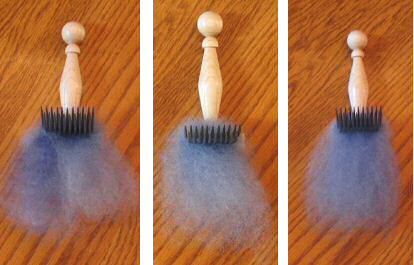
The blues blended well with each progressive exchange of fiber.

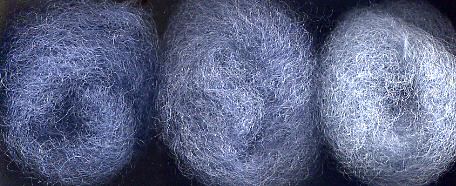
Below are the results with the two original colors for comparison. Navy exhaust on the left, Copenhagen blue on the right, and the blend in the middle. The results are subtle because of the colors I used, but successful enough to encourage more experimenting.

I didn't waste any time spinning these up. What a joy! Since they are only samples and will probably find their way into some knitting project, I put a low amount of twist in the yarns to keep them soft.

Instructions for color blending with a diz can be found at the Majacraft website. And somewhere I think I've seen instructions for blending with a hackle. However, I'm too lazy to try the diz method. And considering how long it took me to purchase woolcombs, don't look for the addition of a hackle to my fiber equipment any time soon. :)


Related posts -
Adventures in Woolcombing
Polwarth - Experimenting With Blends

Monday, October 02, 2006

Adventures In Wool Combing

Well, actually I wouldn't call it “adventures.” “Experiments “ would be more like it.

I have procrastinated purchasing woolcombs all these years for various reasons. Mostly though, because their cost required me to not make a frivolous purchase. Besides, I had a flicker, wouldn't that accomplish the same thing?

However, after a lot of knuckle busting from the flicker, a lot of deliberation, and the recommendation of my friend Ruth in Kansas, I finally decided to purchase Forsyth Minicombs. They have the advantages of being small, lightweight, portable, and not too deadly looking, as well as being well made.

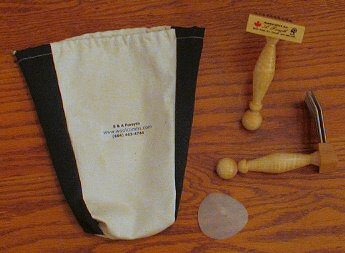
My new Forsyth mini woolcombs, complete with canvas bag & plastic diz.These are 2-pitch, meaning that they have 2 rows of tines.

“Charging” the comb means loading it with fiber. The biggest disadvantage to minicombs is that one can only deal with small amounts of fiber at a time. But, I figured that since I would probably make quite a few messes anyway, smaller messes would be easier to deal with than larger ones.

Comb charged with Leicester Longwool.The butt end of the locks are loaded onto the comb, lashing on about ½ inch of fiber, about half-way down the tines.

The combing itself requires that the combs be worked perpendicular to one another. Exactly how this is accomplished is by whatever method is the most comfortable and least perilous to the comber. So I did a lot of experimenting, and tried every angle.

I tried combing this-a-way.
And that-a-way.I admit that it felt rather awkward no matter which way I held the combs or which dorection I combed. This is a feeling that I know that practice and experience will tend to.

After the fiber is transferred from one comb to the other, the short bits and VM are removed from the first comb and the process is repeated several times.

Dizzing the combed fiber.The other tool which requires some practice is the use of a diz. I'm sure the complimentary one that came with my combs is adequate, but I couldn't help but admire some of the fancy ones in the Woodland Woolworks catalog, nor contemplate the ideas on the Online Guild discussion board for making my own.

A clamp is also available, which I didn't purchase. Without it I had to enlist the help of an spare off-camera hand to secure the comb as I dizzed the fiber.

The result is this lovely open roving, ready to spin, which I will report on soon.

The resulting roving.
In the meantime, woolcombing tips and suggestions are welcome.

Tuesday, September 26, 2006

Leicester Longwool 2 - Sorting & Washing

A valuable resource for the wool comber.Several years ago I traded M some angora rabbit fiber and cotton lint for Peter Teal's Hand Woolcombing and Spinning. But it wasn't until I started working on this Leicester Longwool fleece that I actually took a serious look at it. I have finally decided to take the plunge and try my hand at wool combing. Mr. Teal's book is well suited for the beginning wool comber as it is very practical and down to earth. So it is a good resource for me.

The first thing I did was take a close look at my fleece and attempt to sort it out. Since it had been previously washed, I wasn't able to lay it out like a raw fleece. However, my untrained eye was able to divide it into 2 general groups. One of the finest looking, and the other of the less fine. From the first pile, I began to sort it out according to staple length:

Samples of Leigh's Leicester Longwool sorted according to staple length.
These range from 6 inches on the left to 10 inches on the right. I chose the 8 inch pile to start with as I seem to have the most of that.

The fleece was given to me over a year ago and survived 2 long distance moves including being stored one summer on a hot un-air conditioned Florida porch. Because of this the grease was pretty tacky, so I decided to give it another wash.

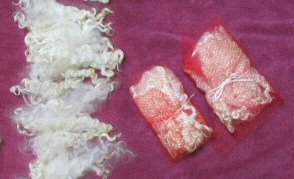
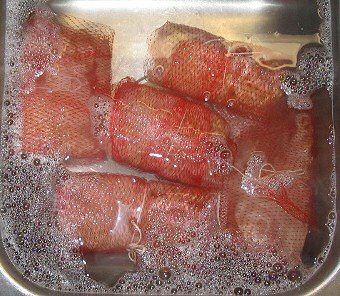
Staples tied in little nylon mesh packets, ready to wash.
I used the little packet method Patsy Zawistoski recommends on her video, Spinning Wool – Basics and Beyond. I love this video because it has so much excellent information on it. I've watched it and my other spinning videos numerous times over the years, sometimes for specific information, and sometimes just to see if I can glean another tip to improve my spinning.

I folded small groups of staples into nylon netting and secured each with a string. This maintains the integrity of the lock structure, which is necessary for woolcombing.

The soaking wash.I used the hottest water I could from my tap and added a kettleful of boiling water, plus a few squirts of Dawn dishwashing liquid.

I only let them sit for about 10 minutes. Lanolin melts between 110 and 120 degrees F (43 to 49 degreed C), so the important thing is to not let the wash water cool below this temp. If it does, the grease will begin to solidify again, which negates why I'm washing it in the first place! [UPDATE: I have since learned that this information on washing out lanolin is not correct. For what I learned, click here.]

I used the same temperature for my rinse soaks, and added a glug of white vinegar to the second to the last rinse. (That was a scientific glug, not a household glug ;)

I then spread the staples out on a towel to dry. In the mean time, I'll review the combing process itself.