Showing posts with label tablet weaving. Show all posts

Monday, January 01, 2024

Tablet Woven Hat Band

There's been no weaving going on during the last days of December, with all the holiday and family activities. But I did one project that had been on my mind for awhile - a hat band from one of my tablet weaving samples. 

I haven't done any tablet weaving since I started weaving Christmas gifts last September, so it's been awhile. I've only woven about half-a-dozen sample bands, all fairly short and each with at least one beginner mistake. Even so, I've been wanting to do something with them. I found the hat at a thrift store and thought it would be perfect for a tablet woven hat band.

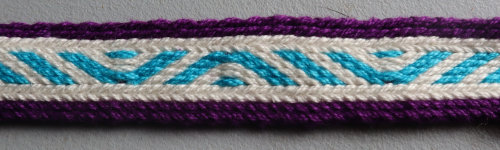
The band I chose was my Ladoga band. It was longer than I needed, so I unwove both ends until it fit the hat, keeping the weft yarn long. With those loose ends I made a twisted fringe. I used the weft thread to wrap around the two bunches of fringe to tie them together, and lastly poked yarn through the band and hat to tie off on the inside. 

The band fits the hat snugly enough that I didn't need to sew or glue it down. With only one tie down, it easily could be removed and replaced if I wish.

I don't know that I will wish, however, because I like it as it is. I like wearing hats and this one will be nice to shade my eyes when I'm out and around the town.


Related Posts

Friday, September 22, 2023

Tablet Weaving: HallTex 152

This is another historical pattern developed from a very old piece. It was one of six tablet woven fragments excavated in the Kernverwasserungswerk Austrian salt mine in 1991. It's been dated between 400 and 800 B.C. Even though this pattern uses four threads per tablet for a total of 48 warp threads, a subsequent analysis determined that the extant piece was actually a skip hole design. So the original had 36 warps threads. I'll try that one in the future, but for now, will stick with the easier pattern shown here.

Pattern

These come from Lady Elewys of Finchingefeld, where she offered two options:

Option 1
Option 2

To start, I chose option 1. The difference between the two options is that option 2 uses yellow in the pattern as well as the borders. She also offers the skip hole pattern on the same web page, which I plan to try later. 

Yarn

Lion Brand Coboo, a cotton and bamboo rayon blend.

My Band

I've been so focused on finishing my twill gamp that I haven't done any tablet weaving for about six weeks. So, I was pleased when this band started off well; the handling the cards no longer felt awkward and they seemed very cooperative in my hands. Maybe I'm finally catching on! Until (there's always an "until," lol) I messed up. I tried to unweave it, but just got confused. But, that's why I'm doing practice pieces, so if I make mistakes I can just start the pattern over. 😏


Related posts:

Thursday, August 17, 2023

Tablet Weaving: Birka 12

The city of Birka was thriving trade center on the island of Björkö, Sweden during the 8th - 10th centuries. Archaeological finds include a number of tablet woven fragments. Many of these are in the brocade technique, in which threads of precious metals were woven into the top of the bands. Apparently, this is an advanced technique, but many of the Birka patterns have been interpreted as threaded in for less experienced tablet weavers. Birka 12 is one of those bands. 

Pattern

Credit: Lady Eleyws of Finchingefeld

This is the third in the Weave Along with Elewys series. New for this lesson are an increased number of tablets, plus the two-color border. 

Yarn

Lion Brand Coboo (cotton / bamboo rayon blend)

Warping

Elewys uses an inkle loom for her tablet weaving. Since I'm using the backstrap method, I've pretty much skipped over the warping section of her videos. I was de-stemming cherry tomatoes the other day, however, and so watched the entire episode to pass the time. What I noticed was that she was able to measure her warp threads in pretty much color order. If I could do that, it would help eliminate the huge tangle I get from measuring my warp by color sections. For this pattern, each tablet contains two colors, so measuring two colors at a time was easy. 

I also decided to add a warp cross to help keep track of thread order!


Side note: In Tablet Weaving: Skip Hole Ladoga, I showed you how I used ponytail elastics to stabilize the tablets with skipped holes. I also like to use them to stabilize the cross when I use my warp holder. It helps me to not pull out too many threads at once and mess up the warp order.

Conclusion? This measuring method is a keeper!

My band

I think I had more challenges with this one than any so far!

What I learned

One challenge of this band was that it was wider than any I'd done previously. The tablet turning sequence is short, which helped keep track of it. Even so, I messed up on one card which made a mistake in the pattern. I just turned it to the correct position and restarted from there. This was just a learning piece, so it didn't matter, but it told me I might want to add extra warp when weaving a project.

The other challenge was the building up of twist in the pattern cards. The pattern repeat is 10 turns long, with cards turning forward for a total of 7 and back for 3. Twist can be dealt with a number of ways, typically by reversing the direction of turning the tablets. A fancier set-up attaches warp ends to fishing swivels. I've been using the method of flipping the cards, so that S becomes Z and Z becomes S. This is what I tried for the pattern cards and it changed the pattern! Another interesting lesson learned.

One thing I'm getting better at is my selvedges. I'm finally pulling the weft firmly enough to get a smooth looking edge, instead of little weft bumps. 

After I got my two problems behind me, weaving went quickly, and I finally managed to get a section of correctly woven Birka 12, which you see pictured above.

Monday, August 07, 2023

Tablet Weaving: Skip Hole Ladoga

This one was introduced as a more challenging version of the threaded-in Ladoga pattern. Considering that Ladoga was only my second tablet woven band, I wasn't sure I was ready for something more challenging. But I have to go to the library to run off copies of the next Weave Along With Elewys lessons, so I gave this one a go in the meantime.

The Ladoga band I made previously is actually an adaptation of the original extant band discovered at the archaeological digs. The adaptation consists of 48 threads. The original Ladoga band, however, was woven on twelve four-hold tablets but only contains 27 threads! And that points to the skip-hole technique, where some of the holes in the tablets aren't threaded, but skipped. These are notated as blank spaces in the pattern. 

The Pattern

Credit: Lady Elewys of Finchingefeld
The accompanying video is here.

Yarn

Artiste #8 Crochet Cotton
I used the same colors as I did for my first Ladoga band, but switched the border and pattern colors.

My Band

Skip hole Ladoga

Top: threaded in Ladoga (front)
Bottom: skip hole Ladoga (front)

Top: threaded in Ladoga (back)
Bottom: skip hole Ladoga (back)
???????????

What I Learned
  • Yes, this was more challenging to weave, but not in the way I expected! I thought I might have difficulty with the shed, but the real difficulty was with the cards. Having four threads in each card stabilizes their position in the pack. With some holes skipped, the cards wanted to turn, so it was challenging to keep them all aligned. 

Without support from the other threads, the cards
with only two threads twisted out of alignment.

After struggling with it for awhile, I hit upon the idea to
use an elastic ponytail holder to hold the pack in place.

When the cards needed to be turned in different directions,
I bundled each group separately. It made weaving a lot easier.

  • One thing about the Ladoga pattern, is that it's easy to tell when to change the direction of turning the tablets from the pattern. So counting isn't strictly necessary.
  • Even though the pattern called for 12 cards, fewer threads meant a narrower band.

Tuesday, August 01, 2023

Tablet Weaving: Ladoga

Ladoga was a Norse settlement in Russia. The original band was discovered in 2010 at the Ladoga Burial Mounds about 70 miles east of St. Petersburg. It has been dated at sometime between the 10th and 12th centuries. 

The Pattern

Credit: Lady Elewys of Finchingefeld
The accompanying video is here.

My earlier blog post, Tablet Weaving Notes, explains how to read the pattern and thread the tablets.

Yarn

Artiste #8 Crochet Cotton
I substituted ivory for the yellow and turquoise for the green.

My Band


It turned out much, much better! This is because of what I learned about the border cards (below).

What I Learned
  • Split pack - when some of the cards are turned one way, the others are turned the other way. In this pattern, only the four center tablets of the warp reverse direction. The tablets on the edges are only turned forward.
  • Turning the border cards only the same direction creates a neat, smooth edge to the band.
  • Turning the border cards only the same direction also creates over-twist in the unwoven warp.
You can see the over-twist in the purple warp threads on the left.
  • There are two ways to deal with this:
    • Reverse direction of turning the tablets to untwist the twist. (This is what we did in the first pattern.) But this creates yarn bumps on the edges.
    • Flip the border cards, so S becomes Z, and Z becomes S. Then continue weaving as before. It's shown in this video, Tablet Weaving Tutorial: Untwisting Warp Threads. Creates a smoother selvedge with no bumps.

Observations
  • This was a good second tablet weaving project. 
    • Learning how to make neater selvedges was encouraging.
    • Keeping track of the cards turning in different directions was relatively easy to follow with this pattern.
  • For some reason, I made several mistakes anyway. Perhaps it was mistakes in turning the tablets, or perhaps I didn't always get a clean shed because I wasn't paying close enough attention.
  • Consequently, unweaving mistakes is more difficult with a split pack! 
  • Learning samples are the way to go! No grief if I just simply start over from the mistake.
  • Also, I'm seeing the appeal of an inkle loom for tablet weaving. When measuring with a warping board, there are a lot of tangles to deal with, especially after threading the cards. That problem seems to be eliminated with the inkle loom. However:
    • I don't have an inkle loom.
    • I'm not inclined to get one.


Related posts:

Wednesday, July 26, 2023

Tablet Weaving: Oseberg 12L1

Oseberg 12L1 is an ancient tablet weaving pattern. It was one of at least 10 tablet woven bands discovered in 1904 during an archaeological dig at Oseberg Farm in Norway. Finds from that dig have been dated to around 834 AD. It's a fairly simple design, and is featured in the first episode of Weave Along with Elewys. It seemed like a good place to start.

The Pattern

There are several variations of Oseberg 12L1 around the internet, but I'm using the one from Elewys's blog, Lady Elewys of Finchingefeld, JdL, GdS. She has several variations with different numbers of colors, but I want to start as simply as possible and so chose this one, with only two colors. 

Credit: Lady Elewys of Finchingefeld

My previous blog post, Tablet Weaving Notes, explains how to read the pattern and thread the tablets.

Yarn

Lion Brand's Coboo, a cotton / bamboo rayon blend knitting yarn.
I substituted a dark blue for the green in the pattern and light green for the yellow.

My finished band

Not perfect; my lines are wavy! But better than my first practice band!


What I learned
  • From the video I learned that the little bumps on the selvedges are from changing tablet direction. this is just the way it is, i.e. not something I can correct.
  • When to change direction of the cards is arbitrary. It's just as well to continue turning in the same direction until the twist in the warp builds up too much.
  • The backstrap method is hard on my back.

Observations

  • This pattern was a good choice for a first tablet weaving because it has only 10 tablets, 2 colors, and the tablets all turn the same direction. 
  • I need to practice on my tension and selvedges.
  • The yarn held up well, but at the end of the band it had the slightest abrasion from the holes in the cards.
  • If I do a lot of this, I'd like an alternative to the backstrap method.


Sunday, July 23, 2023

Tablet Weaving Notes

In my first post about tablet weaving, I showed you how I made the tablets and tried them backstrap fashion to weave a sample piece. Now, I'm getting ready to weave my first band and want to make sure I have a grasp of the basics. In this post, I'm going to discuss reading the pattern, measuring the warp, threading the cards, and steps for weaving. 

Patterns

There are some variations on how patterns are written. For my notes, I'm going to use the one I'm using for my first band, Oseberg 12L1


Credit: Lady Elewys of Finchingefeld

The bottom section of the pattern tells me everything I need to know about the warp and how to thread the cards.


The numbered row across the top indicates the number of tablets.
The letters A through D in the lefthand column correspond to the holes in the tablets
The bottom row of Ss and Zs indicate how to thread the tablets.

To calculate how many warp ends I need, I count the number of each of the colored dots. For this pattern I need:
  • 26 green 
  • 14 yellow 
I can check that by adding them up to make sure they match the total number of dots. There are 10 columns x 4 rows = 40 dots. 26 + 14 = 40, so I counted correctly.

Measuring the Warp

Here's a formula:

Desired finished length x 20% (0.20) + 20 inches = length of warp to measure

Threading the tablets


All tablets must face the same way.
All tablets must be threaded the same way.
S threading means the threading of the warp creates an "S" looking path. 
Z threading means the threading of the warp creates a "Z" looking path.


The heavy black lines represent tablets. The thin blue lines represent warp threads. From above, how the tablet is threaded resembles the midsection of either the letter S or the letter Z.

An excellent explanation of threading is at Tablet Weaving in Theory and Practice. 

Getting started

4 picks to secure the weft (4 turns of the tablets forward, from the A-D position back to the A-D position). Use the stick shuttle to beat down each pick of weft thread. Repeat if necessary. 

Weaving sequence

Turn the cards
Beat down the weft
Pull in the loop snuggly
Pass the shuttle through the shed, leaving a loop of weft (i.e. don't pull tight, yet)

Turning the tablets


Start with A D at the top (unless otherwise indicated)
The numbers on the left represent the weft picks.
The white squares indicate turning the tablet 1/4 turn forward.
The gray squares indicate turning the tablet 1/4 turn backwards.

Now, on to getting started on my project. 

Tuesday, June 27, 2023

A Tablet Loom

So, this is another project idea I got from Permies.com's SKIP merit badge program. It's in the textiles aspect, with the requirement of making a small loom capable of weaving a warp-faced fabric at least 2-inches wide. Examples include backstrap and tablet (or card) looms. I am intrigued by tablet weaving, so that's what I made.

One of the most common ways to make the tablets is with playing cards. I found some really cute cards at Hobby Lobby for under $2, so that's what I used.


The cards are trimmed to make squares.


Then a hole is punched near each corner.


The holes are labeled A, B, C, and D, and the cards are numbered. The width of the weaving is determined by the number of cards (warp ends). The weaving pattern is determined by turning the tablets (or groups of tablets) a quarter turn forward or backward.


I started with a sampler and so only measured about a yard of warp. I used a sugar-and-cream type crochet cotton for my first try.


I watched quite a few videos on threading the cards and thought it looked easy. When it came to doing it myself, however, I realized that various videos explained it differently and that some gave opposite directions! There's a difference in the weaving depending on whether the cards are threaded from the front or the back, which was sometimes discussed as left or right, or as S threading and Z threading. 

The more videos I watched, the more confused I became. I finally thought, 'you know what? I'm just gonna do this and at least I'll make a start and learn something! Then I can figure it out later.'


There are tablet weaving stands, but the easiest way to start is with the backstrap method. So, the only other things I needed were a small stick shuttle, a belt, and a ring to fasten the weaving to the belt.


Then it was time to give it a try and experiment. 


It wasn't as easy as the videos made it look, but I learned a lot. I'm definitely going to experiment more with this. I'll do a technical post on tablet weaving soon.

© 2023 Leigh's Fiber Journal

Related post: