Monday, September 25, 2023

A New Shuttle to Help With Two Things

Before I started weaving the overshot-fashion dishtowel of my twill gamp, I wanted to review yarn sizes. My warp was 8/2 and I needed a heavier yarn for the pattern weft. It's that heavier yarn that brings out the pattern. Of course, recommendations vary somewhat, but something I ran across was the idea to simply double the 8/2 to effectively make an 8/4 pattern weft. Since my stash is mostly 8/2s and 10/2s, that idea was certainly appealing. Yarn has gotten so expensive since I started weaving again, that I'm glad to use what I've already got! I can do this yarn doubling a number of ways: winding two 8/2s on the bobbin together, using two individual shuttles, or 

Double bobbin boat shuttle by Handywoman.

I found it on Etsy, where I had a $5-off coupon. This shuttle will expand my options for pattern weft as I can now easily double what I've already got without having to buy more yarn.

It came with two plastic bobbins!

It's so pretty that I just had to share it. The shuttle is expertly handcrafted, beautifully finished, and reasonably priced. I had a choice of woods and chose cherry. I especially like it because it is compact: 12-inches long and only 1-inch high, but it holds standard 4-inch bobbins. 

It was designed with rigid heddle looms in mind, which are smaller than floor looms and so benefit from equipment suited to them. I don't have a rigid heddle loom, but my table loom is small as well, and I find that using my taller shuttles means that it isn't long before I can no longer pass the shuttle through the warp shed. This low profile shuttle is not as tall as the more expensive brands, so it will give me a little more weaving room before I have to advance the warp.


Janet's shop on Etsy is here, but if you visit her website - Handywomanshop.com - you'll find a greater selection of items, more choices of woods, and better prices. She carries handcrafted weaving and spinning equipment and tools, including some amazingly unique shuttles, and even weaving themed jewelry!

Even though I wasn't planning to buy more equipment, this shuttle is something I'm glad I bought. It will help with both my yarn stash and my table loom. Many weave structures use a heavier pattern weft—including Summer & Winter, one of my favorites—so I know this new shuttle will get plenty of use in the future.


Related post:

Friday, September 22, 2023

Tablet Weaving: HallTex 152

This is another historical pattern developed from a very old piece. It was one of six tablet woven fragments excavated in the Kernverwasserungswerk Austrian salt mine in 1991. It's been dated between 400 and 800 B.C. Even though this pattern uses four threads per tablet for a total of 48 warp threads, a subsequent analysis determined that the extant piece was actually a skip hole design. So the original had 36 warps threads. I'll try that one in the future, but for now, will stick with the easier pattern shown here.

Pattern

These come from Lady Elewys of Finchingefeld, where she offered two options:

Option 1
Option 2

To start, I chose option 1. The difference between the two options is that option 2 uses yellow in the pattern as well as the borders. She also offers the skip hole pattern on the same web page, which I plan to try later. 

Yarn

Lion Brand Coboo, a cotton and bamboo rayon blend.

My Band

I've been so focused on finishing my twill gamp that I haven't done any tablet weaving for about six weeks. So, I was pleased when this band started off well; the handling the cards no longer felt awkward and they seemed very cooperative in my hands. Maybe I'm finally catching on! Until (there's always an "until," lol) I messed up. I tried to unweave it, but just got confused. But, that's why I'm doing practice pieces, so if I make mistakes I can just start the pattern over. 😏


Related posts:

Wednesday, September 20, 2023

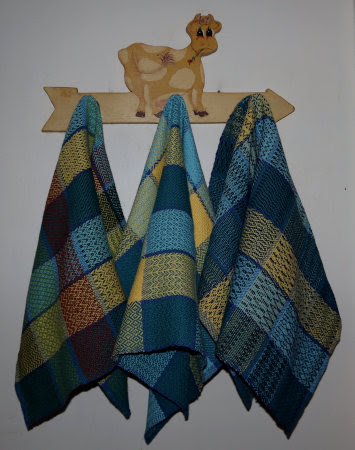
It's a Wrap! The Twill Gamp Dishtowels Are Done

My three dishtowels are off the loom, wet finished, and hemmed. I have to say that this was a great first project for my return to weaving. I learned that a gamp is definitely an interesting way to explore possibilities. I can see why weavers can spend months weaving them. I'd say gamps are the very best in sampling options. It's fascinating to see the patterns revealed pick by pick, how the colors interact, and be able to compare the different patterns side by side. 

Here are some close-ups of each of the towels.

Towel #1: Same color for both warp and weft gave let me see the textures.

Towel #2: Different color weft was good to see color interactions.

Towel #3: Overshot manner gave a completely different look to it.

Finishing them off, I realized the impact of having them in hand. When I look at a photograph of handwoven fabric, I see it. When I hold the actual fabric, I experience it. Does that make sense?

Notes and Observations

  • I knew the draw-in for the various twill samples would vary, but it's acceptable.
  • The draw-in for the overshot fashion towel was consistent for the length of the towel, however.
  • Even though my favorite is the towel woven in overshot fashion, overshot is not something I am drawn to exploring. It doesn't spark my interest.
  • I experimented trying to get the squares square, but I failed, I fear. With towel #1, I tried to weave each weft section a quarter inch longer than the square width. The other two, I made the same number of weft picks (threads) as warp ends (threads). My observation is that the different patterns react differently in their draw-in, take-up, and shrinkage.
  • All the obvious random warp tension issues seemed to work themselves out with wet finishing.
  • Hemming. I need to weave more between the towels for hemming, from now on.
I really like several of the individual woven samples in the towels. I'll get pics of them and make a draft for each, to file away for future projects.

Monday, September 18, 2023

Weaving Software That Runs on WINE : WeaveDesign (Revisited)

WeaveDesign is another weaving software program that I looked at years ago. I didn't seem to use it much previously and never gave it a proper review. But in taking a second look, I see that it now has a liftplan option I can use for my table loom. So for this blog post, I'll include lots of screenshots for anyone else researching software.

To review: I'm looking for four things in weaving software:
  • Liftplan option for table looms
  • Can export WIF files
  • Can print drafts
  • can convert tie-up to liftplan

I'm starting with freeware, and will progress on from there if needs must. 

WeaveDesign is a Windows program, but it will open in Linux in WINE (for which I'm using PlayOnLinux). After opening the program, I had the option of starting a new draft or of importing an existing WIF file. I started with a new draft.


After selecting the single harness loom style, I was able to set up shafts, treadles, pattern size, fabric density, warp and weft colors and the loom system; liftplan for a table loom.


Like other programs, it's just a matter of clicking squares to create a design. The repeat function is easy to use and requires no highlighting.

As you can see, it creates a drawup rather than a drawdown.


I was happy to see I can save files in WIF!


And drafts can be printed out too.


"A Halvdrall Runner"

As with other programs, I can make whatever changes I wish.

A few more features. It has three views: grid (above), thread, and thread plus (below). The thread plus is nice because it shows the interlacements.


There's also an option to save color palettes for future use.


The big question was, could I change this draft from a tie-up to a liftplan???


Unfortunately, that option is grayed out. 

Even so, it's definitely more useful than WeaveDreamer and less finicky than DB-Weave.

Saturday, September 16, 2023

Weaving Off the Twill Gamp Warp

After I wove my three dishtowels plus a good ending header, I still had some warp left on the loom. Of course, a warp can never be woven completely to the end; rather, it can only be woven until the back apron rod gets too close to the heddles to make a good shed. Once I can't pass the shuttle through the opening between the warps, that's it. So, there's always loom waste. The question is, how much?

I gave myself plenty of length when I calculated how long my warp needed to be, so just maybe I have enough leftover to experiment a bit. I got this idea from Peg's blog post, "End-of-Loom Sampling" over at Talking About Weaving. It's true that questions and ideas pop up during the weaving of a project. What better place to sample than the end of the warp?

After I wove the off enough to hem the last towel, I figured it would be a good time to clear off some bobbins. Which I did, and was intrigued by the random stripes that occurred. 

I like stripes. And plaids.

And that made me think of random plaids. So, perhaps that's an idea to tuck away for future use.

What I was really curious about, though, was a thicker yarn for the "overshot fashion" treadled dishtowel. It seems that the common recommendation for my 8/2 warp and tabby weft is a 3/2 pattern weft. Of that, I have only pink and a brownish-gray, but I didn't think I could subject myself tor that color combination. Some weavers double the 8/2s (which is equivalent to an 8/4 yarn), but I finally decided on some cotton crochet/rug yarn, of which I inherited a lot when I bought my Schacht Mighty Wolf loom. It's a bit fatter than the recommended 3/2, but it's just an experiment. 😁

Next decision. What color?

What do ya'll think? Blue? I agree. Blue it is.

So, here it is overshot fashion with the heavier weft. 

Left side of the warp

Nubby selvedges, I see. And of course contrast is key (maybe I should have used the orange). 

Right side of the warp

I don't know if I chose the best pattern, but it gives me an idea, anyway. A heavier weft will truly make the pattern more dominant. 

I wove until the apron rod was advanced as far as it could go.

The end of the warp at the back of the loom. 

One problem I ran into was that some of the knots securing the warp bundles to the apron rod became untied once they were no longer wrapped around the back beam. I retied them, but will probably switch to lashing on the warp in the future.

The end of the warp at the front of the loom.

That was as far as I could weave, but I still had a good shed at that point and could easily throw the shuttle. That's a good thing to know about any loom. 

The unwoven warp from the back apron rod to the fell edge (edge of the weaving) measured 13 inches. This is my back loom waste. In the front, I measured about 5 inches, including the header. So my total loom waste is 18 inches. This is important information, because it enables me to not be wasteful with my yarn. I need enough, but there's no sense wasting it, especially if the yarn is expensive or in limited supply. I allowed 20 inches, which turned out to be a pretty good guess. 

The next step is to cut it off the loom and prepare it for wet finishing.