Friday, September 15, 2023

Twill Gamp Weaving 6

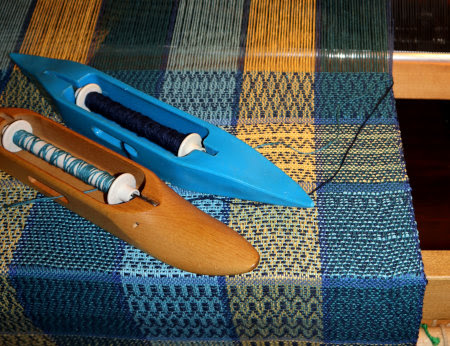
This is the last of it! The third of my three dishtowels is woven, so the next step is getting it off the loom. Then I'll wash it and dry it, and we'll see how they turned out.

I only had one thing to figure out this time. I wove through many of the short treadle draft patterns first and then took a look at some with longer sequences. I'm using The Weaving Book, remember, and many of the patterns have sections that repeat the treadling anywhere from 2 to 6 times. This is characteristic of overshot and creates large pattern shapes, but I avoided these at first because I wasn't sure how to keep track of the treadle order. 

This one, for example. In my case, it's a liftplan, so it indicates the pairs of shafts that I'm lifting:
1. 2 - 3 (x 4)
2. 3 - 4 (x 2)
3. 1 - 4 (x 2)
4. 1 - 2 (x 2)
5. 1 - 4 (x 2)
6. 3 - 4 (x 2)

That's a total of 28 pattern weft shots. Did I really want to work with 28 beads? My numbered bead method for keeping track was working well for ten or less treadle changes, so I had to decide what to do about the repeats. I finally decided to work with just six beads and slide the bead to the middle of the stick until I completed all the repeats.
 
I'm on #4 in the pattern, lifting shafts 1 and 2 twice.

When I complete the repeats, I slide the bead all the way to the right and I'm ready for the next one. I found this works quite well, because it's easy to see the repeats in the fabric and make sure I've got them all.

For future reference, here are the last five sections.

Weft section 5, II 238 to II 241 (page 73)

Weft section 6, II 254 to II 257 (page 74)

Weft section 7, II 278 A to II 281 D (page 75)

Weft section 8, II 298 A to II 301 D (page 77)

Weft section 9, II 294 A to II 297 D (page 76)

Current length on the loom is about 24.75".

Twill Gamp Weaving 6 © Sept 2023

Related posts:

Thursday, September 14, 2023

Book Review: The Handweaver's Pattern Directory

Since picking up weaving again (intended!) I've been absorbing weaving websites, blogs, and videos. The most commonly recommended book I'm seeing is

by Anne Dixon

Seeing that it was published in 2007—two years before I packed up my loom for 14 years—I initially wondered why I didn't have it in my library already, considering what a bibliophile I am. But the subtitle explains it, "Over 600 weaves for 4-shaft looms." About the time this was published, I was selling my 4-shaft jack loom and weaving exclusively on my 8-shaft Glimakra. At the time, I was buying books specifically geared toward 8-shaft weaving.

Now, I'm weaving on a 4-shaft table loom, and have to agree that The Handweaver's Pattern Directory is a must-have for every 4-shaft weaver.

The book has two main sections: the introduction and the pattern directory.

The introduction starts with what to expect from the book and how to understand the weaving drafts. Next, it discusses basic equipment, fibers, yarns, selvedges, sett, weave structure, calculating warp length, color theory, and sampling. Everything is laid out logically, with plenty of photographs, making this section an excellent reference resource.

The directory is divided into four pattern sections: basic threadings, block drafts, lace weaves, and special threadings, which include things like undulating twills, advancing twills, syncopated threading, turned Monk's Belt threading, distorted weft, supplementary warp, warp face weaves, etc. Each section begins with an introduction and basic explanation, along with tips for weaving that category of patterns. Then comes the eye candy.

The photos are all in color, which gives this book a distinct advantage over the books I've been using for my sampler and twill gamp. The interplay of color in the various samples is interesting and helpful. And I think, makes it easier to follow the drafts. For example, the treadling draft uses the weft colors in the piece (rather than just long columns of tiny black squares) so it's easier to follow the changes and keep one's place.

Most pages are set up three samples per, and explore a variety of treadling options (lever lift options for me!) for a particular threading. Some are set up as a two-page spread with three different threadings and three treadling patterns. This is perfect for gamps (definition here), which are excellent learning projects. In fact, I have my eye on "Crackle," pages 130 to 135.

The book wraps up with a chapter on how to finish handwovens, and includes everything to consider before taking it off the loom (preventing unraveling and uneven shrinkage), hemming, fringes, hemstitching, plus detailed information on wet finishing. Following are a glossary, an index (yay!) and a page of weaving resources. Also noteworthy, it's spiral bound, so the open pages lie flat, and the back flap, which folds out with a quick review of how to read the weaving drafts. 

So, yes, highly recommended. Amazingly, I almost didn't buy this book because surely, I don't need more books. But the price on Amazon was the best I'd seen and I needed to round up an order to get free shipping. Or so I told myself, lol. Anyway, it is now the first book I reach for, and it will be one of my most used weaving books, without a doubt.

Tuesday, September 12, 2023

Twill Gamp Weaving 5

Two dishtowels down and one to go. But first, I had to decide how I wanted to weave it. I've done something different with each towel, so for this one, I finally settled on exploring the 'overshot fashion' section in Helen Bress's The Weaving Book. It continues with the same four twill threadings I've been using for my gamp (straight twill, point twill, rosepath, and broken twill), with overshot's heavier pattern weft and a tabby weft the same as the warp. 

Third twill gamp dishtowel woven in overshot fashion.

For my non-weaving friends, overshot is a traditional weave structure that uses two weights of yarns. The heavier yarn creates the pattern, and the lighter weight yarn basically holds the pattern in place. This is important because the patterns typically call for multiple repeats to build shapes of color in the cloth. The lighter weight tabby (which is just plain weave) serves as a binder between the rows of heavier yarn. You can see pictures of an overshot coverlet woven by my 4x-great-grandmother here.

My yarn stash is mostly 8/2 and 10/2 cotton, with very few choices in heavier yarns. Of the 6/2 that I thought would be an option, the only colors I have are pink, gray, white, and navy. Only navy looked good with my warp colors, so navy it is! I'm using navy for the pattern weft for the entire length of the dishtowel, and rotating tabby colors the same as my warp.

Notes and Observations
  • My lever sequence counter is working very well, although I still have to remind myself to move the beads when I change the levers.
  • I think I'm going to need to clamp the loom to the new desk. It has a smooth surface and the loom wants to move with every beat.
  • I'm finally starting to take advantage of the two dowels on which the beater bar can rest. Being a compact loom, there isn't much distance between the breast beam and the castle, which means I have to advance the warp frequently. Simply moving the beater back gives me a few more inches before I have to do that!
  • I'm wondering what it would look like if the pattern weft was a little heavier, although for the purposes of a dishtowel, it' fine.
  • Maybe that's just an excuse to talk myself into buying more yarn.
  • The addition of a third color makes each unit visually more complex, which intrigues me.


Even though I'm finding weaving on a table loom to be pretty slow, I still seem to be making good progress. Here are the first four weft sections, each with a different treadling pattern and tabby color. The treadling patterns don't have specific names, so I'm just identifying them with the codes given to them by Bress plus their page number in the book. All can be enlarged by clicking on the image.

1st weft section,  II 198 A to II 201 D (page 70)

2nd weft section, II 210 A to II 213 D (page 71)

3rd weft section, II 270 A to II 273 D (page 75)

4th weft section, II 202 A to II 205 D (page 71)

Twill Gamp Weaving 5 © Sept 2023

Related posts:

Monday, September 11, 2023

DIY Weaving Aids

Before I got started on the third dishtowel in my twill gamp, there were a couple of things I wanted to address to help me with my weaving. 

The first was a way to put my lever sequence in a convenient place. I write this out on a card to follow while I'm weaving. Previously, I laid the card on the table, but attaching it to the loom near the levers is much more helpful.


The second was a way to keep track of where I am in that sequence. 

This set of beads has holes from side to side (the others went top to bottom). And they fit on a 0000
double pointed knitting needle. The elastic holds it & the beads move easily when I change levers.

People often use numbered beads for the treadling sequence, but with direct tie-up and levers, I decided to number the sequence on my card and use the beads to correspond to that. 

Little things can make a big difference!

Does anyone else have some simple weaving aids they'd be willing to share? 

Sunday, September 10, 2023

Rethinking My Studio Space (Already!)

It started with a stool. 

My weaving stool

It's a perfectly lovely stool, except that it's too low. It doesn't give me the height over my weaving that I need to see what's going on. So, I found myself standing instead of sitting. I muddled that over for awhile, and then recalled my old kitchen stool. It's about five inches taller; would it work?

Yes! My height is much, much better, but my knees bumped into the table. Not comfortable, and I was back to standing again. More thinking. And then I cast my eye upon my computer desk.

It's actually a student desk that I rescued from a dumpster years ago. It's three inches lower than the table my loom is on now. If I put the table loom on it and used my original stool, the result might be better for weaving. I've already bought a new corner desk to replace it. My plan was to assemble it after we finish this side of the room. As you can see, the insulation in the wall needs to be covered, and a greenhouse door will be installed in place of one of the room's windows. 

I procrastinated on this idea, however, because of a nagging question - if I use the old computer desk for my loom, where would I put it??? No matter how I try to work it out in my head, I can't see it fitting into my small studio.

Floor plan with studio & office (click to enlarge).
The footprint of the student desk is 40" x 26"

But the stool situation was not getting more comfortable, so I finally assembled the corner desk and moved my computer.


And the old computer desk? It works perfectly for the table loom!

The desk surface is very smooth, so I suspect I'll have to clamp the loom to it.

The loom fits comfortably on the desk with enough room on either side of the loom for shuttles, bobbins, scissors, ruler, etc. I just need to put a good light somewhere, for weaving in the evenings.

Eventually, that left-hand window will be replaced with a door.

The little shelf under the desk is perfect for my raddle, lease sticks, warp separators,

and cat.

This little desk combined with the stool, puts me at a good height for weaving. 

I've been in my new studio for barely a month and already I need to reassess the space! For now, the loom is going to live in front of my yarn shelves. At least until that window is replaced with the door, which will likely be this winter (because we always seem to replace doors and windows in winter). So that gives me several months to figure out where the loom will go then.

Why is it that a simple idea always seems to entail so many little things to figure out?


Related Post: