Thursday, November 16, 2006

Rare Breed – California Variegated Mutant 2

I spent two pleasant days carding and spinning my CVM fleece.

Since the staples were about 5 inches long, I used my drum carder to prepare them. Whenever I prepare fleece for woolen spinning, I automatically think "hand cards," but really, anything over 3 inches in length really isn't suitable for hand carders. Then when I use drum carded batts for longdraw spinning I think, well, this technically isn't prepared correctly for a true woolen yarn. However I never let that stop me!

Most of the 2 ounce sample measured 6 crimps per inch, I decided to spin it with 6 twists per inch. Since I wanted to spin it longdraw, I consulted one of the appendix in Mabel Ross's The Essentials of Yarn Design for Handspinners.

The formula for calculating the number of treadles needed for an 18 inch draw is:

18 (inches) x twists per inch required ÷ wheel ratio = treadles

So in this case that was:

18 x 6 ÷ 10.5 = 10

Well, actually it equals 10.28, but who's going to quibble about that!

The particulars:

* Fiber Weight, 2 ounces
* Fiber length, 5 inches
* Occasional neps
* Spinning ratio 10.5:1
* Spun woolen method
* 10 treadles per 18 inch draft
* Singles, 28 WPI
* 2-ply, 16 WPI
* Yardage, > 112

This stuff was lovely to spin. It is soft, lofty, and delicious; full of subtle variations of gray and just enough luster.

I don't have anything specific in mind for this yarn, but it makes me want to spin more of it. It would make a fabulous sweater of vest. And since Cathy has offered such an encouraging comment nudging me in that direction, I probably won't wait too long to indulge myself!

Monday, November 13, 2006

Rare Breed – California Variegated Mutant 1

My knitting (Rare Breed Sweater) and weaving (huck lace) projects are in progress but without a spinning project, I feel like somethings missing. So with rare breeds on my mind, I have been anxious to work with the California Variegated Mutant fleece I purchased at SAFF.

I really don't need any more rare breed samples for my sweater, and I really don't need any more fleece, but when I saw the baskets of CVM and fondled its luscious softness, I couldn't help but buy a couple of ounces.


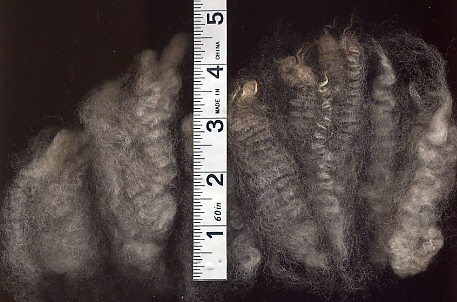
My sample contains a variety of staples which show a range of color and crimp. Length seems to be fairly consistent across the sample, about 5 inches. It's not especially lustrous but very clean with no VM or 2nd cuts. The staples are tapered. The crimp is well defined and I have some locks which measure 6 crimps per inch, and some which measure 2 waves per inch.

There is a lovely range of color, from pale gray to a medium charcoal. The tips are light colored and range from white to tan. The tips are sound.

It is soft enough to wear next to the skin.

It had been scoured before I purchased it, so I can't comment on the amount of grease or the percentage of weigh loss before and after washing.

I did a little research about the breed, I learned that it was developed from colored Romeldales. Perhaps someone thought that the Romeldale color genes mutated to produce a wide range of natural colors (????) I'm not sure about that, but I do think it is some of the loveliest fleece I've gotten my hands on recently. I plan to handcard it and spin long draw from rolags. I think it will make lovely yarn.

Thursday, November 09, 2006

Lace Sampler – Huck

By Leigh

Yesterday I was able to start weaving on my sampler. The workshop is going to explore five weave structures. Besides huck, we will learn huck lace, spot Bronson, Bronson lace, and Swedish lace. The five yard warp I have on the loom will give me an opportunity to learn and explore these. It will require some cutting and rethreading, but that will be better than dealing with separate warps for these!

First on the list is huck. Huck is not technically a lace weave, but it will lead into huck lace, so it's a logical place to start. Also known as spot weave, it is actually a loom controlled textured weave which creates spots of either warp or weft floats. Harriet Tidball (The Weaver's Book) classifies it as a grouped thread or linen weave.

Helene Bress has an entire chapter on it in The Weaving Book: Patterns and Ideas. From her book and the workshop notes, this is what I've learned about traditional huck so far:
  • It consists of short warp or weft floats on a plain weave background.
  • Warp and weft are the same or similar yarn.
  • It requires a minimum of four shafts; two for the pattern blocks and two for the plain weave.
  • The blocks are treadled the same number of times as there are warp ends.
  • How and where the spots form depend on the treadling.
My first two samples (just to get warmed up). These are 12/2s cotton set at 24 epi.:

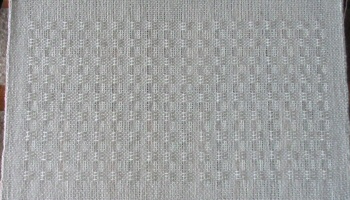
Huck woven warp spots.
Huck woven weft spots.And my third:
Alternating spots on both blocks A and B.The pictures are not exceptional. The flash washed the pattern out and natural light doesn't show it off that well either. We've been assured that is will look better once they are off the loom and washed. You can see how the different times of day effect the color.

I really enjoyed weaving these and can't wait to try the next samples. There are several variations to explore. I'm envisioning blouse fabric and curtains. It is fascinating to me to watch the pattern reveal itself before my eyes. It's almost as much fun as experimenting with color! (Oops, I can't believe I said that. Do note the “almost” :)

I admit that I can't help but wonder how color would effect these. But I'll save those experiments for later. For the moment, I'm content to follow the plan.


Related Posts:
Lace Sampler - Beaming The Warp
Lace Sampler - Huck Lace 1
Lace Sampler - Huck Lace 2
Colored Huck Lace
Huck Towels 1

Tuesday, November 07, 2006

Lace Sampler – Beaming the Warp

By Leigh

This month the Online Guild is featuring a lace weaving workshop. Having spent the past several months exploring color-and-weave effects (specifically log cabin and shadow weave), I think it is a timely change of pace for me. Fortunately, my computer problems haven't put me too far behind in the workshop schedule.

Besides exploring color-and weave, I have been learning how to warp back-to-front. After years of warping front-to-back and struggling with compromised warp tension, I am delighted that b2f warping has made such a difference in my weaving. I can't really lament not having learned it sooner, as it seems to me that f2b is pretty much the American standard these days. I've read that the reason for this stems from the American settlers, who didn't have neighbours close by to help with their warping. But b2f techniques have been developed (or perhaps they've existed from the dawn of ages) which allow a weaver to warp this way alone. It's these techniques which I have been exploring, and with happy results.

I think that being largely self-taught claims most of responsibility for my tension problems. True, I did learn the basics at an excellent one day workshop sponsored by The South Mountain Handweavers Guild, and true, I did take two classes from an excellent weaving teacher. But lets face it, the perfecting of any skill is a process which only emerges from hours of diligent practice. It is the fruit of one's own labor.

I'm not saying that I have the whole thing down pat and could warp a loom b2f blindfolded, or in my sleep. No, I still have to keep my reference materials and notes handy. And I'm still fine tuning. In fact, I was tempted to try some more experimenting with this warp, but decided that perhaps it would be best to get one method memorized before I try experimenting any more. Otherwise I will always feel slow and awkward with the process.

So I've gotten the warp beamed and am ready to thread the heddles. Not without help of course.

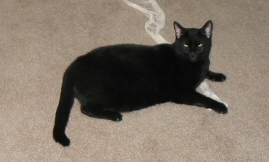
Rascal, helping me weight the warp.  At 16 pounds, he's quite good at it.
Catzee keeping an eye on things.  She takes care of anything that moves.
The ring works better than a shoe string.I am beaming about 5 yards of 12/2 cotton. It is an unbleached natural color. I did make one small improvement in how I weighted the warp bouts. The ring is so much easier to deal with than doing this.

It is a sampler, so I only have 204 ends to deal with, plus floating selvedges.

That said, I'd better get back to work. Hopefully I can get the heddles threaded and my first few assigned inches woven by tomorrow. That's when the good stuff starts.


Related Posts:
Lace Sampler - Huck
Lace Sampler - Huck Lace 1
Lace Sampler - Huck Lace 2

Wednesday, November 01, 2006

Last Shadow Weave

That's “last” as in for awhile, not “last” as in forever. :)

I wanted to try one last shadow weave idea before setting shadow weave aside for awhile. This one further explores texture.

I chose these two yarns:

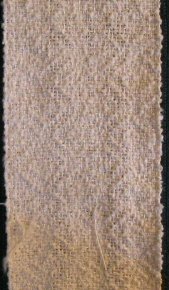
2 white yarns for shadow weave, chosen for texture contrast.


A mercerized 5/3 cotton and a mill end novelty yarn made of who knows what , from who knows where.

I tied on to the same warp as before, keeping the same sett of 16 ends per inch.

Shadow weave design in whites.This is fresh off the loom. Somewhere along the way I had a warp thread disappear, which I didn't notice until I was quite a ways along. This is a distinct disadvantage to working shadow weave in only one color; it's difficult to see mistakes. The lighting makes all the difference in being able to see the design.

I am intrigued enough to be willing to explore this idea more, at a later date. Today however, I begin the Online Guild's Lace Weaving workshop. Something I've been looking forward to for awhile. It will be a pleasant change of weaving pace.

© 2006 Leigh's Fiber Journal

Related Posts:
Shadow Weave: Doing The Triple S - My introduction
Shadow Weave Profiles - How to interpret
Shadow Weave Samples 1 - Begins a series of samples