Tuesday, July 11, 2006

Shadow Weave Samples - 1

By Leigh

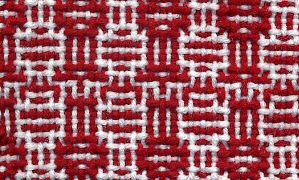
My first set of shadow weave samples is off the loom. I don't have anything profound to report, but weaving these has given me an opportunity to do some experimenting as well as get a feel for it and an idea of what to consider next.

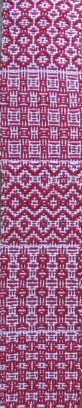
I wove three identical strips of five samples each, choosing different sizes of yarn for each sample strip. In my stash, I found the following of similar color: 8/2 cotton, sock yarn, worsted weight knitting yarn. This gave me an opportunity to experiment with sett as well as yarn size.

The draft (profile actually) was taken from Marian Powell’s 1000+ Patterns. I started with the 4-1 threading on page 66. This is a 4 shaft shadow weave in point twill development. I chose five different treadling sequences to weave the strips, using the same sequences for each strip.

It was the first time I'd worked profiles and since I was unfamiliar with them, they are quite puzzling at first. Here is an excerpt from the page I worked from:


I found that the best way to interpret these was to work them out as a more familiar drawdown on my simple weaving software program, WinWeave.

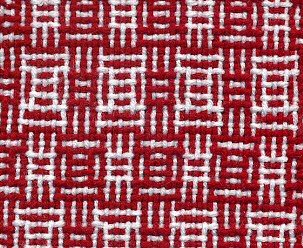
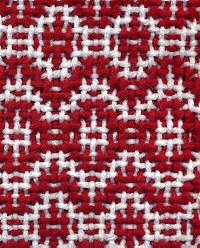
The next pic compares 3 inch segments of the same pattern from the different sample strips:


And here are a few more examples:
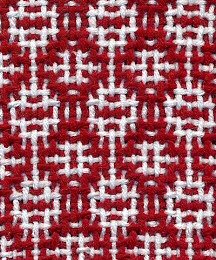


I also discovered how easy it is to make treadling errors! Can you see it?


In re-reading Powell's "this and that" (page 5), I learned to use a shot of sewing thread after completing each treadling sequence, thus giving me a starting point to count from in case I got lost (which more often than I care to admit. :)

Now, on to weaving more samples.


Related Posts:
Shadow Weave Profiles
Profile Drafts

Sunday, July 09, 2006

Shadow Weave: Doing the Triple S

By Leigh

Sounds like a dance step. But, every fiber artist knows what I’m talking about when I quote those three often disliked words, “Sample, sample, sample.” That’s what I’ve been doing.

Now if one is basically an impatient person, like me, then the idea of sampling isn’t very appealing, whether it’s weaving, knitting, or spinning. However, it doesn’t take too many disasters before the wisdom of sampling is exquisitely revealed.

While I was weaving my log cabin scarves, I couldn’t help but think how much log cabin reminded me of shadow weave. Not that I have much experience, but I did make one shadow weave sample for a design board several years ago and have been intrigued ever since:

Shadow Dancer


This is the “Shadow Dancer” detail from one of my design boards. It is woven in Brown Sheep Company’s Nature Spun. It was not only the first time I’d woven shadow weave, but also the first time I’d woven with knitting yarns. I liked it and made my dad an eyeglasses case from it for his birthday that year.

To begin my shadow weave study, I first dug out all the resources I could find, including the March/April ‘05 issue of Handwoven, 1000 (+) Pattern in 4, 6, and 8 Harness Shadow Weaves by Marian Powell, and Color-and-Weave II by Margaret Windeknecht.

As I read Madelyn van der Hoogt’s “Color-and-Weave Basics” article in Handwoven, I was surprised to learn that shadow weave was actually developed from warp rep drafts by Mary Meigs Atwater. (I would have loved to get a hold of some of her shadow weave articles, but those old 1942 issues of Shuttlecraft don’t seem to be widely available, not even on Handweaving.net, nor Ralph Griswold‘s Digital Weaving Archive.)

The technical definition for shadow weave? It’s essentially a plain weave structure, but the blocks follow a twill step sequence so that there are 2 thread overshots at the block edges. Light and dark threads alternate in both warp and weft. There seem to be no strict rules regarding threading and tie-up, as Atwater and Powell approached these differently but achieved identical interlacements.

So, samples are on the loom. Next - Shadow Weave Samples 1


Related Posts:
Shadow Weave Profiles

Friday, July 07, 2006

My Friendship Scarf on Display

Last weekend was Woolfest 2006. It was held in the UK, in Cockermouth, Cumbria which is on the North Western edge of the Lake District. No, I didn’t get to go (dream on, Leigh) but I was affiliated with it through the Online Guild of Weavers, Spinners, and Dyers of which I am a member.

Association stand at Woolfest 2006


The Online Guild is was formed in May, 2002 under the umbrella of The Association of Guilds of Weavers, Spinners, and Dyers in the UK. It's purpose is to provide a community for fiber and textile artists worldwide, who aren’t always able to participate in their local, regional guilds.

Part of the OLG display at Woolfest.


I joined in July of that year and quickly became involved. One of my contributions was to lead a spontaneous knitting workshop in January of 2005. It was based on our new year’s resolutions to clean up our yarn stashes and use up odds and ends. This lead to a Friendship Scarf exchange a few months later. I knitted and sent my scarf off to Scotland and received a beautiful double fringed inkle woven boa from England.

This year a number of these Friendship Scarves were displayed at the Online Guild’s booth at Woolfest, and mine was included!

Display of OLG friendship scarves.


And a close up from my computer photo files:

Close up of my handknit scarf.


The pattern is a self fringing, sideways garter stitch pattern from the Winter 2002 issue of Spin-Off. I used both handspun and commercial wool and mohair yarns.

The Woolfest images are used with the kind permission of the Online Guild's photographer, founder, and convenor, Margaret Parker.

© 2006 Leigh's Fiber Journal

Wednesday, July 05, 2006

Toe Up Socks

Not too long ago I joined the Southern Knit Bloggers webring. Ever since then I’ve been acutely aware that I’ve made very few knitting posts! :o So here's another.

I really and truly love to knit; I just don’t do it much in the summer. It’s too darn hot to have a knitting project in my lap. I always keep a pair of socks on needles however, just to pass the time and keep my hands busy. This is what I have to show today.

Handknit toe up socks


The handy dandy wire hanger sock blockers are an idea from The Knitting Zone. The pattern is quite different from any toe ups I‘ve knit before, as it features a Turkish cast on toe and a reverse Dutch heel.

The toes were quite a trick as they required 2 circs to cast on with. It took me several tries, but it does make a nice toe. I would have taken pictures of the process, but I started these socks before I started blogging.

The reverse Dutch heel was new for me as well. Usually I work short row heels, but for these a flap was knitted and then a gusset.

detail of handknit sock gusset My only problem was a gape. I call it a gape rather than a hole because it is actually an enlarged stitch rather than a space between stitches. I worked the socks with 5 double points and suspected that the gape was because I wasn’t circulating the stitches around the needles as I was working the gusset. I did this on the second sock and sure enough, no gape.

The pattern is by Fiona Morris. She told me she planned to put it on her website eventually, but I haven’t checked to see if she’s been able to do that yet. I knitted them with Bernat Sox Nouveau! using solid royal blue and a variegated yarn in those lovely jewel tones.

Next up is another pair of socks, these for my Dad’s birthday next month. I also need to start planning my winter knitting project. I usually manage one sweater or vest each winter, most often with my handspun. 

© 2006 Leigh's Fiber Journal

Related Posts:
Gallery Photos - Socks

Monday, July 03, 2006

Evaluating My b2f Warp

By Leigh

With my log cabin yardage off the loom I am ready for a new weaving project. My first (second actually, the first was a disaster) attempt at warping back to front was successful, so I am ready to use it again. Two major reasons stand out in my mind:
  1. I definitely happier with the tension. Was it consistently perfect? No. But now I have some things to work on.
  2. It was so much easier to thread the heddles from back to front.
So, I’ve been re-reading my resources and also the blog comments, many of which offered practical help as well as encouragement. I plan to follow the same steps as before (basically Deb Chandler’s one lease method), but pay attention to improving warp tension.

Actually the tension was pretty consistent and weaving went pretty well with my yardage until I got towards the end of 5 yards. At that point the sides were looser than the center of the warp. It didn’t effect the end result, but of course my question is, why? Did it have to do with how I tensioned the warp as I wound it on? Did I not tie my 2-stick heading onto the front apron rod evenly? (see Peggy Osterkamp’s Warping Your Loom & Tying On New Warps chapter 6.)

One thing I want to experiment with is weighting the warp as I wind it on. I have milk jugs filled with water in mind at the moment. And this time I will not cut and re-tie the header sticks again.

At any rate, with Rascal’s help (which he insisted on giving) I’ve begun preparing my warp.

Oh no you can't


Related Posts:
f2b Versus b2f - Beginning of this series
b2f Log Cabin Weaving - finished fabric from this series
B2F Warping - Still Tweaking
B2F Vs. F2B - Why I Switched