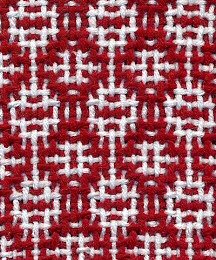
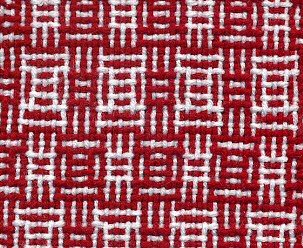
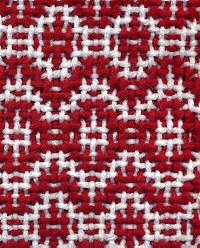
Block B: 2-3-4-3Block D: 4-1-2-1Block C: 3-4-1-4
Saturday, September 21, 2024
Weaving Stool Cushion: About That Draft
Monday, September 18, 2006
Shadow Weave Profiles
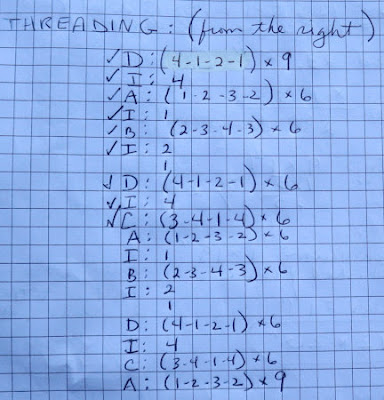
It has been said that the best way to learn something is to teach it. One of the challenges I had in preparing this warp, is that the shadow weave pattern was not written as a draft or even a profile, but rather a description in paragraph form. It is the undulating 4 shaft shadow weave found on page 80 of Margaret B. Windeknecht's Color-and-Weave II.
The description goes something like this:
Blocks A, B, & C are threaded 4 times for a total of 8 ends per block
Blocks D, A, & B are threaded 3 times for a total of 6 ends per block
Blocks C, D, & A are threaded twice, for a total of 4 ends per block
Blocks B, C, D, & A are threaded once, for a total of 2 ends per block
Blocks B, C, & D are threaded twice, for a total of 4 ends per block
Blocks A, B, & C are threaded 3 times for a total of 6 ends per block
Block D is threaded 4 times for a total of 8 ends
Repeat
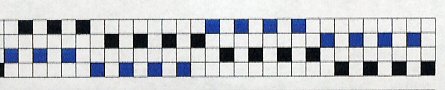
I couldn't follow this to thread my heddles, so I opened up WinWeave and tried to create a draft from these directions. I still got confused. Then I wondered if I tried to write it as a profile first, then perhaps it would make more sense to me. So I came up with this:
For some reason this looked easier to follow than the text description. Each small blue square on the graph paper represents one unit, i.e. one dark and one light thread. The number of squares in each rectangle represent how many times that unit is repeated in that block.
This profile is read right to left, the blocks on the bottom being the A blocks, the next line up being the B blocks, etc. So the first A block on the right is 4 units (1 dark thread and 1 light thread for a total of 8 threads), the next block, B, is 4 units (8 threads), etc.
After that I had to figure out how to translate all that into a heddle threading pattern. This was a bit more challenging as the profiles Ms. Windeknecht uses are different from the profiles I had become familiar with in Marian Powell's 1000+ Patterns.
Ms. Powell uses adjacent shafts for threading the blocks, while Ms. Windeknecht uses opposite shafts as developed by Mary Meigs Atwater. So:
Block A - Atwater, shafts 1 & 3 - Powell, shafts 1 & 2
Block B - Atwater, shafts 2 & 4 - Powell, shafts 3 & 4
Block C - Atwater, shafts 3 & 1 - Powell, shafts 2 & 1
Block D - Atwater, shafts 4 & 2 - Powell, shafts 4 & 3
I wrote out the 2 shafts for each square of the profile using the Atwater system, and came up with this (these are the first 4 blocks with A, which uses shafts 1 and 3 on the right, all the way to D, using shafts 4 and 2 on the left):
A standard tie-up is used and it is to be treadled as drawn in. After I finally got it onto WinWeave, the draft and drawdown something like this:
Of course, this isn't the entire pattern. WinWeave wanted to print in out on 5 pages, which I decided not to do.
If anyone has actually read through this, congratulations! If anyone actually understands it, stand up and take a bow! I would love to ask for feedback as to whether or not it makes any sense, but I think that would be asking a bit much of my readers. So thank you for bearing with me. I think I understand it better for trying to explain it, though I don't know if I could do a repeat performance in a month or two.
Related Posts:
Profile Drafts
Undulating Shadow Weave 1 - Weaving
Undulating Shadow Weave 2 - Hemstitching
Undulating Shadow Weave 3 - Finishing
Shadow Weave Samples 1 - Begins the series of samples
Monday, October 13, 2008
Profile Drafts
The first question we need to answer is, what is a block? A block is a repeatable section of an overall pattern. Blocks consist of units, which are smallest number of threads needed make the weave unique. (More on that in this post.) Blocks can have as many repeats of a unit as the weaver desires.
As an example, let's look at this summer & winter dishtowel I wove about a year and a half ago. It is a simple 4-shaft design, using a Fibonacci sequence in both the threading and the treadling.
Below is the thread by thread draft for one pattern repeat. You can click on it to enlarge it.
Here is a profile of the same draft.
Each square in the profile represents a threading unit. If you compare it to the thread-by-thread draft, you see that from the right, unit A is threaded once, then unit B twice, then A three times, etc. The profile has two rows, because it uses only two blocks. The first row is for block A, the second for block B, and so on for additional blocks.The beauty of a profile, is that its pattern can be adapted to any block weave. For example, here's the same profile in M's & O's (click to enlarge)
Or, a Multiple Tabby Weave (click to enlarge)
As you can see, profile drafts are not only easy to read and write, but are very versatile as well.Related Posts:
Shadow Weave Profiles
Tuesday, April 07, 2009
One Thing Leads To Another
My samples for the Complex Weavers Tied Weaves Study Group Sample Exchange are ready to go.
Each one is attached to a weaving record sheet which includes the draft on the back, plus a write-up of how I developed the idea. Because my barcode name draft was too large to print out, I included only part of that, but added a complete profile draft. I called my draft "Tortie Trails," in honor of its source of inspiration.Initially, I planned to move on to something else entirely after I mailed the samples. However, this image .....
.... got me thinking along other lines. I didn't intend for the sample to shrink like that, but the unexpected result made me wonder if I could do it on purpose.
This sample is a 10/2 unmercerized cotton for warp and tabby weft, and an 8/2 rayon for pattern weft. I read that rayon tends to shrink more than cotton, so hopefully this will give me a similar effect to Catzee's cloth. This one is more in the proportions of a scarf, so if it works, I can wear it!As with many of my sources of inspiration, one idea leads to another. The result of this is that my weaving experience seems more like a journey than a classroom experience. But it's hard not to follow the evolution of ideas. In fact, I doubt I could do it any other way.
Posted 7 April 2009 at http://leighsfiberjournal.blogspot.com
Related Posts:
An Unexpected Wrinkle
Poll Results & Test Press
Tuesday, February 03, 2009
Summer & Winter Pine Tree Table Runner
Here it is, off the loom, wet finished, and ready to use. The pine trees ..........
And the snowflakes / birds nests ..............
The project particulars:- Draft: adapted from Carol Strickler's A Weaver's Book of 8-Shaft Patterns (#549 page 155)
- Warp: 8/2 unmercerized cotton in navy blue
- Weft:
- tabby: 8/2 unmercerized cotton in navy blue (different cone)
- pattern: 5/2 mercerized cotton in light green
- tabby: 8/2 unmercerized cotton in navy blue (different cone)
- Sett: 16 epi
- PPI - 18 pattern ppi and 18 tabby ppi
- Total warp ends: 220
- Width on loom - 13.75 inches
- Width off loom - 12 inches
- Width after washing - 11 inches
- Length on loom - 2.5 yards (total warp length, tied on)
- Length off loom - 72.5 inches
- Length after washing - 63.5 inches
- Wet finishing - cold water wash and hot dry
What I learned:
1. That it would be easier to see mistakes if I had woven with the "winter" (dark) side up. After it was off the loom, I discovered a treadling error, which wasn't nearly as noticeable on the side I looked at as I wove (summer, light side.) I don't quite understand the structure well enough to correct this with needlework, so there it remains. You can see it in the bottom photo if you look closely.
2. That to weave the profile draft in the book, I had to weave each block with four pattern shots (plus their tabby shots.) To put it another way, I had to weave each profile block with two units of the designated threading. If I wove with only one unit per block, the result was very squatty looking pine trees. I got a glimpse of this when I doodled with the draft on DB-Weave, but what was actually happening didn't sink in until I started weaving.
3. About that skeleton tie-up. I've tried it two ways on my 8 shaft countermarche Glimakra.
This way ............
........... which puts tabby treadles on the extreme left (1 & 2) and the tie-up treadles (3 & 4) next to them. Also this ...............
.......... which puts tie-down treadles on the left and tabby shafts on the right. I changed because I was having trouble keeping track of the treadling order the first way. However, I had the same problem with the second tie-up as well! What I've learned is that I have to find a better way of keeping track of which tie-up treadle is next, without losing the pattern treadle. I don't have it all figured out yet, but I'm learning from my experience in spite of myself.Related Posts:
Back to the Pine Trees
Snowball, Star, or Snowflake?
Monday, December 02, 2024
Crackle Sampler Washed & Pressed
|
|
| Samples #1-4 |
- warp
- 10/2 cotton
- 160 ends
- 20 e.p.i.
- 10-dent reed threaded 2 per dent
- weft
- 5/2 (or 10/2 doubled) cotton pattern weft
- 10/2 cotton ground weft
- Some samples used a 10/2 pattern weft
-
See
introduction
for profile draft, threading, and tie-up.
- Width in reed: 8 inches
- Finished width: 7 inches
Shrinkage makes a difference, of course, both in fabric size and the look of the fabric. For example, sample #6 which is a twill treadled without tabby.
|
| Sample #6 before washing |
|
|
|
Sample #6 after washing |
The
summer & winter treadling
was one I was interested in. If you recall, this is one I thought might be a
contender for
dining room draperies, to coordinate with my Blue Willow china. Wet finishing made a wonderful
difference . . .
|
|
|
Samples 11 (top) & 12 (bottom),
summer & winter manner of weaving |
Sample 12 looks like it might do very well for that project and deserves a larger sample.
The
woven as lace samples
also improved with wet finishing. It's difficult to appreciate in a photo because the pleasingness of the effect is
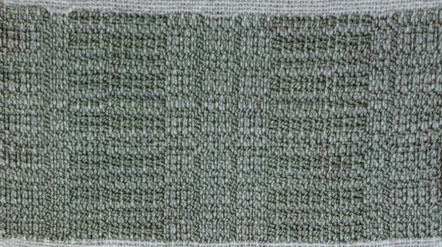
textural. Same color warp and weft makes it difficult to photograph. It needs the angle of light to see it in a picture.
|
|
|
Samples #13, 14, and 15. |
|
|
|
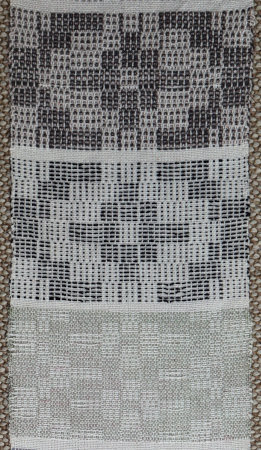
Bottom to top: samples 16, 17, 18 |
The shadow effects samples also interested me on the loom. The one on the bottom (on the right), #16 is called "Shadow-y." It doesn't have good color contrast between warp and weft, so I find it more difficult to appreciate. I'd like to try it again with contrasting colors.
The middle sample, #17, Shadow Blocks, is okay, but doesn't inspire me, I think because it's flat looking compared to the top sample, #18.
#18 is Mary Snyder's Shadow Blocks and is much more interesting. I think this is because it has a more crackly look to it. Plus, using more colors offers more opportunity for color blending (which is what drew me to crackle weave in the first place). I chose two neutrals (dark gray and brown) for my two color wefts, and I think brighter colors would be really fun.
Another sample that I was curious to see wet finished is #27, lengthwise stripes. Here it is below, before and after wet finishing.
|
|
|
#27, lengthwise stripes on the loom |
|
|
|
#27, lengthwise stripes after washing, drying, and pressing |
I like that the stripes pop out more after finishing and I'm happy that the little background stripes remain. This one would be fun with various stripes being different warp colors.
|
|
|
Samples #29 - 32 |
I wove a lot of samples, and amazingly, I didn't exhaust the catalog of manners of weaving for crackle. But I've got a good collection and I'm getting important information about my yarn size and color choices. Some of them I'd like to weave again, to explore them on a larger project. Sampling is good to a point, but doesn't necessarily tell me how the fabric will behave on a larger project.
My next step is to sew the edges of each sample to prevent fraying. Thankfully, I made good notes in my blog posts, and each of these will be printed out for a sampler book. Each sample will be secured with it's information and notes. I'll use the new photos to update my Crackle Manners of Weaving page.
Between all that plus some sewing and mending, I have plenty to keep me busy for awhile.
Wednesday, October 16, 2024
Crackle Weave Study Part 1: Manners of Weaving on 4 Shafts
- Crackle is a twill based block weave.
- The blocks are composed of 3-shaft point-twill threading units,
- but it isn't a unit weave. In a unit weave, the blocks weave independently of one another.
- Crackle blocks do not weave independently of one another because each block shares pattern shafts with one of its neighbors. (See threading key below)
- Blocks A and B share shafts 2 and 3
- Blocks B and C share shafts 3 and 4
- Blocks C and D share shafts 1 and 4
- Blocks D and A share shafts 1 and 2
- Exception: by omitting one block in the sequence, it's possible to weave rows of only one block.
- The number of blocks is determined by the number of shafts. 4 shafts can weave 4 blocks.
- In 4-shaft crackle, blocks weave as either pattern blocks and background blocks.
- As a twill derivative, treadling follows the odd/even shed order of twill.
- To maintain that order, transitional thread ends (incidentals) are used between blocks.
- Floats are no longer than three ends or picks.
- Based on the sampler idea from Susan Wilson's Weave Classic Crackle & More, page 30.
- warp
- 10/2 cotton
- 160 ends
- 20 e.p.i.
- 10-dent reed threaded 2 per dent
- width: 8-inches
- length: 5-yards
- weft
- 5/2 (or 10/2 doubled) cotton pattern weft
- 10/2 cotton ground weft
- threading
- Susan recommended something with diagonals, points, or zigzags
- I used her diamond motif threading (page 34) because it includes both consecutive and non-consecutive blocks. That way, I'm hoping to get a better idea of what's going on.
-
threading key:
Threaded right to left. O = incidentals, threaded at the end of the block only. -
profile draft:
- tie-up
![]() |
| Numbers in right-hand column indicate shafts. Numbers along the bottom indicate treadling. |
- Part 1: manners of weaving on 4 shafts
- Part 2: color and crackle
- Part 3: manners of weaving on 8 shafts
Tuesday, July 11, 2006
Shadow Weave Samples - 1
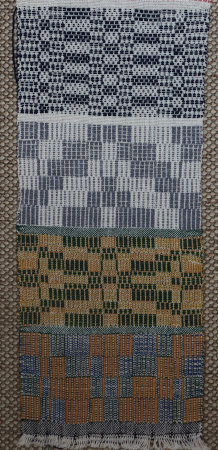
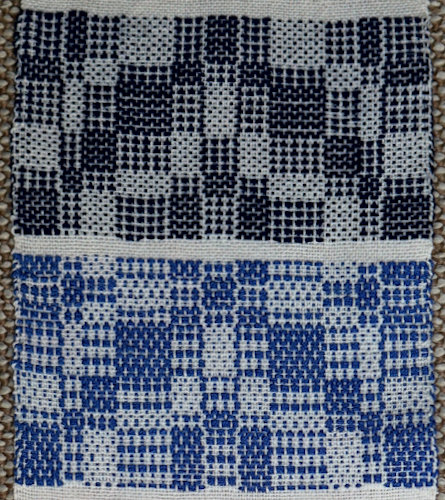
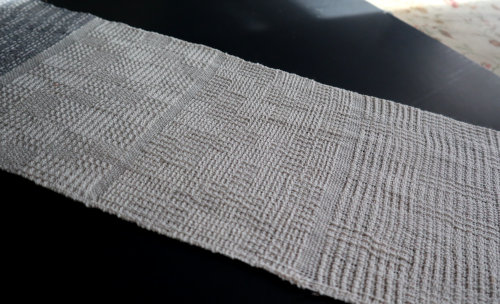
My first set of shadow weave samples is off the loom. I don't have anything profound to report, but weaving these has given me an opportunity to do some experimenting as well as get a feel for it and an idea of what to consider next.I wove three identical strips of five samples each, choosing different sizes of yarn for each sample strip. In my stash, I found the following of similar color: 8/2 cotton, sock yarn, worsted weight knitting yarn. This gave me an opportunity to experiment with sett as well as yarn size.
The draft (profile actually) was taken from Marian Powell’s 1000+ Patterns. I started with the 4-1 threading on page 66. This is a 4 shaft shadow weave in point twill development. I chose five different treadling sequences to weave the strips, using the same sequences for each strip.
It was the first time I'd worked profiles and since I was unfamiliar with them, they are quite puzzling at first. Here is an excerpt from the page I worked from:

The next pic compares 3 inch segments of the same pattern from the different sample strips:

And here are a few more examples:


Now, on to weaving more samples.
Related Posts:
Shadow Weave Profiles
Profile Drafts
Wednesday, October 15, 2008
Summer & Winter: Tie-Up
I started this Summer & Winter series with a basic definition, and then discussed threading and profile drafts. Next comes the treadle tie-up.
Tie-ups determine which shafts are lifted to create various sheds. For a project or pattern from a book or magazine, we tie-up the treadles as the draft indicates. But what if we want to explore all treadling possibilities?
Summer & winter weaves a pattern tied to a plain weave ground. This means that two treadles must be tied up for plain weave, which are used for the tabby picks between the pattern picks. The rest of the treadles are free for any combination.
A complete tie-up gives the weaver all possible sheds for the given threading. For S&W it must:
- allow for plain weave and tabby treadling*
- allow for pattern treadling
- combine every pattern or combination of pattern shafts, with first one and then the other tie-down shaft
The tie-down shafts are tied to treadles 1 and 2. The pattern sheds are tied to treadles 3 though 8, and the tabby sheds are tied to treadles 9 and 10. With this tie-up, all possible sheds are available to the weaver.This is fine if we have ten treadles, but what if we don't!??! Does that mean that the only way to explore all the treadling possibilities for a 2-block S&W is to periodically change the tie-up?
No, it means we need to use a skeleton tie-up to accommodate the number of treadles actually available.
What is a skeleton tie-up? Click here to find out.
[*I'm using the terms plain weave and tabby in a modern sense, where plain weave usually refers to a structure itself (over one, under one, etc), and tabby being the use of plain weave shots alternated with pattern shots, such as in summer & winter, crackle, or overshot. ]
Posted 15 Oct. 2008 at http://leighsfiberjournal.blogspot.com
Related Posts:
Summer & Winter: A Basic Definition
Summer & Winter: Threading
Summer & Winter: Treadling
Summer & Winter: Structure and Theory
Skeleton Tie-Ups for Jack Looms
Skeleton Tie-Ups for Countermarche Looms