Saturday, September 11, 2010

Guild Retreat

The Western North Carolina Fibers/Handweavers Guild had its annual guild retreat today. The turnout wasn't large, but that only seemed to make the event all the more cozy and intimate.

It was a rainy, gloomy day,


but that didn't dampen anyones spirits for kool aide dyeing.


Did you know that the different drink mix brands create different hues?  For example, a green mix in four different brands will give you four different kinds of green.

Two looms were set up for working on baby blankets for Project Linus.


The spinning circle offered a time to visit and chat.


That's my Kromski Minstrel in the lower left corner.  I actually made some progress on my pol-paca! I can't believe I first blogged about it almost two years ago. Most of the yarn I've already spun is still packed away from our move.


Teena joined the circle while working on heddle making.


Walt brought his work with him, one of his custom benches with woven seat. You can see another one here.

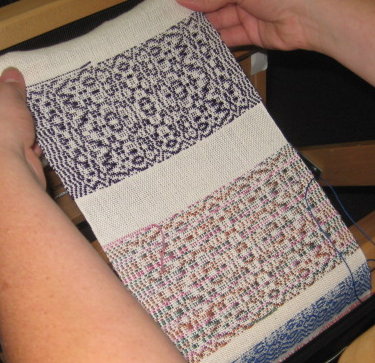
The other fun thing we did was to weave our name draft.


Several looms were threaded in an overshot name draft with our Guild's name, Western North Carolina Fibers/Handweavers Guild.


We learned how to draft our own names for the treadling.


I was familiar with the concept, but had never actually woven a name draft before.  Each letter of the alphabet is assigned a shaft number.  We learned how to add shaft numbers in between duplicates.  For example, with my first name (above top), the L, I, G, and H are all assigned to shaft 2.  By adding shaft number 3 between adjacent 2s, I had a weavable draft.

Neighboring shaft numbers were circled in pairs, and the pairs counted to determine the treadling sequence.  Since it is overshot, tabbies were thrown in between each pattern weft. My treadling, without the tabbies, was:

1 - 2, x 2 (shafts 1 and 2 lifted twice)
2 - 3, x 4
1 - 2, x 1
1 - 4, x 1
3 - 4, x 1
2 - 3, x 4
3 - 4, x 5
1 - 4, x 3
reverse (I did add one shot of 1 - 2 here, to avoid the 1 - 4 being treadled 6 times).


Here's my name treadled forward and reverse on the Guild name threading.  As you can see, I chose a space dyed yarn.


Here's a close-up.  It's been almost a year and a half since I've woven anything. When I sat down at the loom I wondered if I'd even remember how!  But it was as though I'd never taken a break.


We really had a lot of fun.

Guild Retreat © September 2010 by Leigh at Leigh's Fiber Journal

Friday, September 03, 2010

A Little Sample Of Llama

I have finally managed to get a little sample of llama fiber from Charlie. I say "finally managed," because I learned very quickly that llamas don't particularly like to be caught and handled. Since I wrote an update about Charlie on my homestead blog, I also wanted to show you his fleece. I figured my sadly neglected fiber blog would be the best place to do that.

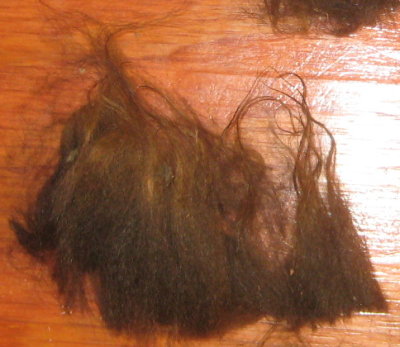
His color is not a true black, but rather a very dark chocolate brown. The tips are lighter brown from sunbleaching.  Here's a close-up of his shoulder area (with flash, making the color a bit reddish)....


And hip. The bump in the upper right is his tail...


Off the llama....


I managed to get a couple of staples from his shoulder. While they measures three to six inches in length, this isn't an accurate assessment of a full year's growth. He's only seven months old, and has had one shearing, albeit a poodle type blanket cut. Nor did I cut this close to the skin, but left enough on him so he wouldn't look like he had a patch of missing wool.


Because Charlie's so young, his fleece is wonderfully soft. He was sold to me as a "woolly" llama, and I have since learned that there are several types of llamas, based on their wool.

Tapada llamas are the woolly llamas.  Their fleece in medium to long, dense, and can be silky, crimpy, and wavy. They are considered single coated and should have less than 1% guard hair. They need shearing once a year.

Lanuda llamas, are another woolly type, but these grow wool all the way down their legs. I didn't know enough to ask the breeder about the wool types, but based on how his fleece is growing out, I'm guessing Charlie is one of these. He had his first shearing before I bought him, so I don't' know what he'll look like with his fleece completely grown out. Llamas are shorn once a year, and that will be a job for next spring.

Curaca are medium wooled llamas, with guard hair content averaging 3 to 15%. Unlike tapadas and lanudas, which must be shorn, cucacas shed somewhat. Because of that they are often shorn every two to three years. Their wool grows below their knees like lanadas.

Ccara llamas are the classics. They have fairly short, double coats, the guards accounting for at least 15% of the fleece.  Because of the guard hairs, they don't pick up a lot of debris (which Charlie is always full of). Of course the downy undercoat is what a spinner wants. A ccara's is semi-crimpy and evidently fairly easy to harvest, as only the inner coat sheds. Removing it is a matter of grooming it out. No shearing or clipping required.

Before I got Charlie and began researching this, I didn't have a clue. I had never spun llama before, but now I understand why spinners have such different experiences with it.

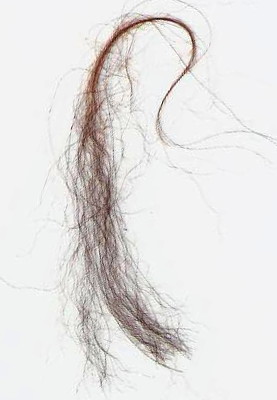
Here's a scan on the left.  I don't know how well you can tell, but I'm assuming that the straight fibers are guards. The rest of it has an undefined crimp of about 10 or 11 per inch. His wool will get coarser as he gets older, but how much remains to be seen.

It contains no grease, but is dusty and loaded with VM. This is because llamas like to roll in the dirt, in the grass, in the weeds, in the brambles, whatever.

It kills me to see Charlie loaded with VM and at first, I wanted to comb him out every day. Llamas however, don't like being petted or brushed and combed. I quickly figured out that if I messed with his fleece every time I caught him, he would soon be very difficult to catch. So we've been working on trust, and that means respecting his "no touch" rule. I should mention that this rule appears to apply to humans only. It's okay if a chicken perches on him, of if a goats plops down right beside him. It's just not okay for a human to touch him.

I haven't had a chance to spin it yet, but when I do, I plan to card it and spin woolen. I'm sure though, that I'll do a lot of experimenting with it. I'm very curious as to how the yarn will turn out. Hopefully I'll have a chance to do that soon.

To see photos of Charlie and read what I'm learning about llamas, visit my homestead blog, here.

A Little Sample Of Llama © September 2010 

Friday, August 06, 2010

Have I Mentioned My New Fiber Source?

Those of you who visit my homestead blog probably already know about Charlie.


He's a "woolly" llama and is the newest addition to our homestead.


He's just a little guy, 6 months old, who is to serve as guard llama for the goats (and chickens apparently), and a fiber source for me.  He's already been sheared this year, which is just as well, because we have our hands full just getting him used to us.

For a few more photos, click here. :)

© August 2010 by Leigh at Leigh's Fiber Journal

Thursday, June 03, 2010

Old Fabric Finds

When we bought our place, the house was cleared out but the outbuildings weren't. Dan wanted to use one as a workshop, but it had to be cleared out first. It was loaded with the previous owner's junk, plus a little of our own. As he toted stuff out, he found an old suitcase. In it, was a pile of old cotton flour and sugar sacks. We were pretty busy at the time so the suitcase was set aside and forgotten. Somehow we got to talking about that the other day, and he pulled it out so I could take a look.

Most of the sacks were worn, torn, and stained. Many had been cut open to use for other things. All were cotton. A few still had their original stamped labels, faded, but legible nonetheless.

Many of them were sugar sacks, like this ten pound Dixie Crystals sack.

Front

Back

According to an article on Wikipedia, the original Dixie Crystals sugar refinery was built in 1916-1917 in Port Wentworth, Georgia. The refinery was sold in 1997 to Imperial Sugar, which continues to sell the Dixie Crystals brand today.

This ten pound sack once contained Hershey's granulated sugar. Hershey's of course, is the famous chocolate maker located in Hershey, Pennsylvania, though they no longer sell sugar.

There were several of these larger 100 pound sugar sacks. Notice where it was made, Central Hershey, Cuba. This gives a clue as to how old the sacks might be. According to this website, the Hershey Company built Central Hershey, a sugar mill and mill town, in Cuba in 1916.

This was at the time of World War I, when sugar was being rationed. Milton Hershey wanted to ensure a supply of sugar for his chocolate manufacturing, and what better way than to produce it himself. He sold the sugar mill in 1946, to the Cuban Atlantic Sugar Company.

Also in the suitcase was at least one flour sack.

I couldn't find much information about Sunkist Flour on the internet, other than two tidbits. First, an excerpt from "Reports of cases determined in the Appellate Courts of Illinois, Volume 186", which referred to a legal case in 1910. Sunkist flour was evidently milled by the Maney Milling Company in Omaha, Nebraska. The plaintiff had an order for 4,000 barrels of flour (at $5 per barrel), of which only 155 were delivered before the mill burnt down.

The other tidbit was on the website of the Douglas County Historical Society of Omaha as a list of miscellany. It mentions a Sunkist Flour ink blotter, circa 1940.

Notice that it is self-rising flour. I didn't know this, but self-rising flour was invented in 1845 in Bristol, England.

This one is partially too faded to read, but as you can see, it is hen feed. Of course, we already knew that previous occupants of our house had chickens. I reckon today we would call this layer ration.

It appears to be stamped "Green (something or other) Hen Feed." I can't make out that "something or other" so I have no way to research it. Still, it was an interesting find.

Most of the other sacks have been washed so many times that the inks are completely faded. Though worn and stained, the cotton fabric is usable, for sacks or for something else. Maybe a quilt? Nothing is anywhere near "mint" condition, so not of much value. Still, these are little glimpses into the history of our old house.

Old Fabric Finds © June 2010 

Friday, April 16, 2010

Stash Reduction Afghan Progress & More Socks


Progress on my stash reduction afghan for Project Linus is coming along slow but steady. I never did get that orange yarn, though I would have loved to add orange to this. I just got too far along and gave up on it.

It's at the point though, where it is too big and bulky (and hot) to take with me when I go places. For that, I wanted my usually "go" knitting, socks!

I told DH I'd make this next pair for him. I handed him Knit Socks! 15 Cool Patterns For Toasty Feet , told him to pick a pattern, and to pick a color. Well, he ended up liking the exact pattern I had just finished for myself (pic of my finished socks here), the "Classy Slip-Up" socks.

New socks begun.  Yay!
And what color did he want? Blue and red. Oh dear. For one thing I had just finished knitting a pair of these and wasn't terribly interested in knitting the same pattern so soon. The other thing is that the pattern doesn't exactly lend itself to two color knitting. What to do.

When I pointed the color problem out, Dan said, well, he liked the stripy effect of another pattern in the book, the "Checkered Textures" sock.


Not an accurate scan of the colors, but you get the idea. You can see the full, original photo on page 97 of Betsy Lee McCarthy's book.

The challenge then was how to combine the two sock patterns. I really had to think about this for awhile. My solution is nowhere near the stripy effect of the "Checkered Textures" socks, but he's happy with it, and that's what counts.


The cuffs, heels, and toes will be knitted in blue, the rest of it alternates the blue and red yarns. The blue row is always the slipped stitch row. Since it is the red yarn in the previous row that is slipped, the result is red stripes. The yarns are from KnitPicks.

As with my other projects, these will probably take awhile. But as long as Dan can see some progress on them from time to time, he's happy.