Monday, August 14, 2006

Shadow Weave Sample Strip Off the Loom

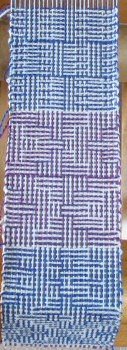
Leigh's shadow weave sample strip.
My shadow weave sampler strip is finally off the loom. I say finally, because it seemed to take an awfully long time to weave.

I wasn’t sure of the best way to photograph all ten yards, so it ended up in a pile. Close ups plus yarn and weaving details can be found in this post.

My weaving width was a fraction shy of 3 inches (46 ends sett at 16 epi). Fresh off the loom the strip measured 2 & 5/8 inches wide by 9 yards 5 inches in long. I might have been able to eek out a few more inches, but I finally had one thread break close to the end of the warp, and so just wove it off. The yarn, Knit Picks lace weight merino at 4141 yards per pound, proved to make a sturdy warp.

After wet finishing and steaming, it measured 2 & 1/2 inches by 8 & 2/3 yards.

Next will come some experimenting with lengths of this. And even though I’m curious to see how they will look sewn together lengthwise, I have to admit that mostly, I'm just glad to have it off the loom!

Next - Shadow Weave - The Next Warp

© 2006 Leigh's Fiber Journal

Related Posts:
Shadow Weave Profiles- how to interpret
Shadow Weave Samples 1 - Begins the series of samples

Saturday, August 12, 2006

Winter Knitting Project

Now that I have the bag to carry it in, it is time to seriously work on planning my winter knitting project. Summer and its heat are for knitting socks. Winter and its cold are for knitting sweaters.

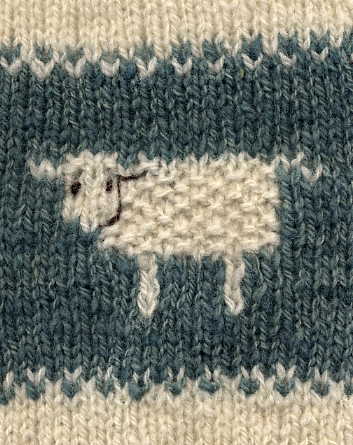
My project this year will be my Rare Breed Sweater. I’ve been working on this idea for a long time. It first came to me in August 2002, when the Online Guild did its first rare breed challenge.

The breed for that first challenge was Hebridean. As I worked with my 300 grams of fleece samples I wondered (as always), “But what can I do with it???” Then I had one of those “light bulb” moments. I could use this sample, plus any rare breed samples I could get my hands on, in a motif featuring rare breed wools.

I later worked up a swatch idea with some of my handspun from the Online Guild‘s Ryeland Rare Breed Challenge:

Leigh's handknit swatch from the Online Guild's Ryeland Rare Breed Challenge.


Then I began collecting. Over the past four years I’ve obtained and spun samples of:

My handspun rare breed yarns so far.


Left to right: Cotswold, Lincoln Longwool, Tunis, Soay, North Ronaldsay, Shetland, Wensleydale, Navajo Churro, Jacob, Teeswater, Hebridean, White Faced Woodland, and Hog Island.

The Hog Island was roving which had been dyed blue before it was given to me. Of the North Ronaldsay and Navajo Churro, I have several colors to choose from.

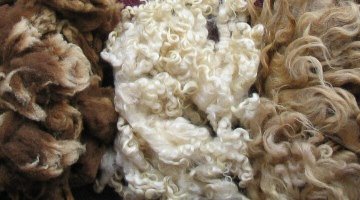
I still have a few left to go:

The 3 rare breed fleeces left to spin.


From the left, Manx Loghtan, Leicester Longwool, and Karakul are yet to be spun. This is good because it is still too hot to have a large wool project in one’s lap.

After I finish the last of the spinning, I will have to do some serious swatching to explore design ideas I have been contemplating. The body of the sweater will be Ryeland, as I purchased a whole kilo of raw fleece and so have the most yarn in that breed. Each knitted sheep will be a different rare breed.

I won’t pretend that this WKP (winter knitting project) will take only one winter. I knit for relaxation and pleasure (read I knit s-l-o-w-l-y) though I do usually manage to knit one sweater or vest each year. Even so, I am excited about finally getting to start the knitting part of this project. It’s been a long time coming.

© 2006 Leigh's Fiber Journal

Related Posts:
Rare Breed Sweater Swatches
TA-DAH! Rare Breed Sweater Done!

Monday, August 07, 2006

Sample Strip Bag Completed

The challenge has been “What do I do with all my handwoven sample strips.“ I presented an idea in my last post, and I completed it over the weekend. In contemplating the suggestions from the comments for this post, I was able to work though several things I had questions about.

My first question was about the bottom. I had vaguely thought to simply use one of my handwoven strips for the bottom, but Valerie’s suggestion to use commercial fabric made more sense as it addressed a couple of things: waste (as in, who’s going to see the bottom anyway), and wear (as in, why wear out handwoven fabric when commercial fabric will do), not to mention possibly getting the bottom of the bag dirty.
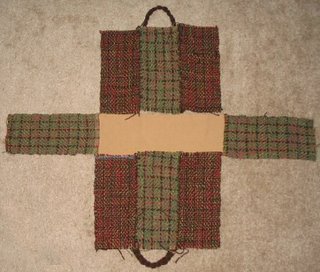
Sample strip bag pieces laid out.


First I braided the i-cord. It took about 7 yards for a two yard braid. I really liked Tricia’s idea of fulled i-cord, as it would have prevented any stretching of the handle. But since I wasn’t working with wool, I’ll have to save this suggestion for another time.
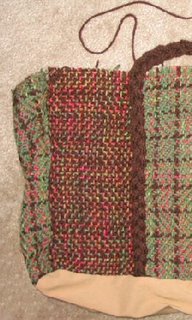

The bag's sides, strap, & bottom handsewn together.The handwoven side panels were whip stitched together and the i-cord was stitched to the outside in the same manner. Next, the end panels were placed wrong side together with the sides. I used a running stitch to sew them together, leaving the selvedges exposed on the outside of the bag to make a nice edge. Lastly, I sewed the bottom panel on by hand.

Another problem I had contemplated was that I didn’t want the bag to have a soft, droopy bottom. Initially I had wondered about putting cardboard in the bottom, but Charleen came through with the suggestion to use plastic canvas. Perfect!
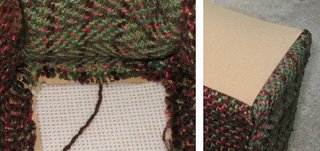
Bottom of the bag, inside & out.


I tucked the plastic in under the seam allowance around the bottom. This took care of the possibility of the corners of the plastic poking through my handwoven fabric. I tacked it down in a couple of places to prevent slippage. The result was a beautiful, firm bottom to the bag.

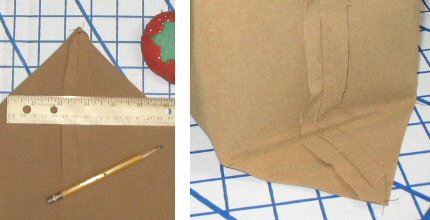
I made the lining from a simple rectangle of the same fabric I used for the bottom. After sewing up the side seams I measured for the corner seams. Using a ruler to keep the liner’s side seam centered, I measured and marked a line as long as the bag’s width.
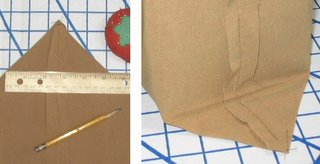
How I sewed a square corner for the bottom of my bag.


Stitching across this line made a nice squared corner
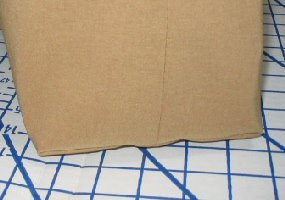
Outside view of squared corner.


I sewed the lining to the bag with right sides together, leaving an opening on one end. I pulled the bag right side out and hand stitched the opening closed. I added a couple of reinforcing stitches for the hand straps and that was it!
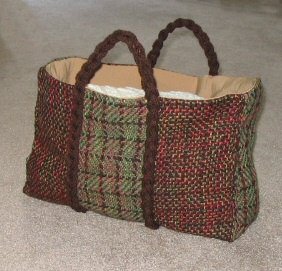
The completed handwoven sample strip bag.


My plan is to use this for my Winter Knitting Project. I love to use baskets for yarns and knitting, but find that they are often awkward to transport. So this bag will be used for that.

© 2006 Leigh's Fiber Journal

Friday, August 04, 2006

Bag Idea for Sample Strips

With the discussion and ideas for samples and sample strips, I’ve been thinking about possible things to do with some of the extras.

Sometimes inspiration comes from unexpected places:

Rascal, making himself at home on my neat pile of handwoven log cabin scarves.


That “Oh, no” moment led to an idea:

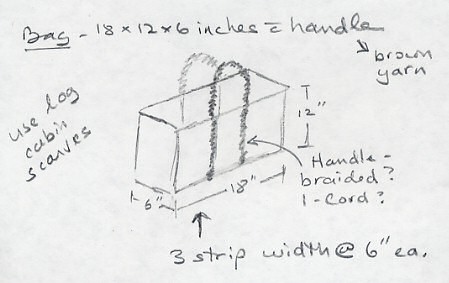
Sketch for a knitting bag made from log cabin scarves & sample strips.


Each scarf is 6 inches wide, so I can sew three together to make the body of the bag with an 18 inch width. I'll use another sample scarf for the ends. Haven't decided about the bottom yet.

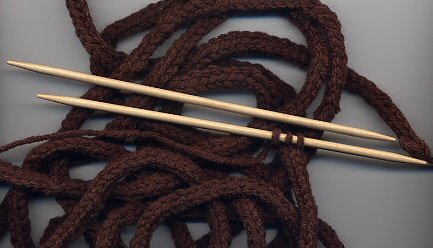
After contemplating several options for the strap/handle, I finally decided to knit an i-cord:

Knitted i-cord strap for bag.


I reckon a couple of miles ought to do. I’m thinking about braiding it to make it sturdier.

© 2006 Leigh's Fiber Journal
Next - Making the bag.

Wednesday, August 02, 2006

Shadow Weave Samples - 4

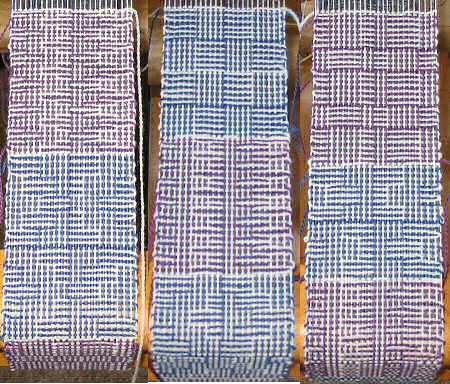
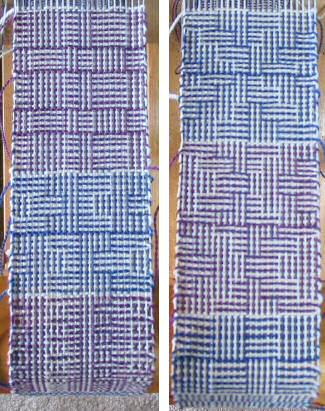
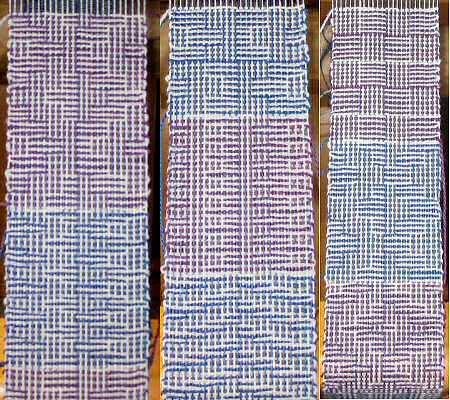
Leigh's Fiber Journal shadow weave samplerAfter I took the last shadow weave samples off the loom, I warped a 3 inch width of 10 yards (which the impatient side of me thinks was an insane decision) of Knit Picks Shadow , their lace weight merino. I warped back to front, which I am finally getting comfortable with. I've been using almost full half gallon milk jugs as weights and am very happy with my warp tension.

My idea for this warp has been to weave a long sample strip which I can cut and sew together into a vest? cardigan? pullover? handbag? ?????

The warp alternates blue and white, while the weft colors of blue and purple with white alternate for each variation. These are an opposite development of shadow weave from Marian Powell's 1000+ Patterns in 4, 6, and 8 Harness Shadow Weaves, page 103. The yarn weighs in at 4141 yards per pound and my sett is 16 epi. (The individual photos weren’t all the same size, but you get the idea.)

Here is a sampling of the variations I’ve been trying:


Leigh's Fiber Journal shadow weave samples
More shadow weave samples
And still more shadow weave samples!
Finally, here's the last of them.
One good thing about small samples like this is that it doesn’t matter if I make a few treadling errors. Who’s gonna know? There is also a lot of freedom to experiment; if I don’t like it, that’s okay because it’s only a small part of the entire strip.

This sampling/journaling/exploring/learning activity with weaving is a crucial step for me as a weaver. However, when I’m in a sampling mode, I struggle with the tension of the usefulness vs. uselessness of my end product. Oh sure, the samples are valuable to me personally, but somehow they don’t satisfy my inner desire to produce beautiful and useful things. Sometimes I weave scarves as samples, but how many scarves does one need?

This sample strip is an attempt to resolve that tension. How well it works will probably depend on whether I actually use it for anything. ;)

Next - Shadow Weave Sample Strip Off the Loom

© 2006 Leigh's Fiber Journal

Related Posts:
Shadow Weave: Doing the Triple S - my introduction
Shadow Weave Profiles- how to interpret
Shadow Weave Samples 1 - Begins the series of samples