By
LeighSharon
made a comment in my
last post about something I've observed too; that many weavers are staunchly defensive
about their warping method! This is akin to another "controversy" which exists
amongst spinners: Scotch tension versus double drive. It is oddly amusing that
flame wars develop over these things, especially considering that when one
examines a length of handwoven cloth, or a skein of handspun yarn, it is
impossible to determine through observation alone what method of warping or type
of wheel was used.
Well, I'm not going to go there. But I have truly
appreciated the comments and questions I've received on the subject of looms and
warping. As
Peggy Osterkamp said
in her introduction to
Warping Your Own Loom & Tying On New Warps,
"I want to weave as well and efficiently as possible. I want to weave without
the anxiety that a disaster can occur at any time. If problems occur, I want
to know how to fix them."
That's me too. And that's why the discussion through blog comments is so helpful
to me. I like to receive feedback and hear what others do in a similar
situation. Questions make me think things through carefully. This is what helps
me grow as a weaver. While I can't offer any definitive answers to all the
world's weaving problems, I can tell you about my own journey, and why I
switched from front to back, to back to front warping.

When I learned to weave 7 years ago, I learned to warp front to back. At that
time I didn't really care whether or not there were other ways to do things. It
wasn't until I was given a copy of Peggy Osterkamp's 2nd book that I began to
consider doing things differently. I read through it, and when I got to chapter
3 I read this.....
"In the first book in this series, I wrote that 98 percent of a person's time
is spent actually realizing and enjoying the goal. It has always made sense to
me to learn to enjoy the 98 percent -- in weaving and in life."
This gave me pause, as I realized that while I loved weaving, I didn't enjoying
warping. So when I next dressed my loom, I started at the front of Peggy's book
and worked my way step by step through to a big mess. Literally. I'm not sure
whether it was the kitestick or the raddle that ultimately did me in, but I
finally reached a point where I threw up my hands and said "forget it." Without
another thought I went back to f2b warping.
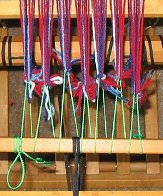
I did keep one thing from that experience however,
lashing on. Tying all those knots onto the front apron rod always seemed like too much
work to me, especially as adjusting the individual knots to even out the tension
was particularly frustrating. Lashing on made it easier for me to adjust the
tension, even after I'd started weaving the header!
That was about 5
years ago. That experience however, did make me more curious about why some
weavers preferred the b2f method, so I started to ask them about it. It seemed
that the top two reasons I heard was either because that was the method they
first learned, or because it gave that particular weaver excellent tension. Now,
we all know that a perfectly tensioned warp can also be achieved warping front
to back too, but considering that tension continued to be a big problem for me,
I decided to let this argument sway me and give b2f another go.
This
time I researched the topic with all the resources I could get my hands on. I
finally chose to try Deb Chandler's method from
Learning To Weave. I think one of the
reasons for my previous failure, was that I was trying too many new things at
once. Deb's b2f method was more similar to how I was already warping.
That b2f warp, done last May, was a success. I've been working on fine tuning my process
ever since. I have to admit however, that while better tension is the mark of
it's ultimate success for me and increases my enjoyment of warping, another
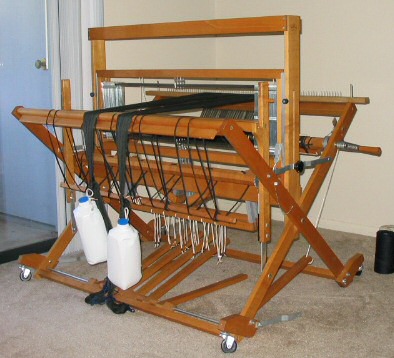
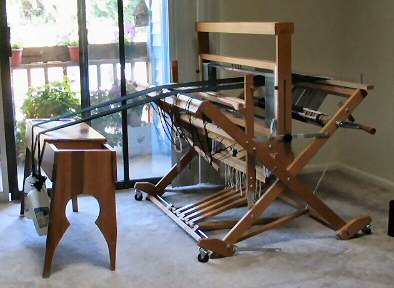
reason ultimately sold me on the process. I found that because the way my
Schacht Mighty Wolf is constructed, I could see both warp and heddles better and
thread the heddles more easily with my bifocals! Neither a very romantic nor
powerful argument for most of you, but for me it meant no more cranking my neck
to get that thread through the heddle eye!
Many of my tweaks are
still in the experimental stage. I try new things for awhile, continue with them
if they help, drop them if they don't:

*
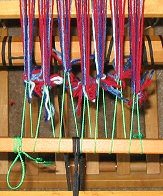
Rings to hold lease sticks - yes, a
keeper. Initially, these
replaced shoe laces
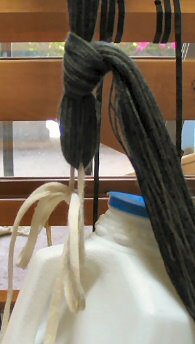
when I first used them to attach my warp to my milk jug weights. I have since
replaced the rings as milk jug holders with s-hooks, an idea I got from your
comments and visiting your blogs.
*
Lease sticks left in warp - yes, this is
a keeper. It's value is seen when a warp end breaks or when it's time to tie on
a new warp. I don't always use my large clunky lease sticks; it depends upon the
warp. I do like the holes in the ends of them however, especially in using the
rings to hold them together.
*
Leaving the raddle in while weaving -
maybe. I'm still undecided about this.
Marie's and
Sara's comments
about jack looms were very helpful to me and I want to research this more in the
future.
*
Bias Twill measuring tape - yes, another
keeper. Actually getting bias tape instead of twill is pretty much par for my
course, i.e. if I don't write it down, then I don't remember! (At least I
remembered "tape" ;)
So, there you have it for the moment. As it is,
I'm now very happy with back to front warping. Not only is it more comfortable
for me with my particular loom, but I like that the warp only travels through
the heddles and reed once. Not sure if this actually preserves the warp any
better, but it is a factor. If any of you have other reasons why you prefer your
warping method, I'd love to hear them.
Related Posts:
f2b Versus b2f
- Beginning of a series
Evaluating My b2f Warp
B2F Warping - Still Tweaking
How To Lash On A Warp