Saturday, November 02, 2024

Crackle Manners of Weaving: Lace Weaves

Samples #13, 14, & 15 of my 4-shaft crackle manners of weaving sampler.

Susan Wilson offers three treadling patterns for weaving crackle as lace
  • Bronson lace (p.39). (This one is called Snyder lace by Lucy Brusic.)
  • Mystery Lace (p. 42)
  • Two-block lace (p. 42)
Weaving notes:
  • All are one shuttle weaves.
  •  I used the same 10/2 yarn for weft as I used for warp.
  • I'm using a table loom, so the treadling plans are given as liftplans.
  • The threading and tie-up can be found in the introduction to my sampler.

As Bronson Lace

Sample #13: treadled as Bronson lace

Bronson lace treadling
  • Block A: a, 1-4, a, 1-4, a, b
  • Block B: a, 1-2, a, 1-2, a, b
  • Block C: a, 2-3, a, 2-3, a, b
  • Block D: a, 3-4, a, 3-4, a, b

As Mystery Lace

Sample #14: Treadled as Mystery lace

Mystery lace treadling
  • Block A: a, 1-4, a, b, 1-4, b
  • Block B: a, 1-2, a, b, 1-2, b
  • Block C: a, 2-3, a, b, 2-3, b
  • Block D: a, 3-4, a, b, 3-4, b

As 2-block Lace

Sample #15: Treadled as 2-block lace

2-block lace treadling
  • Block A: 3-4, 1-4, 3-4, 1-4, a, b
  • Block B: 1-4, 1-2, 1-4, 1-2, a, b
  • Block C: 1-2, 2-3, 1-2, 2-3, a, b
  • Block D: 2-3, 3-4, 2-3, 3-4, a, b

Weaving observations
  • Being a one-shuttle weave, these wove up quickly.
  • Even though I'm a color weaver, I enjoy weaving monochrome lace.
  • Of the three, the mystery lace seems to have the most obscure pattern. The Bronson is the most lace-like. The 2-block lace is the most textured. On the loom, at least.
  • I'm thinking if I do use the summer & winter treadled crackle for fabric for dining room curtains, then lace under curtains (like shears) in the same threading might look well. 
  • Washing made a big difference, but since both warp and weft are white, it was difficult to get a good photo to show them off. But by taking the photo at an angle, the light highlights the texture.

Left to right, Bronson, Mystery, and 2-block treadlings

    Thursday, October 31, 2024

    Crackle Manners of Weaving: Woven as Summer & Winter

    Samples #11 & 12 of my 4-shaft crackle manners of weaving sampler.

    Summer & winter (S&W) combined with crackle is mentioned by both Susan Wilson (Weave Classic Crackle & More) and Lucy Brusic (A Crackle Weave Companion), but they approach it differently. Brusic refers to crackle treadling on S&W threading (page 44 of her book). It's an idea she gets from Mary Snyder's The Crackle Weave), while Wilson discusses S&W treadling on crackle threading (pages 36-38). Since my sampler is threaded for crackle, Wilson's is the option I chose. 

    I did a study on summer & winter years ago (list of posts here), so I had my own notes to review. I focused on the treadling, of which there are six classic ways to treadle the pattern weft in S&W (You can see examples in this post). All use tabby:
    • 1-2-1-2
    • 2-1-2-1
    • 1-2-2-1
    • 2-1-1-2
    • 1-1-1-1
    • 2-2-2-2
    Wilson discusses two of them in her book:
    • 1-2-1-2
    • 1-2-2-1
    The difference is in how the pattern weft threads line up, either alternating or stacked in pairs.

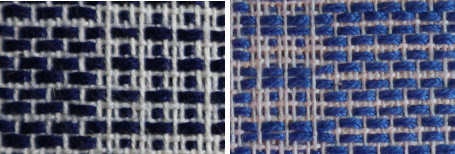
    Left: treadled 1-2-1-2. Looks like alternating bricks.
    Right: treadled 1-2-2-1. Looks like stacked bricks.

    This is using the standard 2/2 balanced twill tie-up.

    Numbers in right-hand column indicate shafts.
    Numbers along the bottom indicate treadling.

    Here are the samples.
     
    Sample #11: 1-2-2-1 S&W treadling

    Sample #12: 1-2-1-2 S&W treadling

    Both samples use 10/2 doubled for their pattern wefts. By sample 12, I had figured out which shed to use for smoother looking transitions between the blocks. Consequently, I like the second one better. 

    No matter what I'm weaving, my mind is always busy wondering. Some of my thoughts are creative curiosity (what if I changed this? or tried that?). Some of them contemplate practical applications (what project could I use this for?) For these samples, I'm thinking ahead to a (probably distant) future project, which is to weave drapery fabric for my dining room windows. What I want, is something to coordinate with my Blue Willow dishes. 

    The Scandinavian Favorite table runner I wove last year.

    Blue Willow has an intricate blue and white border pattern around the edges.


    I've been looking for something that would compliment that, and I'm thinking crackle threading with summer and winter treadling could work very well. I'll add it to my list of possibilities.

    Sunday, October 27, 2024

    Crackle Manners of Weaving: On Opposites


    In weaving, opposites can refer to either:
    • Pattern blocks. For example, one pattern block is woven lifting one or two particular shafts, and the next block is treadled with the opposite shafts. Tabby must be used to avoid long warp floats and stabilize the fabric. My Cottage Windows table runner is woven this way.
    • Alternating opposite sheds. For example, a shed from shafts 1-2 is alternates with 3-4. Tabby is optional, but produces a more stable fabric.
    Sample #9: Blocks On Opposites

    The draft for this sample is based on one from Anne Dixon's The Handweaver's Pattern Directory, page 131. 

    Sample #9, crackle blocks on opposites

    • Warp and tabby are 10/2, pattern weft is 10/2 doubled
    • Alternates sheds 1-2 and 3-4 with tabby.
     
    Sample #10: Opposite Sheds with Tabby
     
    Sample #10, woven on opposite sheds

    Sample #10 close-up
    • 2 pattern wefts in different colors with tabby
      • 1-2, a
      • 3-4, b
      • repeat as desired
    • Warp and tabby are 10/2
    • Pattern wefts are 6/2
    Based on the sample photo in Weave Classic Crackle & More, I was fully expecting to not be impressed with this one. So, I was surprised when i liked the look of it. I got to thinking it would make nice yardage for a lightweight jacket or heavyweight shirt. I wove more, rotating the blocks:
    • 1-2 and 3-4
    • 2-3 and 1-4
    • 3-4 and 1-2
    • 1-4 and 2-3
    It makes a nice but subtle patterned fabric. I particularly like plaids and checks, which would be easy to create with this manner of weaving. I'll keep it on my "to try" list for a future yardage project.

    Another example

    My Cottage Windows table runner woven on opposite blocks.

    Resources
    • Wilson, Susan, Weave Classic Crackle & More, pages 45, 52
    • Brusic, Lucy M., A Crackle Weave Companion, page 29
    • Snyder, Mary E., The Crackle Weave, page 11
    • Dixon, Anne, The Handweaver's Pattern Directory, page 131

    Related posts

    Saturday, October 26, 2024

    Crackle Manners of Weaving: Polychrome

    Poly (many), chrome (colors). In weaving, polychrome describes a category. The effect is produced by using a variety of weft colors, treadled in one of several ways to create blocks of color. 

    I particularly like Susan Wilson's definition of polychrome, because it's based on her research of the weaving literature to find the common factors in all the definitions. I think this is important, because I'm seeing that many books describe only one of the various polychrome treadling patterns.

    Polychrome Characteristics

    • multiple weft colors (2, 3, or 4)
    • typically a single warp color
    • the treadling pattern creates blocks of color side by side
    • includes a variety of treadling methods
    • commonly used with crackle, but also overshot and summer & winter

    Because polychrome covers a number of treadling methods, I chose a few to start and added examples from other blog posts. I may try more later, depending on how much sampler warp I have.

    Resources

    Usually, I put my resources at the end of the post, but since I'm picking and choosing from them for my sampler, I'll list them here and refer to the page numbers with each sample.
    • Snyder, Mary E., The Crackle Weave (1961 edition)
    • Brusic, Lucy M., A Crackle Weave Companion
    • Wilson, Susan, Weave Classic Crackle & More

    Sample #7: Polychrome Blocks (Snyder page 101, Brusic pages 52-53) 
     
    #7 Polychrome Blocks
    • 4 weft colors
    • woven in overshot manner
    • rotates 2 colors per block
      • pattern weft is one color
      • tabby is a different color
    • rotate through the four colors as follows:
      • Block 1 (lift shafts 1-2) 
        • pattern: color #1
        • tabby: color #2
      • Block 2 (lift shafts 2-3)
        • pattern: color #2
        • tabby: color #3
      • Block 3 (lift shafts 3-4)
        • pattern: color #3
        • tabby: color #4
      • Block 4 (lift shafts 4-1)
        • pattern: color #4
        • tabby: color #1

    Sample #7 polychrome blocks detail
    Weaving Notes
    • In my first picture, I can't see my blocks as distinct entities and am pondering this.
      • Firstly, I'm thinking heavier pattern wefts would bring out the blocks more.
      • Snyder's study recommends using 10/2 for both warp and weft, set at 24 e.p.i. I'm using 10/2s but my sett is 20 e.p.i. (as per Wilson's sampler instructions.) Can't help but wonder if I wouldn't like the tighter sett better.
      • Also, I'm thinking the light color warp washes out the color effect of the blocks. I'll have to experiment with a darker warp in the future.
    • Getting the sampler off the loom and wet finished with make a difference also.
    • In general, the draft seemed complicated at first, but the sheds and color rotation are logical and easy to follow.

    Sample #8: Traditional Polychrome (Wilson, pages 54, 57, 58) 
     
    #8 Traditional Polychrome Crackle
    • 3 shuttles
      • 2 pattern wefts in different colors
      • 1 tabby weft, can be same as warp or a different color
    • colors and tabby are rotated in the same sequence throughout
    • treadling is a 6 pick sequence (translated here as a lift plan because I'm using a table loom)
      • Block A
        • 3-4 (weft color 1)
        • 1-4 (weft color 2)
        • tabby a
        • 3-4 (weft color 1)
        • 1-4 (weft color 2)
        • tabby b
      • Block B
        • 1-4 (weft color 1)
        • 1-2 (weft color 2)
        • tabby a
        • 1-4 (weft color 1)
        • 1-2 (weft color 2)
        • tabby b
      • Block C
        • 1-2 (weft color 1)
        • 2-3 (weft color 2)
        • tabby a
        • 1-2 (weft color 1)
        • 2-3 (weft color 2)
        • tabby b
      • Block D
        • 2-3 (weft color 1)
        • 3-4 (weft color 2)
        • tabby a
        • 2-3 (weft color 1)
        • 3-4 (weft color 2)
        • tabby b
    Weaving Notes
    • In light of my observations for sample #7, I decided to use a heavier pattern weft.
      • warp and tabby are 10/2 in natural
      • pattern wefts are red and dark gray in 6/2
    • I think that was a good choice.

    More examples of polychrome from previous posts projects

    Classic Crackle sample #2, details here.

    On Opposites Photo is from my Cottage Windows table runner 
    • In weaving, opposites can refer to either:
      • Alternating opposite sheds. For example, a shed from shafts 1-2 is alternated with 3-4. Contrasting colors are used for the wefts. Tabby is optional, but produces a more stable fabric.
      • Pattern blocks. For example, one pattern block is treadled with shafts 2-3 for so many shots, and then treadled 1-2 for so many shots. The second block is treadled with the opposite shafts 4-1 and 3-4. With this treadling, tabby must be used to avoid long warp floats.
    • produces a weft-faced fabric
    • See Weaving On Opposites for more information.

    Thursday, October 24, 2024

    Crackle Manners of Weaving: Woven as Twill


    Crackle is a twill derivative and can be treadled as for any twill pattern, of which there are dozens. It may be woven with tabby or without. I've done a number of these previously (see End of Warp Sampling), and so for this sampler, I decided to experiment with different twill patterns. I found one in Davison called "Rambler Rose," that can be woven with or without tabby.
     
    #5. Treadled as Rambler Rose I with tabby

    #6. Treadled as Rambler Rose II without tabby

    Weaving Notes
    • Warp for both samples is 10/2 cotton in natural
    • #5 pattern weft is 10/2 doubled, tabby is same as warp
    • #6 pattern weft is 5/2 cotton, tabby same as warp
    • Adding tabby obviously expands the pattern (almost loses the pattern)
    • Neither is especially interesting to weave
    • Nor can I think of anything I'd use them for

    More examples

    As mentioned above, I previously wove a number of twill treadled samples on the remaining warp of a  Scandinavian Favorite table runner. These can be seen at my End of Warp Sampling blog post. 

    Click here to see the samples listed below

    All were treadled without tabby:
    • straight twill
    • point twill
    • broken twill
    • birds eye twill 
    • rosepath twill
    • twill and reverse
    • skip twill
    • pebble weave (Davison)
    • & a different birds eye twill

    Resources
    • Wilson, Susan, Weave Classic Crackle & More, pages 31-32
    • Brusic, Lucy M., A Crackle Weave Companion, pages 28, 36, 
    • Snyder, Mary E., The Crackle Weave, pages 13, 23
    • Davison, Marguerite Porter, A Handweavers Pattern Book, page 37