Monday, December 22, 2008

Warm Holiday Wishes For My Readers

By Leigh

I have to admit that I didn't get many fibery things done over the weekend. No knitting progress on my Shetland Sampler Cardigan. On the weaving front though, I did start to measure a new warp to replace the yucky one I cut off my loom .

Actually, the entire week ahead looks to be busy with holiday traditions and their preparations. I may not get much blogging done.

Our holiday tradition in December is Christmas, though we've made some changes this year. We went "green" with our Christmas tree (see Catzee's report on that right here.) Some things are long outgrown (see Rascal's report on one of those things here.)

We've also declined to get caught up in the shopping frenzy. Christmas as a retail holiday just doesn't cut if for us. This year we put a spending limit of $5 per gift. Rather, we choose to celebrate Christmas as a birthday, with the focus on the gift that can't be bought.

So, at this time of reflection as the year draws to a close, I want to thank you, all my readers, for visiting and commenting. You are such an encouragement to me. And I want to wish you the very best of whatever holiday and tradition you choose to celebrate. Or not celebrate.

And last but not least, Catzee and Rascal want to share their holiday greetings with you. Just click on their pictures below.

Friday, December 19, 2008

SSC Shoulders

By Leigh

Progress!

Ready to start on the bands.
Front and sleeve steeks are sewed and cut, and the shoulder seams are finished.

I used the "knit and bind-off technique"on the shoulders

K&BO step 1Front and back of shoulder are placed on needles one size smaller than those used for body of knitting. Using a needle of the larger size, the front and back shoulder stitches are knitted together. Right needle through both, then knit together.


K&BO step 2After two stitches, bind off one and continue until seam is complete.

Someone else can probably explain that better than I, but hopefully you get the idea.


Here's a view of the inside of the finished shoulder seam....

K&BO inside view
And here's what it looks like from the outside.....

K&BO outside view
I didn't plan it to look this way, but I'm not dissatisfied. At least both shoulders turned out the same!

One thing I didn't do was shoulder shaping, as I don't have a clue of how to do that in the round.


Related Posts:
Sewing & Cutting the Steeks
Shetland Sampler Cardigan Complete!

Tuesday, December 16, 2008

Abandoned Warp

By Leigh

What could have been a good project, if it wasn't for the warp.I have abandoned this project. In less than six inches of weaving I've already had five warp ends break. That's going on one repair per inch! With an intended project length of about 48 inches (times two), that is not acceptable.

This was to be a Pine Tree Table Runner in summer & winter. I adapted the draft from Carol Strickler's A Weaver's Book of 8-Shaft Patterns (#549 page 155).

I bought the warp as a mill end, about 7 or 8 years ago at Holly Bee in Valdese, North Carolina (back in the days when they had a shop and sold weaving yarns). It's an 8/2 unmercerized cotton, and I think I paid only a dollar or two for it. It would be okay weft, but it is too weak to be warp. And there's only so much frustration a body can endure.

Posted 16 Dec. 2008 at http://leighsfiberjournal.blogspot.com

Related Posts:
Summer & Winter: A Basic Definition
Summer & Winter: Structure & Theory

Saturday, December 13, 2008

More Weaving Software That Can Run On Linux

By Leigh

I've already blogged about ArahWeave and WeaveDesign. The other day, Laritza passed this one on to me; another weaving program that runs on WINE. It 's freeware, it's from Brunold Software, and it's called DB-WEAVE.

I was doubtful at first, because the initial blurb states that it is for designing dobby loom patterns, but as I read on, I was delighted to discover that it also has a tie-up mode.

I got it up and running in WINE in no time. Like a lot of freeware, the help files are pretty much nonexistent.

[UPDATE 14 Dec 08 - Many thanks to Frida, for alerting me to a pdf manual for DB-Weave. You can find it here.]

To explore the program, I inputted a draft from Shelp & Wostenberg's Eight Shafts: A Place to Begin.

You can click on almost any photo to enlarge.

A 1st look at DB-Weave
I have figured out that the red lines indicate the basic threading and treadling units. The drawdown highlights the intersection of these in red at the bottom right hand corner.

I found "Options" under the "Extras" menu.

The options box
These can be set as your default settings, or for individual drafts. You can see that "Sizes" sets the number of shafts, treadles, epi, and ppi. "Grid" overlays a grid on the draft, making it easy to keep your place. "Settings" allows you to choose single or multiple treadle modes (which I need for skeleton tie-ups and treadling!), and rising or sinking shafts. "Symbols" is for how the grid squares are filled in, and "View" lets you choose how draft is viewed on the screen.

The fun part is playing with the "Threading," "Treadling," and "Tie-Up" menus. (Click on any photo for a closer look-see.)

Playing with threading possibilities
Threading options include mirroring, normal or straight rising and falling, 2 choirs (above), 3 choirs, fixed, user defined, and copied from treadling.

Exploring treadling
The Treadling menu includes mirror, normal rising and falling, crossed, fixed, and copy from threading (above, aka "tromp as writ" or "as drawn in."

Design fun with the tie-up menu
Tie-up menu allows invert, roll (up, down, left, or right), and slope (increase [above] or decrease), or make central symmetric.

The draft view (above) can be with or without the drawdown. In addition, there is also.....

Color view of the draft
... color view, with the weaver's choice of warp and weft colors.

Fabric view of the draft
This is fabric view.

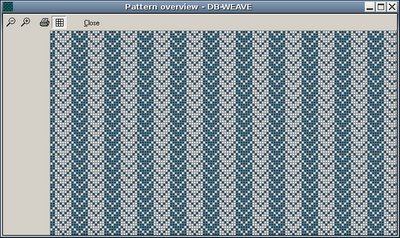
Overview of the draft
And overview.

Another feature I like is the undo and redo buttons! I don't have those with WeaveDesign. DB-Weave also imports and exports wif files (the standard format for most weaving software.)

Under the "Extras" menu, I also found .....

Dobby pegplan of the draft.
... pegplan mode. There's also a "weave" option in that menu which apparently tells the computer to talk to the loom. However, I don't have a dobby loom, nor are my computer and my Glimakra on speaking terms, so someone else will have to tell us all about that.

"Extras" also lets the weaver change the warp/weft ratio, and base setting for the program (choice of American, Scandanavian, or German/Swiss). Language options are English or German.

I haven't figured it all out yet, but I do find this program easy to experiment and play around with. I'm sure some of the menu options are dobby features. To me, it's the easiest free weaving software I've worked with so far. So for the moment, it's the one I'm going to stick with.


Related Posts:
Hurray for Hardy! Hurray for Wine! - WeaveDesign
Weaving Software for Linux - ArahWeave Part 1
ArahWeave Continued - ArahWeave Part 2

Wednesday, December 10, 2008

Sewing & Cutting The Steeks

By Leigh

Do I need a drumroll for this? Here are photos of sewing and cutting the neck and front steeks of my Fair Isle Shetland Sampler Cardigan.

The first thing I did was to test stitch tension on my sewing machine with a small knitted swatch. When I was satisfied with that, I sewed the actual steeks.

Machine sewing the steeks
I followed the instructions in Peg Arnoldussen's Essential Techniques for Serious Knitters (see my review in this post). The stitch is straight and small. I think I set my machine at about 20 stitches per inch.

Close-up of stitch placement.
The line of machine stitches had to go either down the middle or between stitches.

Stitch lines on either side of where opening will be cut.
My front steeks were six stitches wide. For these I sewed three rows of machine stitches on each side. For the wound neck steek (which I actually did first), one row of machine stitches went down the center of the edge stitches, and another along the outside of the edge.

Cutting the steek.
Then came the cutting between the stitched lines. It actually wasn't as scary as I thought it would be. I just reminded myself that this is only fabric after all.

Finished neck (wound) & front (checkerboard) steeks.
Here is the left upper front of the cardigan. You can see how both steeks turned out. I'll repeat this process the sleeve openings and my Siamese Sleeves.

The next step is to block this piece. Then I'll sew and cut the armhole steeks, stitch the shoulder seams, and then I can begin on the bands!


Related Posts:
Spinning & Knitting Update
Steeking So Far
Wound Neck Steek
Shetland Sampler Cardigan Complete!