Monday, May 26, 2008

Calculating Sett

By Leigh

When it comes to calculating sett, I am a great fan of using charts. My favorite sett charts are found in the appendix of Peggy Osterkamp's New Guide to Weaving Volume 1: Winding a Warp and Using a Paddle. (You can see samples of these charts at her website, here.) Usually I can find what I need on one of these charts, however, I do have some oddball yarns that I've picked up here and there, which sometimes aren't listed.

Such is the case with the 16/3 cotton I want to use for my next multiple tabby weave experiment. So far, I've mostly used 8/2s cottons, because that's what I have a lot of. But I want to weave some everyday table napkins in navy and white, and I need a lighter weight warp yarn to go with the heavier navy weft.

Peggy's charts don't list 16/3 cotton, so I'm going to have to resort to another method to calculate the sett. I've decided to try something new, so here I am, thinking "out loud." Trying to explain concepts to others always helps clarify them for me. I only hope that in the end, all of this makes sense to you too!
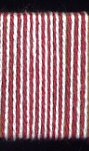
The first step for any method is to figure out the wraps per inch.

Wraps per inch (WPI) can be calculated in one of two ways. The first way is to physically wrap the yarn around a one inch measure and to count how many wraps it takes to achieve a solid inch of yarn. A more detailed description of how to do this is here.

The second way is by using the Ashenhurst Rule.

The Ashenhurst Rule calculates the wraps per inch without doing the wrapping. This is especially helpful for fine or slippery yarns. This method is found in Winding a Warp and Using a Paddle, on page 90. If you don't have that book and would like to read a more detailed explanation, you can find the excerpt here.

Here's the formula:

WPI = 0.9 x √ of YPP

WPI = wraps (diameters) per inch
√ = square root of
YPP = yards per pound

The key to this one is knowing the yards per pound of the yarn. Sometimes this information is readily available, sometimes not. In my case I have absolutely no idea. However, I can figure it out with a McMorran Balance.

I considered doing a tutorial on how to use the McMorran Balance, but Laritza at Yorksett Arts & Crafts already has a good one, so I will refer you to it; just click here.

Using my McMorran Balance, I discover that the ypp is 5250. Grabbing my calculator and plugging that number into the formula, I get:

0.9 x √ of 5250 = 65.25 WPI.

Okay. So 65 and a quarter wraps will give me a solidly covered inch of my yarn. However, I need to make room for the weft, so that requires another calculation (this version also from Osterkamp):

Sett = WPI x weave firmness

This is how I learned to calculate sett.

WPI ÷ 2 = epi for balanced plain weave
WPI x 2/3 = epi for balanced 2/2 twill

Where WPI = wraps per inch and
..............epi = ends per inch

This gives what Peggy calls "maximum sett" for a balanced weave. If the sett is closer, then the fabric becomes warp dominant. One the other hand, the weaver may want a softer fabric. We have two choices here too. One can either weave a bunch of samples to decide what is best, or one can try ....

Allowing for the Purpose

This is something else found in Peggy's book. She lists suggested percentages to use depending upon the weave firmness wanted. This is based on the purpose for which the cloth will be used. You can find the box chart on page 93 of her book, or read the excerpt online here.

The threading draft I am planning to use is a broken twill, and my yarn is 65.25 WPI, so here are my calculations:

65 WPI x 2/3 (or .67 on my calculator) = 43 epi maximum sett

Taking Peggy's recommendation for 80% of maximum sett, (see "Sett: Making Your Weaving Easier").

43 x .8 = 34 epi to start.

So there you have it. The art and science of calculating sett. The science is in the math, and the art is in the weaver's choices based on knowledge and experience.

There are a couple of other methods, but these are the only ones I have experience with so far. I'd love to hear your thoughts and experiences, so please leave a comment if you feel so inclined.


Related posts:
Another Way to Calculate Sett
Measuring Wraps Per Inch (WPI)
How to Use a McMorran Balance (Yorksett Arts & Crafts)

Thursday, May 22, 2008

Shetland Sleeve Update

By Leigh

Due to Life getting in the way, there hasn't been any weaving or spinning going on for about a week now. I have been knitting however. Here is how my Shetland Sampler Cardigan sleeves look now:

You can see the checkerboard steek up the center of the sleeve.
Less than two weeks ago I posted about just getting started on them, so this is a lot of progress for me! This is 92 rows worth and it measures 12.5 inches, so I'm roughly 2/3 of the way done.

If you're just dropping by for the first time, there are actually two sleeves here, as I'm using Lucy Neatby's Siamese Sleeves method. If you look closely, you can see the two stitch markers on the circular needle at the top of the photo. These are marking one of the two 6-stitch steeks which separate the sleeves. The increases on either side of it help create the odd looking pattern.

The cuffs will be added after the sleeves are cut apart and seamed.

I'm such a slow knitter that it never occurred to me that I might actually finish this thing this summer. I will definitely set it aside when the weather gets too hot to have a wool sweater in my lap. But so far our weather is very fine so who knows, I may have it done before you (and I) know it!


Related Posts:
Ready to Start Those Sleeves - Discovering Siamese Sleeves
Starting the Sleeves - Sleeve Increase Calculator
Siamese Sleeves Done!
Wound Neck Steek

Tuesday, May 20, 2008

I'm Getting Bored With This

This is the latest batch of multiple tabby weave samples, just off the loom. I feel like I'm spinning my wheels because I'm not achieving anything I'm happy with.

I tied on about a yard of 8/2s cotton warp in three new colors, using the same Fibonacci stripes as the last sample warp.

Of the samples shown in that earlier post, I liked the ones with the heavier, sport weight knitting yarn as weft best. I wanted to experiment more with this, using different weft colors. I thought that I had a heavier black cotton yarn to work with, but it turned out that it wasn't as heavy as I thought. I used it anyway.


I really had a lot of trouble with getting an even beat as you can seen in the above photo. The goal is an balanced weave with as many picks per inch as ends per inch. Quite disappointing.

Then I found a 6/3 cotton in a medium gray and used as weft with my 8/2 warp. I still had the same problem with getting an even beat. I did try though . However, you're going to have to tilt your head to the side to view this photo properly....


..... as Blogger insisted on rotating the photo when it uploaded it. I tried several times but couldn't get it uploaded the way it is supposed to be. I searched Blogger Help Group to see if I could find a solution for this problem, and apparently others have had it on occasion, but none of the discussions helped me. So there it is anyway.

Here is something similar in a different color weft (and not rotated)....


The weft packed in a little more evenly, though not consistently. I am puzzled, because the sett is the same as all the other samples, 20 epi. I'm not sure why I'm having issues this time when I didn't before.

And lastly I decided, what the heck, I'll just let it do what it wants, and beat it hard.


The weft is the same 8/2 cotton as in the yellow warp stripe. This was interesting because packing down the weft distorted the horizontal lines with washing. This sample has a little more potential than the first three, though I think a contrasting weft would have been better.

I've been thinking a lot about these samples, and why I wasn't happy with them. Finally I realized that I am disappointed because I was trying to see if I could get multiple tabby weave to imitate summer & winter, which has been my favorite weave so far. I still think the results would have been better with an heavier weft; such as the sport weight knitting cotton yarn. However, I'm just sampling from my stash, hence the limitations.

I'm not sure what I'm going to try next. Choices include:
  1. Using a finer warp and the same wefts
  2. Using the same warp and purchasing more sport weight cotton for a heavier weft.
  3. Moving on to a totally different draft from Dr. Bateman's book.
While I'm at it, I may as well try a new threading too.

© May 2008 by Leigh at Leigh's Fiber Journal

Related Posts:
Multiple Tabby Weaves - the basics

Wednesday, May 14, 2008

Serger Research & Decision

By Leigh

In my Sewing With Handwovens (???) post, I mentioned that I was researching sergers. I was very interested in all the comments to that post; both the opinions and the advice. I wanted to share with you what I've discovered through my research and what I decided.

I started with the weaving lists I subscribe to, Weaving, WeaveTech, and the Online Guild of Weaver's, Spinners, & Dyers. It was interesting because the different lists had quite different ideas about serging handwoven fabric. The opinions ranged from "wouldn't be caught dead using it on my handwovens," to "use it all the time on my handwovens."

For those of the first opinion, the objection seems to stem from an association of serging with cheaply made, mass produced garments. This group primarily seemed to be those who've woven many years, and started sewing long before sergers became available to home sewers. The second group were largely younger weavers, who seemed to more readily accept serging as common practice.

One question that I needed to answer for myself, was what a serger could do for me that a sewing machine couldn't. Some of the appealing points were:
  1. Ravel-free edges and seam finishing - I learned to sew when pinking was enough. Not only is this no longer common practice, but handwoven fabrics especially need something to prevent unraveling.
  2. One step finishing and trimming. A serger/overlocker seams, overcasts, and trims all in one step. This is a big plus for someone like me, who wants to spend time on other things.
  3. Less bulky seams
  4. Rolled edges for things like napkins and fine fabrics.
  5. 2 feed dogs for differential feed - How often have I finished a seam to find that the two layers of fabric didn't finish up evenly! I always thought this was me, but it turns out that ain't necessarily so. It's also the fabric. The speeds of the separate feed dogs on a serger can be adjusted individually to take care of that.
  6. Decorative stitching wasn't so much a selling point for me. Having done a lot of hand embroidery in the past, any sort of machine decoration doesn't appeal to me much.
Now, it may be true that some or all of these things can be accomplished with a sewing machine. Mine is six years old and is a very basic model manual model. This serves me for what I am interested in doing: basic garment construction. Newer, upgraded machines do a lot more and are beginning to imitate overlock features. So, one possibility would be to replace my old sewing machine with a newer, upgraded model. However, those are all way out of my price range. Since I don't buy things on credit and my current sewing machine is still serviceable, I decided it to research inexpensive sergers to see what I could come up with.

Thanks to the customer reviews on Amazon.com, this is what I decided on.....

A Brother 1034D Overlock Machine.

For me, the selling points included:
  1. Compact - a must in our decidedly dinky living space
  2. Can use standard spools of sewing thread as well as serger cones
  3. Uses standard sewing machine needles (some sergers requires special needles)
  4. Choice of 3 or 4 thread overlock stitches
  5. Blind hem stitching
  6. Easy conversion to rolled hem function
  7. Easy threading
  8. Free arm capability
  9. Easy disengagement of cutter blades.
  10. Includes three, easy change presser feet: multipurpose, gathering, and blind hem.
  11. 2 instruction booklets and 2 instruction CDs, with tips such as: one doesn't have to thread from scratch every time; simply tie on the new thread and pull it through.
  12. Price - it was within my budget
  13. Value for cost - this per customer reviews.
Another nice feature is a built in threading chart for the loopers, though it came pre-threaded with sample spools.

... and the color coded tension dials ....

So there you have it. I still have the learning curve to face, but I'm not terribly daunted. Yet.


Related post:

Saturday, May 10, 2008

Starting The Sleeves

By Leigh

The Shetland Sampler Cardigan sleeves are officially begun!

The first thing I did was to click on over the The Knitting Fiend's online Sleeve Increase Calculator. By plugging in the number of rows to be knitted and the number of stitches in the first and last rows, instructions for the sleeve increases were automatically calculated for me. Here's what I got (click on the photo for an enlargement).

Should enlarge if you click the image

My next stop was Lucy Neatby's website to double check the instructions for the Siamese Sleeves.

Since I am knitting both sleeves at once, I had to double the number of stitches to cast on and add steeking stitches between the sleeves. This number of stitches was cast onto my 16 inch US2 circs with waste yarn (see "A Shetland COWYAK")

After a couple of rows of waste yarn, I started knitting with the yarn for the sleeves. I decided that I'd better use stitch markers to mark the beginning and end of both sleeves "just in case."


As long as I keep track of which row I'm on to get the increases properly placed, I should have properly fitting sleeves.

The other thing I've started on is the steeks for the armholes. These are technically checkerboard steeks, though as I mentioned before, the checkerboard effect is lost with the one color rows. The blue yarn marks the beginning of the steek, which is six stitches wide.

Wool Enough commented that the pattern appears to have black faced white sheep facing a brown fence. Can you see it? I'm delighted with that observation because like her, I too am rather wool obsessed!


Related Posts:
Ready to Start Those Sleeves - Discovering Siamese Sleeves
A Shetland COWYAK - Casting on with waste yarn.
Siamese Sleeves Done!
SSC Sleeves & Cuffs
Shetland Sampler Cardigan Complete!