Tuesday, April 29, 2008

Polwarth - Experimenting With Blends

By Leigh

After I finished my Polwarth preparation experiments, I decided to try blending some with alpaca. Since woolcombing made the nicest preparation, I also decided to use that for my blending experiments as well. I did it the same way I blended colors on the woolcombs. (Photos and explanation of that, here.)

To save a little time, I didn't diz the blended fibers into top, rather I drafted straight off the woolcomb...

Spinning off the combI couldn't have done that with full size combs, but it works well with my minis. Here are the results:

Polwarth & Alpaca 1 blendThe alpaca is on the right, the Polwarth is in the middle. The alpaca, though brown, has a reddish cast. This blend had the nicest hand and was soft and silky to spin. Very lovely.

Polwarth & Alpaca 2 blendAgain, alpaca is on the right. A darker brown than the first one, but shorter than the Polwarth. Even so, the blend drafted fairly evenly off the comb. I like the color of the yarn, but it isn't as soft.

Polwarth & Alpaca 3 blendI blended some with cinnamon colored alpaca out of curiosity. The yarn has more interesting color depth, though that's hard to see in the above image. However, since I have more of the dark brown alpaca, I think I'd prefer to save this color for a project all on its own.

I reckon the next step is to decide what size yarn I need and how much of it. I still leaning toward weaving with it; either an afghan or perhaps fabric for a winter coat. If I do that then I'll have to decide on a pattern so I can calculate for yardage. Obviously I still have a lot of decisions to make!


Related posts -
Adventures in Woolcombing
Color Blending on Woolcombs
Next Spinning Project - Polwarth
Polwarth - Experimenting With Preparations

Saturday, April 26, 2008

Sewing With Handwovens (???)

By Leigh

For two weeks I've been wanting to tell you about this month's Western North Carolina Fibers/Handweaver's Guild meeting. The program for April was "Sewing With Handwovens" with Liz Spear. What an inspiration!

Liz started by telling us about her own journey into the world of weaving, creating, and marketing her own designer clothing. Then she shared many of the garment making tips she learned through her own experience, and answered all our questions. She also brought an entire garment rack of her own designs which we were able to see, touch, try on, and take a close look at.

Sewing was my introduction into the world of textiles. I learned how to sew in a mandatory home ec class in junior high, and absolutely loved it. I loved looking at fabrics, at threads, and at patterns. I loved creating my own designs and was forever combining sewing patterns to get what I wanted. All through high school I "designed" and made my own clothes. In fact, my mother encouraged me to apply to the Art Institute of Chicago to study clothing design. In those days however, I wasn't one to follow my mother's advice, but on this I sometimes wish I had.

Gradually I became interested in other fiber arts, going next to quilting and embroidery. Later, I sewed most of my daughter's clothing when she was little, doing a lot of smocking and embroidery on them. Spinning and weaving didn't come until she was in high school. Now, I occasionally sew for myself with commercial fabrics, but most of my time seems to go to weaving, spinning, knitting, and blogging. Of my own handwoven fabrics, I can pull out one vest (no photo), one necktie (that post here), and a few bags (click here to see those). But that's it.

Liz's program has made me think about why I've been reluctant to do more sewing with my handwovens. It's not as though I haven't woven yardage with the intention of sewing with it.....

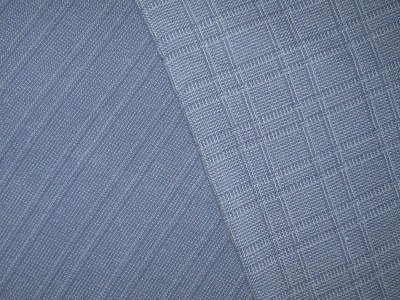
Photo of some matching fabrics I wove about 5 years ago.
2 matching cottons fabrics of log cabinOr that I don't have plenty of oddments and scraps to create with.....
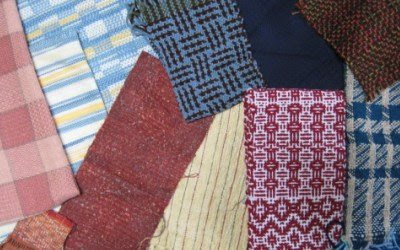
Assorted samples and leftovers.Somehow I just don't feel confident enough to tackle it. One reason is knowledge, or rather lack of it. I've assumed that working with handwoven fabric requires special techniques. Another reason is that I've not always been satisfied with what I've created. Too often, the finished item didn't match the idea in my head. That's bad enough with boughten fabric, but with handwoven fabric?? It breaks my heart just to think about it. Then too, I'm reluctant because I never learned anything about fine sewing or tailoring. I can do basic garment construction from a pattern, with barely passable zippers and button holes. But that's about it. My inner sense tells me that handwoven cloth deserves the very best of all the details.

What I'm trying to get around to saying, is that Liz's program has equipped me with a new resolve to actually start sewing with my own fabrics. Like everything else, I realize that I'll never get started if I continue to think of reasons why I can't do it. Like everything else, it starts with a decision and a first step. So, I've made the decision and am ready to take that first step. I've been researching sergers and thinking about getting one.

Please don't expect too many posts about my actually doing this. I may have found the resolve to take that first step, but I still have to get up the nerve to take the second one.


Related Posts:
Hemming Handwoven Fabrics
How Do You Hem Your Handwovens?
Serger Research & Decision

Wednesday, April 23, 2008

MTW - Rainbow Warp Revisited

Do you remember this black weft sample from the rainbow warp?

Multiple tabby weave with rainbow warp & black weft.
Like many of you, I usually prefer black for contrast, because it really seems to make the other colors pop out. But still, I wondered how it would look with white. Finally I couldn't stand it any longer. I just had to experiment with a white weft as well.

My rationale for tying on another rainbow warp was two-fold. One was to experiment with a white warp, but the other was to weave one more sample in the rainbow weft series of samples. I had already sampled wefts of purple, blue, green, yellow, and orange. But I forgot one with red. So I wanted that one to add to the others. I added a photo of it the original post showing all of them.

Here are the six rainbow samples together. They measure about 15 by 17 inches. I'm still thinking about making napkins, though they seem a tad heavy for that.


And here is a photo of the white weft sample.


It doesn't have the 3-dimensional quality that the black weft one does, but I like it. More candy-like and whimsical in appearance.

With all that out of the way, I am now mentally free to resume the other multiple tabby weave ideas that I want to experiment with. In fact, I should finish tying on a small sample warp today.

Sunday, April 20, 2008

Polwarth - Experimenting With Preparations

By Leigh

I haven't mentioned the Polwarth in about a month, but I have been busy with it. Since there was some concern about the tenderness of the fleece, I made sample yarns from five different preparations.

Yarn from handcarded Polwarth.Handcarded - Actually, at five inches, the fleece was too long for handcarding. The best fleece length for handcards is no more than three inches, or the width of the cards. It's not that it can't be done, but the problem is that if the fleece on the cards isn't completely separated during carding, it gets folded back onto the cards. This makes it harder to get the individual fibers separated into a smooth preparation.

I was careful with my carding, and the rolags were a little neppy. These make it harder to control the yarn during spinning, so the yarn is a little lumpy. When I first learned to spin, I thought these lumps this added character to my yarn. Now I know that these become pills, which is something I don't want in my final product.

Yarn from dog combed Polwarth.Dog Combed - This is one of my favorite ways to work with fleece. I comb both the tips and the butts of the staples to open them up. Then I hold the locks parallel in my hand and spin from on end until that lock is used up.

This preparation was much nicer, though there were still a few neps.

Yarn from  drum carded Polwarth.Drum Carded - I admit that this is usually my preparation method of choice. Mostly because it is the quickest. Also because it blends color variations well.

In terms of results, drum carding didn't do any better than handcarding. The neps were still there, so the yarn was lumpy. Fortunately though, I didn't get a lot of fiber breakage, which was my concern with the tender fleece.

Yarn from flick carded Polwarth.Flick Carded - This is my least favorite way to prepare fiber for spinning. I end up with busted knuckles every time! I flicked both ends of the staples and then drafted them into a roving. This spins very nicely.

This made a better preparation than the hand or drum carders as it got more of the short bits out. Still, I've already ruled this one out.

Yarn from wool combed Polwarth.Wool Combed - I probably don't have the proper combs for this fleece, but I figured I'd give it a try with what I had anyway (Forsyth Minis).

This made a lovely preparation and the smoothest yarn. Wool combing gets all the neps and short bits out, so that it's easier to control the results and is a breeze to spin.

Before I choose a preparation method however, I need to decide what I want to do with the yarn. I have a whole fleece, so there is plenty for a large project. One thing I'm considering it is using the yarn for weaving. I rarely weave with my handspun. I'm also considering blending it with some of the alpaca I have leftover from last summer's spinning. If I do that, I will have to consider blending as part of my processing choice. That means I still have a little more experimenting to do. Obviously this isn't a project that will be completed anytime soon!

Posted 20 April 2008 at http://leighsfiberjournal.blogspot.com

Related posts -
Adventures In Woolcombing
Next Spinning Project - Polwarth
Polwarth - Experimenting With Blends

Tuesday, April 15, 2008

Goodies in the Mail

4 samples of Shetland rovings in different colors.Isn't that scrumptious? These heavenly Shetland samples arrived in the mail the other day from Sharon. It's exciting because three of them, the white, brown, and light fawn are from her own Shetlands. The gray is from Sharon's neighbor Mim (who recently started her own blog). I am very pleased to have these additions for my Shetland Sampler Cardigan.

The light fawn comes from Sharon's Nevada State Fair Reserve Grand Champion. That will give my cardigan a little more brag factor, don't you think? The fact is, with the all the lovely samples from blogging friends, this cardigan will be really special to me.

At the moment, these are nestled in a basket where I can admire and pet them while I finish spinning samples of various preparations with the Polwarth. But I should be able to start spinning them soon.

© April 2008 by Leigh at Leigh's Fiber Journal