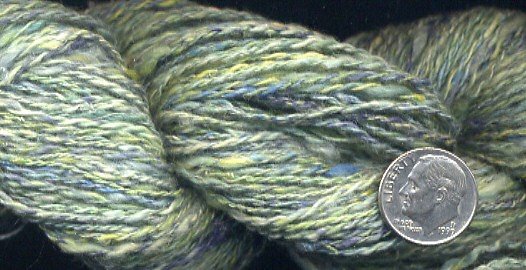
Thursday, June 29, 2006

Silk Spinning Update

I am still spinning away on my silk samples. I received a lot of good comments on how I might possibly use the yarns. At the moment, the finished ones are residing in a basket. Once I complete all the samples, I will put some of those ideas to work (assuming I can wait that long : ) The original post & pic about my silk goody pack is here .

Yarns completed so far:
* B2 silk brick
* Mulberry silk noil
* Tussah noil
* Clean noil
* Throwsters waste (and here)
* Silk caps
* Carrier rods
* Alpaca/silk blend
* Bluefaced Leicester/tussah silk blend

Silk samples yet to be spun:
* Silk hankies
* A1 silk brick
* Tussah silk sliver
* Merino/silk blend
* Homemade silk caps
* Soy silk

I also still have cocoons to try reeling and noil with which I want to try silk fusion.

What’s currently on the wheel:

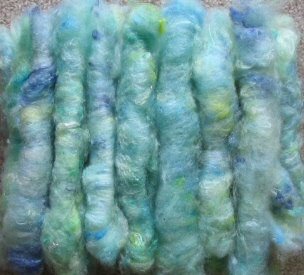
Spinning camel down silk blend fiber


This is carded camel down/tussah silk blend. It’s so lovely that it practically spins itself. I would love to have more than an ounce of this stuff! It’s absolutely begging to be put to some knitting needles.

Also, because I have had so many encouraging comments (both public and private) about my various silk photos, I’ve put them in an album on Flickr. You can find the link on my sidebar as Leigh’s Silk Photos. I’ve included my pix of the process of making and working with silk caps, dyeing and spinning throwsters waste, and working with the carrier rods. I added a few extra photos to these categories to better explain the steps of each process.

So as you can see, I'm making good progress on my silk samples. I'm learning a lot and will have a lot of lovely sample yarns to have fun with.

Tuesday, June 27, 2006

An Interesting Blog

My friend from North Carolina, Carol, sent me the link to an interesting embellishment blog, In a Minute Ago by Sharon Boggon.

Carol is always finding interesting things on the web. This one is not specifically a weaving, spinning, or knitting blog, but it deals with textiles (both contemporary and historical), fiber arts in general, quilting (especially crazy quilting), needlework, and embroidery. It also has a fantastic stitch dictionary, which all embroiderers and embellishers will be interested in.

I like this blog because quilting and embroidery were two of my first textile loves. Quilting is part of my family heritage. I remember my great grandmother hand sewing quilt after quilt.

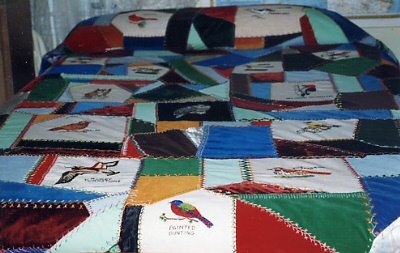
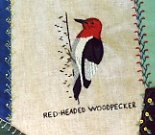
My record UFO was my one and only crazy quilt. It took about 22 years to complete:


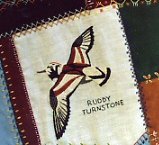
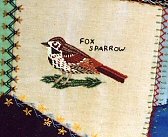
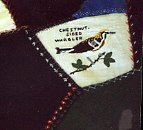
I defense of myself, I have to say that for the first 10 years I didn’t know it was going to become a quilt. The bird embroideries were gifts to my parents and grandparents at various times for many years. When my grandparents died, and my step mom inherited all the embroideries, she asked me to make them into a quilt. Then my daughter was born and life turned to raising children. The quilt was packed away. My dad used to love to tease me about it. His first question when he called would always be “How’s the quilt coming along?” We would both laugh, but that quilt nagged at my conscious. There were other things I was interested in, such as learning to spin, but for some reason the quilt kept me from moving on. (For close-ups of all my bird embroideries, click here. )

Sara Lamb has an interesting comment on her blog about being a single project person (an SPP). I’ve thought about that and wondered how it applies to me. I usually have a project on one of my spinning wheels, something on the loom, and one or two knitting projects at hand. But I finish what I start. There was a time in my early life however, when I started many things and finished none. My problem was that I didn’t have the self discipline to finish anything. When a new impulse struck, I was off and running.

Somehow the crazy quilt was my turning point. My enthusiasm for it as a project was long gone, but I knew that I had to finish it. I knew that I could never go on to anything else until it was done. I lamented having ever agreed to do it. I agonized that there was still so much to do on it.

Finally, my family had a conference and told me I had to finish the quilt. Everyone vowed to help with cooking and dishes and housework to give me time to finish it. So, roughly 12 years after I started it, I finished that crazy quilt. Then I packed it carefully in a box and mailed it off to my folks. I had such a sense of relief! I felt free! Shortly after that I bought my first drop spindle. Later came my first spinning wheel, then my second, then the loom. I haven’t made a quilt since.

Sorry for the digression, but crazy quilting does bring back memories. So, back to In a Minute Ago. Sharon updates her blog frequently with all kinds of interesting textile related links. Currently, she is presenting “A 100 Details for 100 Days.” Every day for the next 100 days she plans to feature a different stitch, embellishment, or seam treatment. Today she is on day 8.

But …………be forewarned. If you do visit her blog, you’ll find that it’s easy to spend hours here!

© 2006 Leigh's Fiber Journal

Monday, June 26, 2006

Response to Some Thought Provoking Comments

From Peg:
I know the tension between pursuing in depth and exploring everything ...............If you constantly jump around, you will never discover the depth of your own creative abilities.

Good point. Which makes me think that I’ve probably never verbalized my original goal for starting this weaving project. It is to familiarize myself with a variety of basic weave structures. A secondary goal is to understand how color effects them.

Basically I've just been a monkey-see-monkey-do sort of weaver. I can follow a draft and weave it accordingly, but I’ve never really understood what I was doing. I can’t tell you why summer and winter is what it was for example, nor huck, nor crackle, nor very many other weave structures. Of course, simply becoming familiar with them obviously isn’t the same as mastering them. And it won’t mean exhausting all the possibilities either. Not at this point anyway.

Part of my motivation to do this is because I still feel rather ignorant as a weaver, even after six years of weaving. I have a desire to weave well, but also to intellectually comprehend I‘m doing. I want to be able to ask intelligent questions about weaving and have intelligent conversations with other weavers. I want to stop feeling out in left field in regards to experience and terminology.

So hopefully I’m not jumping around so much as I am working my way toward a goal of generalized understanding. From there I will be able to approach both the familiar as well as the new with a depth of knowledge and experience which will open doors creativity for me.

From Jackie:
…… how about a painted light and solid dark, or using think and thin yarns. Think bunching and spacing.

This is interesting because actually, I think this is the general direction I've already been heading in. One thing about log cabin is that the technical definition is pretty narrow. My plan is to start exploring shadow weave, which seems a logical extension of log cabin. So perhaps I’m not leaving log cabin behind but rather moving into their larger color-and-weave category.

At some point I plan to weave that Oelsner log cabin variation, but I think I'll wait until I can apply it to a project. I find that when something like that really catches my attention, I mull it over and over in my mind until I finally have act on it. When that variation reaches this point, then it will materialize! (pun intended : )

But.......will I ever find an actual weaving niche???? I wonder.

© 2006 Leigh's Fiber Journal

Saturday, June 24, 2006

b2f Log Cabin Weaving

By Leigh

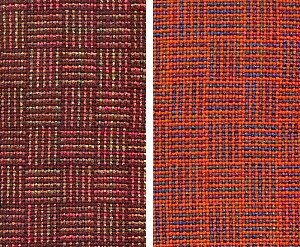
My fabric is off the loom. And not only that, but it’s been washed, ironed, and measured. In fact, here it is:

My handwoven log cabin fabrics.


The two are from the same warp of 16/2s cotton sett at 24 epi. I wove the piece on the right first, as drawn in. For the one on the left, I used only the dark blue for weft. Oddly, the two fabrics shrank to different widths, with the stripes measuring 32 inches after washing, and the log cabin at 33 inches. (?)

What I didn't do was put them in the dryer. It's traumatic enough to put my handwoven fabrics into the washing machine; I just couldn't handle the possibilites of what the dyer might do to them! So they were line dried.

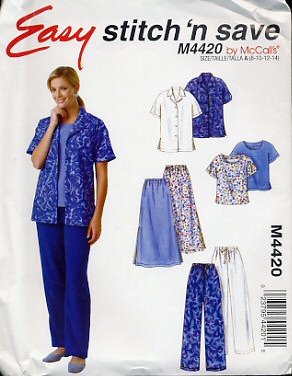
Happily, they didn’t shrink too much and my pattern pieces fit the cloth. I plan to make a striped skirt and log cabin top from this pattern:

Sewing pattern for my handwoven fabrics.


Since I’ve not used this pattern before, I plan to work it up with some dollar fabric before I cut my handwoven. Better to find out about pattern adjustments on the inexpensive stuff!

As I’ve experimented with log cabin weaving for the past two months, I’ve made some observations. I’ve noticed two factors which influence its appearance: first, the number of warp ends in the blocks; second, the joins.

In the photo below, the sample on the left has an odd number of ends and the one on the right has even.

Handwoven log cabin scarvesWhile both give the impression of being woven with striped ribbons, there is a difference in the definition of the "squares." The sample on the left is more flat looking while the one on the right almost looks as though the ribbons cast a shadow; it has a more 3-dimensional appearance. This detail could make an interesting design factor.

Since the example on the left has an odd number of threads in each block, then the first and last warp ends are the same color. In this case dark - DLDLDLD. But the sequence could also begin and end with light threads - LDLDLDL, so that the joins would be light. Compare below:

More handwoven log cabin scarves.A painter is taught that one’s eye is drawn to light and to use it to direct the viewer's attention. But in these samples, I find that my eye is drawn to the dark colors. Perhaps it’s simply because I like the pieces with the dark joins best. I think they define the “ribbons” better. Again, this is another factor I'll keep in mind the next time I weave log cabin.

Beyond color, I wanted to experiment with variations in the block sizes. The result of this experiment is the yardage I’ve just taken off the loom. My inspiration for this was initially Helene Bress’s The Weaving Book page 16, then Margaret Winderknecht’s Color-and-Weave II page 77, and finally my WinWeave software (where I worked out a compromise.) More recently I’ve gotten my hands on a copy of G. H. Oelsner’s A Handbook of Weaves, and discovered some log cabin variations on pages 352 to 355. These too have piqued my curiosity.

But I have problem. It is that whenever I weave, I constantly wonder “how would it look if I did this,” or “what would happen if I changed that.” So before one thing is off the loom, I have already planned the next 2 or 3 variations I want to try. My imagination seems to have no limit as to possibilities and I sometimes think I could spend my entire weaving life exploring one thing. But there are so many weave structures and color effects to explore that eventually I have to make myself stop and try something different. So it is now. Though I still have lots of ideas, I’m going to set log cabin aside and come back to it another day. It's time to explore something else.

Next ...... Evaluating My b2f Warp


Related Posts:
f2b Versus b2f - Beginning of this series
Evaluating My b2f Warp
B2F Warping - Still Tweaking
B2F Vs. F2B - Why I Switched

Wednesday, June 21, 2006

Silk Carrier Rod Yarn

The carrier rods: picture here

How I dyed them: click here

The rolags:

Rolags from silk carrier rod fiber.


The yarn:

Yarn from dyed silk carrier rods.


This was a lot of fun to spin. The fiber length for the rods was about an inch, but I had about a dozen cocoons stuck in the rods, for which the fiber length can be more than an arm’s length! I cut this as I could and spun mostly long draw, but had to work the long cocoon fibers in the inch worm fashion. The hand and luster of the finished yarn are lovely.

My problem is that I am compiling quite a collection of yarns from the various forms of silk, each yarn only about an ounce. Not that the collection of itself is a problem, but I am wondering what to do with it all. I would like to not see these yarns end up in a tub or a drawer, I want to use them for something!

Related Posts:
Guess the Objects
Silk Carrier Rods