Friday, January 31, 2025

Pine Tree & Snowflake Crackle Bookmarks

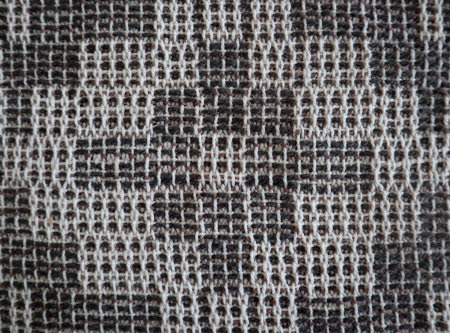
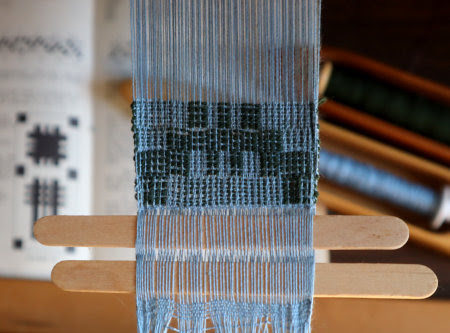
I had a yard-long warp and managed to weave three pine tree and snowball snowflake bookmarks. Atwater and Snyder called them snowballs, but I changed the name to snowflake because, as you can see, mine aren't solid like their diagrams. 
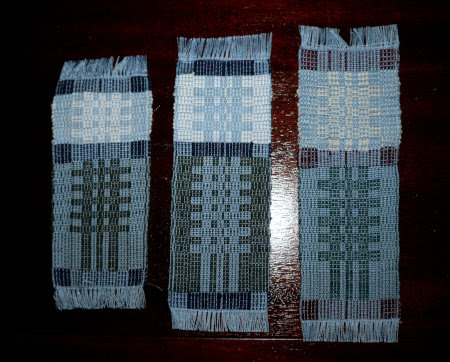
Fresh off the loom in the order woven (left to right). The middle bookmark is backside up.

Particulars

  • Pattern: Mary Snyder, The Crackle Weave (1961 edition) page 24, which was based on Mary Meigs Atwater's The Recipe Book Series I, Recipe No. 12.
  • Structure: 4-shaft crackle weave
  • Yarns (all cotton):
    • Warp: 20/2 cotton warp in light blue
    • Tabby weft: same as warp
    • Pattern weft: 
      • for the two on the left I used 6/2 in dark green and white
      • 10/2 for the one on the right I used 10/2 in medium green and natural
  • Warp ends: 100
  • Sett: 44 e.p.i.
  • Sley: 3-4-4 in a 12-dent reed
  • Threading: 
  • Treadling: ad lib

Notes and Observations
  • There wasn't a treadling draft so I experimented.
  • I also experimented with yarn weights and colors.
  • Of the pattern yarns, I like the heavier 6/2 better.
    • It made a firmer fabric, which would be more suitable for a table runner.
    • It made the pattern stand out more
  • I had a couple of warp yarn breakages, some of which I didn't fix because the sett crams the heddles so close together, making it difficult to rethread them. 
This was a good project and I gleaned good information for a possible future table runner in an adaptation of Atwater's coverlet pattern.

Pine Tree & Snowball Bookmarks: Planning

Sunday, January 26, 2025

Nature's Color Palettes: Thoughts & Observations

Continued from Nature's Color Palettes: A Few More

I'm still taking photos to play with for color palettes.

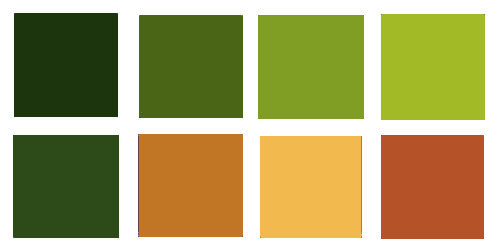
Moss

Moss color palette

By using Gimp photo editor's zoom, I was able to find "hidden" colors, like the orangey browns in the moss. 

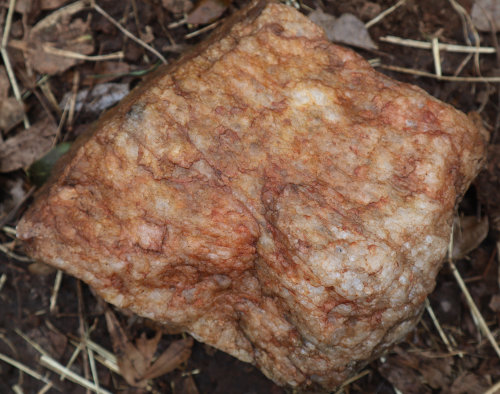
Quartz

Quartz color palette

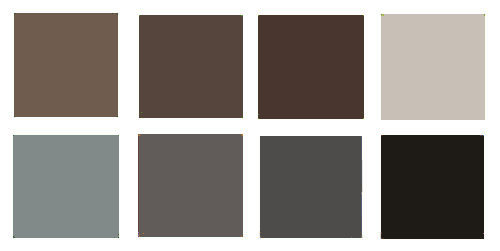
Fungi

Fungi color palette

Interestingly, the fungi color palette is very similar to the natural colors of Shetland sheep fleece.

Handspun Shetland in whites, silvers, grays, fawns, moorits, and blacks.

It also reminded me of one of the samples I wove for my Crackle sampler with natural, medium brown, and dark gray yarns.

Crackle sample #18 - Snyder's Shadow Blocks

Maybe that's why the color combination was so appealing to me.

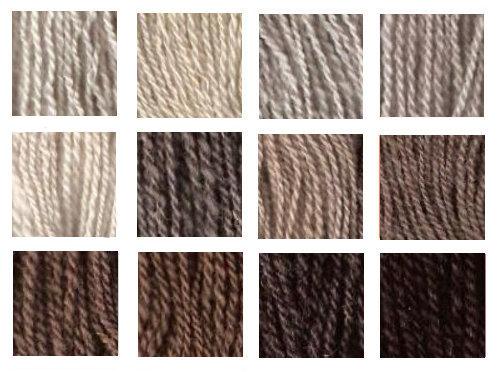
Then the Shetland samples reminded me of the colors of the natural cotton samples I got at a charkha spinning workshop

Palette of natural cotton colors

Observations:
  • My winter season color palettes are primarily browns, grays, blues, and greens
  • The greens are mostly warm greens.
  • Also, I'm realizing how much my eye blends and assumes what colors I'm seeing. When I use the photo editor color picker, I get the color of one pixel which sometimes surprises me because my brain has interpreted the blend of colors differently. 
  • Because of that, I have to admit that these palettes are only possible because I'm using a computer. 
  • And that has me wondering about color blending in weaving, which is a complex topic.
  • Lots more to ponder and explore.

Monday, January 20, 2025

Nature's Color Palettes: A Few More

Continued from Nature's Color Palettes: An Idea

Dawn Snow

Dawn Snow color palette

Snowy Pasture

Snowy Pasture color palette

Leyland Cypress Skyline

Leyland Cypress Skyline color palette

Holly

Holly color palette

 © Jan 2025 by Leigh at Leigh's Fiber Journal

Related post

Friday, January 17, 2025

Nature's Color Palettes: An Idea

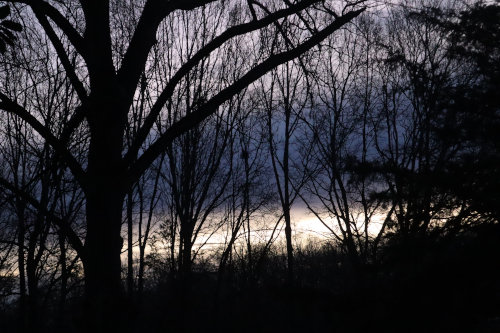
The other day I went out to the barn for early morning chores. When I opened the barn doors, I looked through our bare woods and across the neighbor's field to see the sun coming up. I thought the colors were so lovely: pale pinks, peaches, purples, blues, greens, grays. I wished I'd brought my camera. 

One of a weaver's many decisions in project planning is color. Sometimes I know what I want, but often I'm pulling out dozens of yarns to see what color combination inspires me. Sometimes it takes me days and days to decide. What if I had a selection of palettes available from which to choose? Nature always inspires me, so what if I took photos around the homestead and used Gimp (my photo editor) to pull out a variety of colors to make color palettes? 

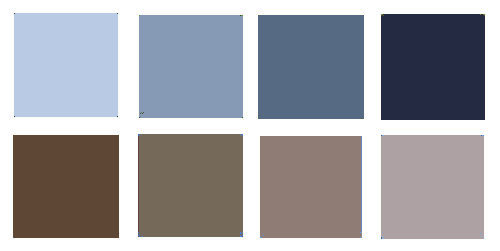
Here are my first ones, using Gimp's color picker and bucket fill tools to create the palette.

January Daybreak

January Daybreak color palette

January Sunrise

January Sunrise color palette

Winter Evergreens

Winter Evergreens color palette

Pine Cones

Pine Cones color palette

Of course, more colors could be added for each palette. But I think for weaving, quilting, or knitting, these will work well for choosing color combinations. For the yarns, I have several options. One is that it will help me choose color combinations from my stash. Another would be dyeing my own yarns. I don't feel I need to be exact in my color matching; close enough would be good enough for me. 

Being a color person, this exercise is quite fascinating to me and I've been making more to form a collection. I can see them forming seasonal categories. Not sure yet if I'll print them out, although a booklet would be helpful. But to start, I have them here on my blog.

Monday, January 13, 2025

Pine Tree & Snowball Bookmarks: Problem Corrected

 Well, I got my setback sorted out. Turns out I needed to add 13 more warp ends to complete the threading pattern. Rather than unwind the warp and start over, just rethreaded the heddles from where the mistake was, and then weighted the additional warp bout in back. 


I don't know if it was lazy of me to do it that way, but it was certainly easier!

Then I tested out the sheds to make sure the pattern was symmetrical and now I've got it. 


Liftplan from the bottom:
1. Shafts 3-4
2. Shafts 1-3
3. Shafts 1-2
4. Shafts 2-3

Last time, I mentioned that there are no treadling instructions for the bookmark, so this gave me an idea of which sheds I need for the pine trees and snowballs. It appears that I'll only need sheds 3 (shafts 1-2) and 4 (shafts 2-3) for these, and shed 1 (shafts 3-4) for the squares between the motifs on the selvedges. 

I'm referring to sheds rather than treadles because this is a direct-tie table loom that requires a liftplan instead of a treadle tie-up. It I did have treadles to tie up, the numbers (1, 2, 3, 4) would refer to the treadles.

Now I can get started on weaving some bookmarks.