Tuesday, June 27, 2023

A Tablet Loom

So, this is another project idea I got from Permies.com's SKIP merit badge program. It's in the textiles aspect, with the requirement of making a small loom capable of weaving a warp-faced fabric at least 2-inches wide. Examples include backstrap and tablet (or card) looms. I am intrigued by tablet weaving, so that's what I made.

One of the most common ways to make the tablets is with playing cards. I found some really cute cards at Hobby Lobby for under $2, so that's what I used.


The cards are trimmed to make squares.


Then a hole is punched near each corner.


The holes are labeled A, B, C, and D, and the cards are numbered. The width of the weaving is determined by the number of cards (warp ends). The weaving pattern is determined by turning the tablets (or groups of tablets) a quarter turn forward or backward.


I started with a sampler and so only measured about a yard of warp. I used a sugar-and-cream type crochet cotton for my first try.


I watched quite a few videos on threading the cards and thought it looked easy. When it came to doing it myself, however, I realized that various videos explained it differently and that some gave opposite directions! There's a difference in the weaving depending on whether the cards are threaded from the front or the back, which was sometimes discussed as left or right, or as S threading and Z threading. 

The more videos I watched, the more confused I became. I finally thought, 'you know what? I'm just gonna do this and at least I'll make a start and learn something! Then I can figure it out later.'


There are tablet weaving stands, but the easiest way to start is with the backstrap method. So, the only other things I needed were a small stick shuttle, a belt, and a ring to fasten the weaving to the belt.


Then it was time to give it a try and experiment. 


It wasn't as easy as the videos made it look, but I learned a lot. I'm definitely going to experiment more with this. I'll do a technical post on tablet weaving soon.

© 2023 Leigh's Fiber Journal

Related post:

Thursday, June 22, 2023

Tool Roll for My DPNs

In anticipation of the outcome of our current house remodeling project, I'm trying to get some things organized and ready to go. Some of the things that badly need organizing, are my crochet hooks and knitting needles. My straight needles reside in a tall decorative can, which is fine. The size is embossed on the ends of the needles, so I can easily find what I need. 

My circular needles, crochet hooks, and double pointed knitting needles, however, are another matter. Mostly they reside in pencil cases, so that I have to hunt for what I need. The crochet hooks are easiest, because they too, have the size on the hook. The circs and DPNs, though, aren't labeled, so I have to use my needle gauge tool to figure out which is which. Plus, the DPNs are usually scattered everywhere, so finding enough to make a set is another chore. I needed a better system. 

That's when I learned about tool rolls. What a great idea, I thought. I can keep things organized, tidy, and easy to find. I started with my double pointed needles. 


I looked at a number of designs, but eventually figured out my own. A tool roll is basically a rectangle of fabric with pockets, that can be rolled up and tied into a compact bundle. 


One of the things I didn't realize, is how many DPNs I have. I have multiple sets of some sizes, but there are some gaps in my collection as well. The nice thing about a customized tool roll, is that the pockets can be made to suit. 


This will be home for my sizes US1 through 10. 


I left empty pockets for needles I need, and had enough space for a pocket for my needle gauge tool!


Folded, it looks like this...


And here it is rolled up and ready to tuck away in a handy place.


Besides being extremely useful, this is a great project for fabric scraps. 

One tool roll down and two more to go.

© 2023 Leigh's Fiber Journal

Monday, April 17, 2023

Mending: Invisible

Mending is one of those historical skills that has made a come-back. While it was primarily utilitarian at one time, it's taken on new life and prestige as an art and craft in it's own right. Because of that, it's worth defining some terms:

  • Plain mending - utilitarian patching, darning, and repair
  • Visible mending - decorative, such as boro, sashiko, embroidery, fancy patchwork
  • Invisible mending - re-weaving or re-knitting cloth to look like the original fabric

Because mending is a desirable self-sufficiency skill, I've blogged about some of my plain mending (such as mending socks) and some of my visible mending (such as my barn jacket). Recently, I decided to try my hand at invisible mending. 

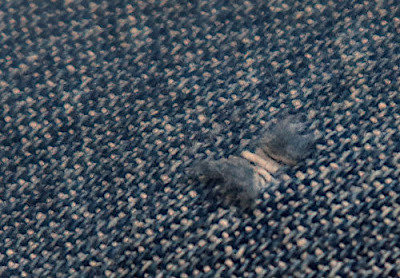
To learn on, I chose my favorite denim work skirt. I discovered the beginnings of a small hole when I hung it out to dry on the clothesline. 


The repair required finding threads that matched the colors of the fabric. Even though the blue threads are a dark blue close up, I chose a medium blue thread because it blended better with the overall impression of color.


I caught it early enough that I only had to re-weave the blue threads. 


I'm not patient enough to do fine, close work, ordinarily. But this was small enough that it didn't take long, although one of those crafter's magnifying lenses would have been helpful. A blunter needle would have been helpful, as well. The sharps needle kept catching the white threads.

I also want to note that I didn't try to replicate the twill weave; I just did the best I could at picking up threads to weave through. The goal is so that the hole isn't noticeable at a couple of feet away. Do you think I succeeded?


A fancier weave or multiple colors would certainly make it more challenging. Assuming one is up to that challenge!

All in all, I think this is a useful technique to learn. The end result of plain mending chore or play clothes probably has low expectations for most of us. But learning how to properly mend career, dress, or town clothes is both a budget and a landfill saver. What's not to like about that?

Monday, April 10, 2023

Stretchy Knit Market Bag

This was another project idea I got from Permies' SKIP program. The requirement was to crochet or knit a bag with straps, measuring at least 12-inches by 12-inches. I looked around for ideas and found a pattern for a knitted market bag from Sheep & Stitch.

For my yarn, I chose Yarn Bee's Sugarwheel cotton knitting yarn.


The pattern required two types of needles, straights for the body of the bag...


and circs for knitting the bag edging plus handles.

There's also a video that goes with this pattern, which was really helpful because I confess the pattern was a little puzzling at times. The instructions called for straight needles but the pictures only showed knitting on circular needles. I verified with the pattern maker in the video comments, that straight needles were indeed fine.


The other problem was that no knitting gauge was given. My tension must have been different because when it came to picking up for the sides of the bag, I ran out of rows before the pattern did. So I had to adapt (rather than frog it and re-do). 


Even so, I think it turned out well. It became a birthday gift for my stepmother, and she really liked it. 

Will I make it again? Uncertain. I find lace type knitting a bit fussy and I don't enjoy fussy. Still, it was good for a one time project and made a great gift. 

© 2023 Leigh's Fiber Journal

Monday, March 20, 2023

Sewing a Zokin

March is the month when we start to spend more time outside. The earth is awakening, the weather is milder, and it's lovely to be out of the house. But there are still plenty of cold and rainy days. Days that are good for indoor projects, like sewing zokin.

Zokin is Japanese for "cleaning cloth." It is made from old, torn, or stained cloth, and has become a somewhat universal term for this style of cleaning cloth. But it has an interesting cultural background, and the best explanation comes from Atsushi Futatsuya of Sashiko Stories. In his video, Zokin with Sashiko (Zokin as Cleaning Rug) & Apply it to Ordinary Days, he describes the stages (or progressive uses) of Japanese cleaning cloths.

  • Fukin - kitchen cloth (dish cloth or tea towel)
  • Daifuki - for wiping tables
  • Zokin - final form, used for cleaning the floor, washing the car, or scrubbing a sink

I love this philosophy. It's so true to the "use it up, wear it out" concept of that little ditty so many of us frugal people love.

Use it up
Wear it out
Make it do
Or do without

Old dishtowels are perfect for making zokin, and I had several old terry cloth dishtowels that were too worn for their original purpose.


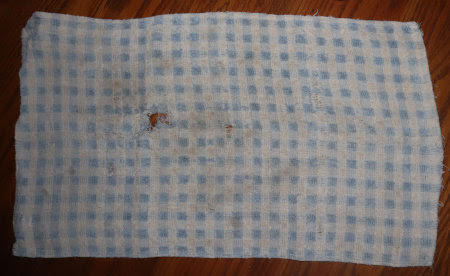
I got these years ago. We lived in an apartment and one kitchen wall had blue and white checkered wall paper. I bought these dish towels to match. When the first one became holey and frayed, I cut it into cleaning rags. I'm pleased to keep old clothing and towels out of the landfill that way, but my rag bin is almost overflowing. That's when I learned about zokin and thought it was a great idea. 

Finished size is arbitrary and I decided I could make two zokin from one dishtowel. I cut each one in half lengthwise, pressed down the cut edge, and folded the strip into thirds. 

The layers are stitched together with sashiko. You may recall from my Japanese Mending post, that sashiko is simply running stitch. It's often colorful and decorative, but for these, mine is simply functional.


Finished zokin

Besides old towels, I've seen these made out of old t-shirts and sweats. It's a great way to re-purpose end-of-life garments. My only recommendation would be to use natural fabrics, because polyesters and acrylics don't absorb water well. That, and when the zokin are beyond use, natural materials (in this case cotton), can be composted to feed the soil. That final act completes the cycle.

Sewing a Zokin © March 2023